Pigeonhole Perch
THE PIGEONHOLE PRINCIPLE — if you have more pigeons than pigeonholes, at least one pigeonhole has more than one pigeon. A small, sharp counting argument that proves "must exist" claims with remarkable economy.
Press play to listen along. The line being read lights up as you go.
Show full transcript
Loading transcript…
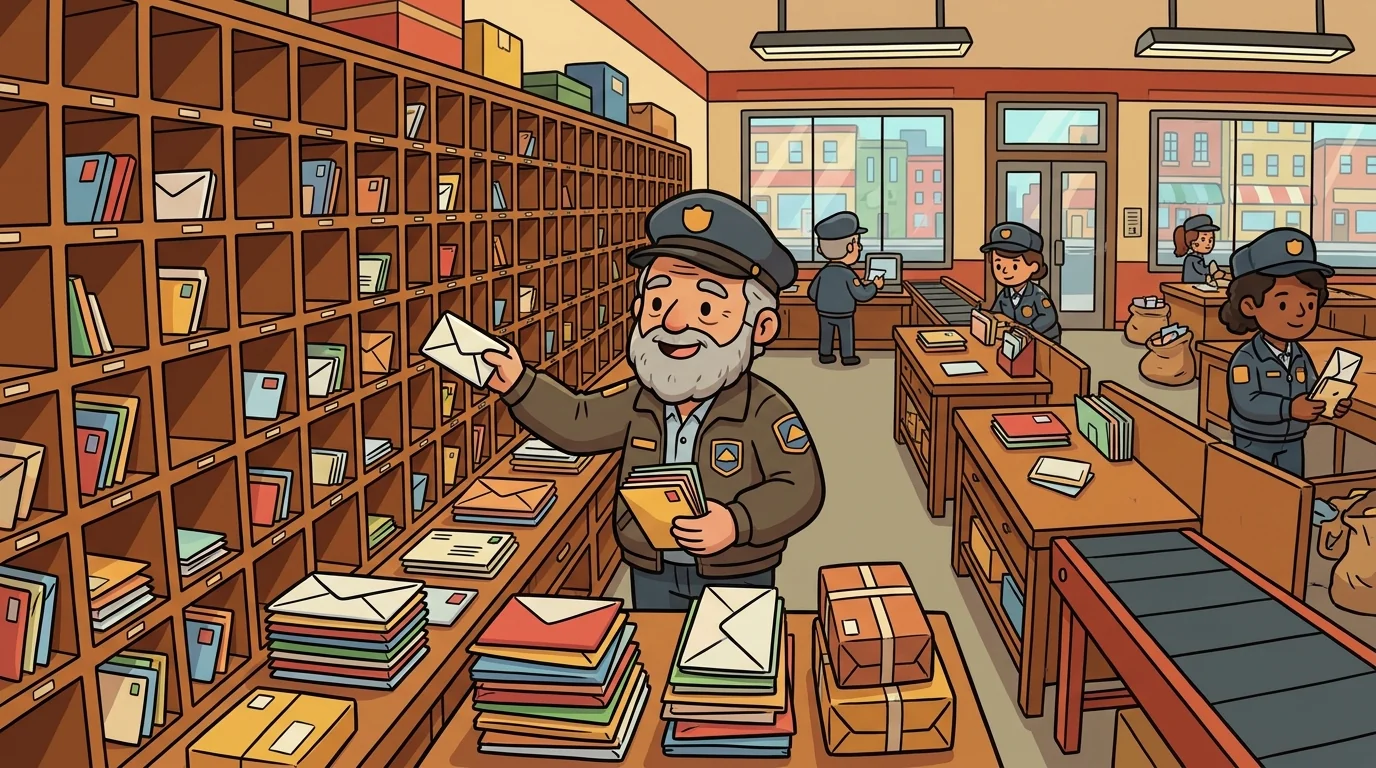
Pigeonhole Perch worked, for forty years, at the central post office in the capital city.
(Yes, the central post office is the same one that figured in Queen Vesper's bad-winter story — although that was in the GambitTales kingdom, which is, as far as ProofQuest's documents are concerned, a related-but-distinct mathematical neighbourhood. Names sometimes coincide across kingdoms. The capital post office, in any kingdom, is the kind of place that takes a long time to develop the kind of careful person Perch became.)
Perch's job at the post office was sorting letters. The post office had, for as long as anybody could remember, a wall of pigeonholes — actual wooden pigeonholes, labelled with destinations, into which incoming mail was sorted before being sent out for delivery. There were two hundred and forty pigeonholes. Perch sorted, by careful estimate, about three thousand letters per day.
This is a lot of sorting. Perch did not get tired of it. Perch was, in a way Perch's colleagues found mildly mysterious, content.
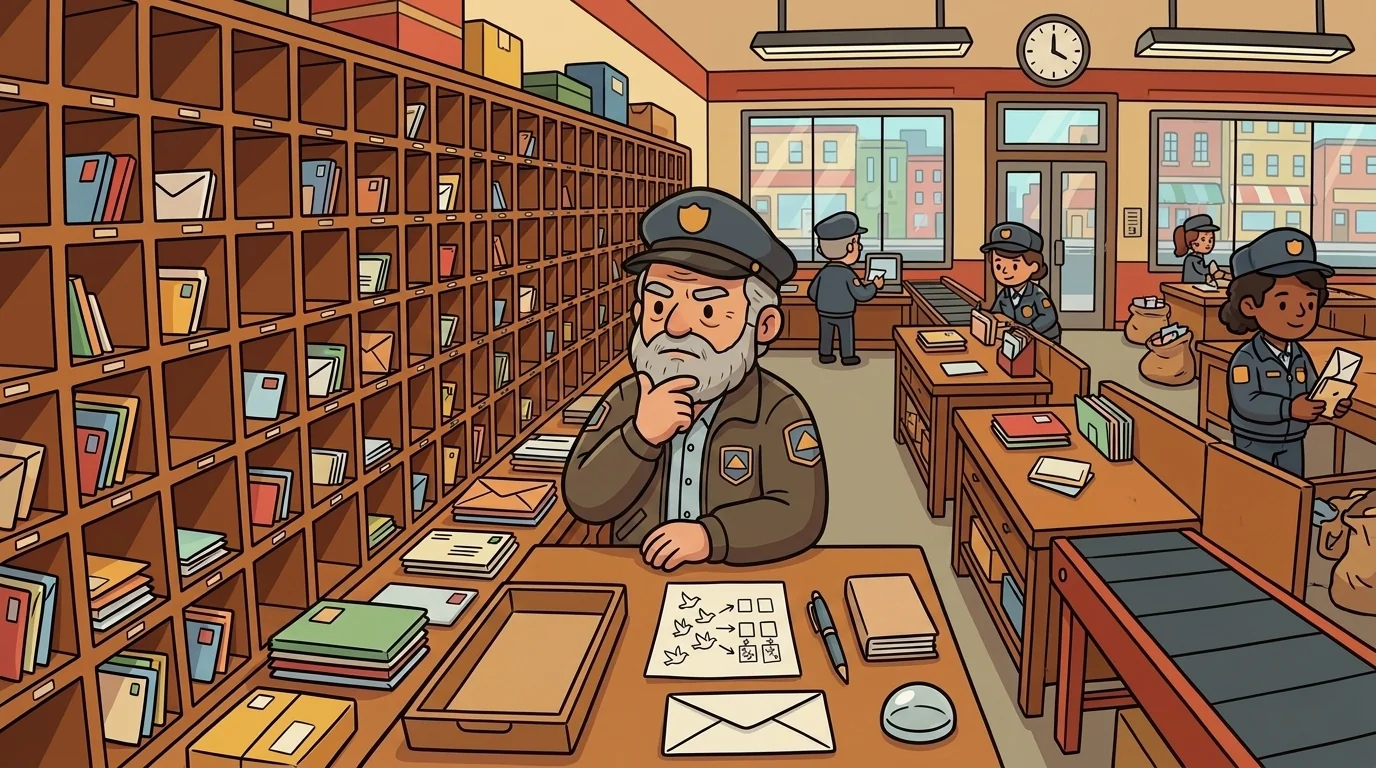
Then one morning, when Perch had been at the post office for thirty-two years, something happened that turned Perch into a kind of detective.
A letter went missing.
This is, by post office standards, not unusual. Letters go missing. Most of the time they are eventually found — usually behind a desk, or in the wrong pigeonhole, or tucked into a colleague's stack. The lost-letter procedure was a standard one. Perch had run it many times.
This particular lost letter, however, was unusual — it had been deposited in the morning collection by a customer who swore she had put it into Perch's hands personally. Perch had no memory of receiving it. The customer was certain. The post office searched. The letter did not turn up. The customer was unhappy. The customer's letter contained important information for her sister, who lived in the eastern province. The matter was, in post-office terms, a bit of a thing.
Perch sat down that evening to think about it.
What Perch noticed was this: the post office had two hundred and forty pigeonholes. The morning collection had contained about two thousand seven hundred letters, by the daily log. The pigeonholes had been sorted twice that day. After the second sort, every pigeonhole should have contained either zero or some small number of letters depending on its destination.
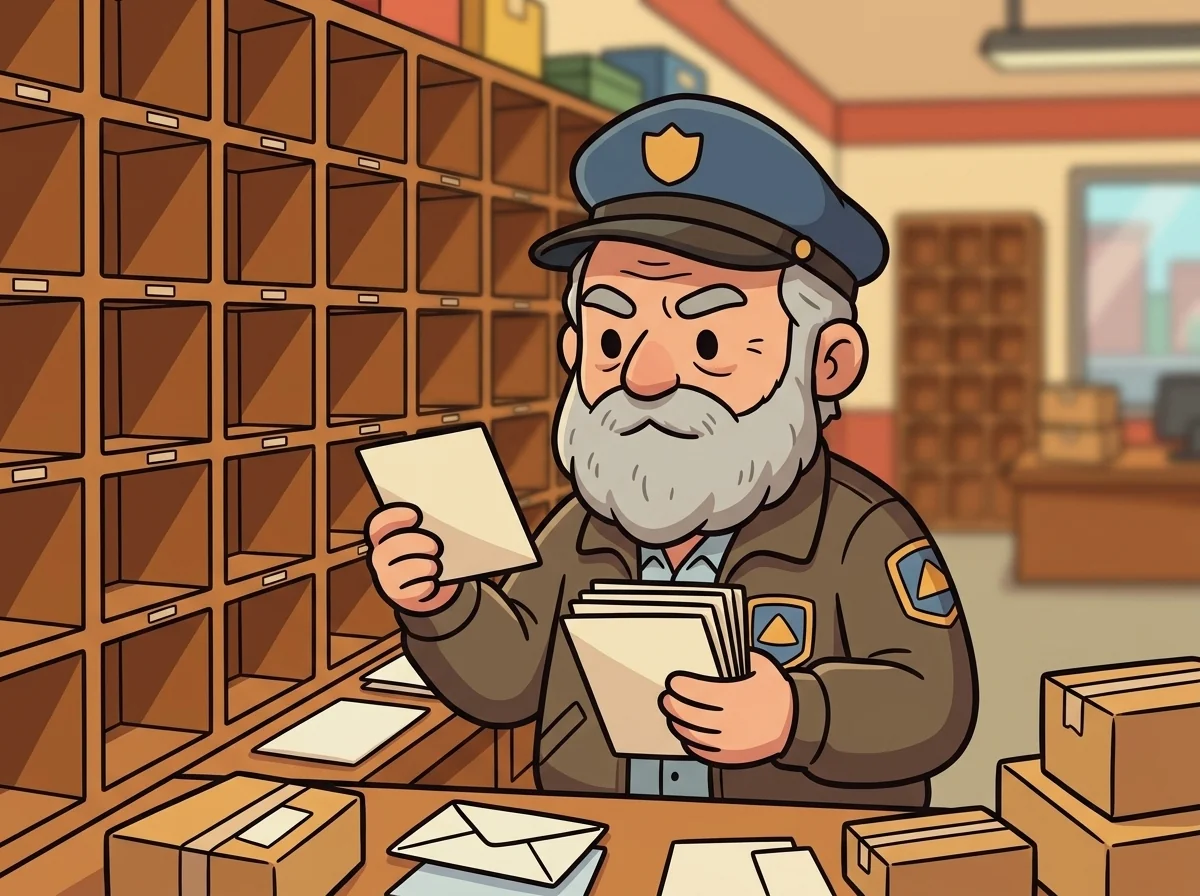
Perch counted, by going through the log carefully, the total number of letters that had been delivered that day from those pigeonholes. The number was 2,699.
The morning collection had been 2,700.
There was one missing letter.
Perch thought about this. Two hundred and forty pigeonholes. 2,700 letters sorted in. Average: a little over 11 letters per pigeonhole. But the average is, Perch knew, just the average. Some pigeonholes had more letters than the average. Some had fewer.
The customer's letter had been addressed to the eastern province. Which pigeonhole was that? It was pigeonhole 113. Perch went to the post office that night, opened pigeonhole 113, and looked carefully.
Pigeonhole 113 had thirteen letters in it.
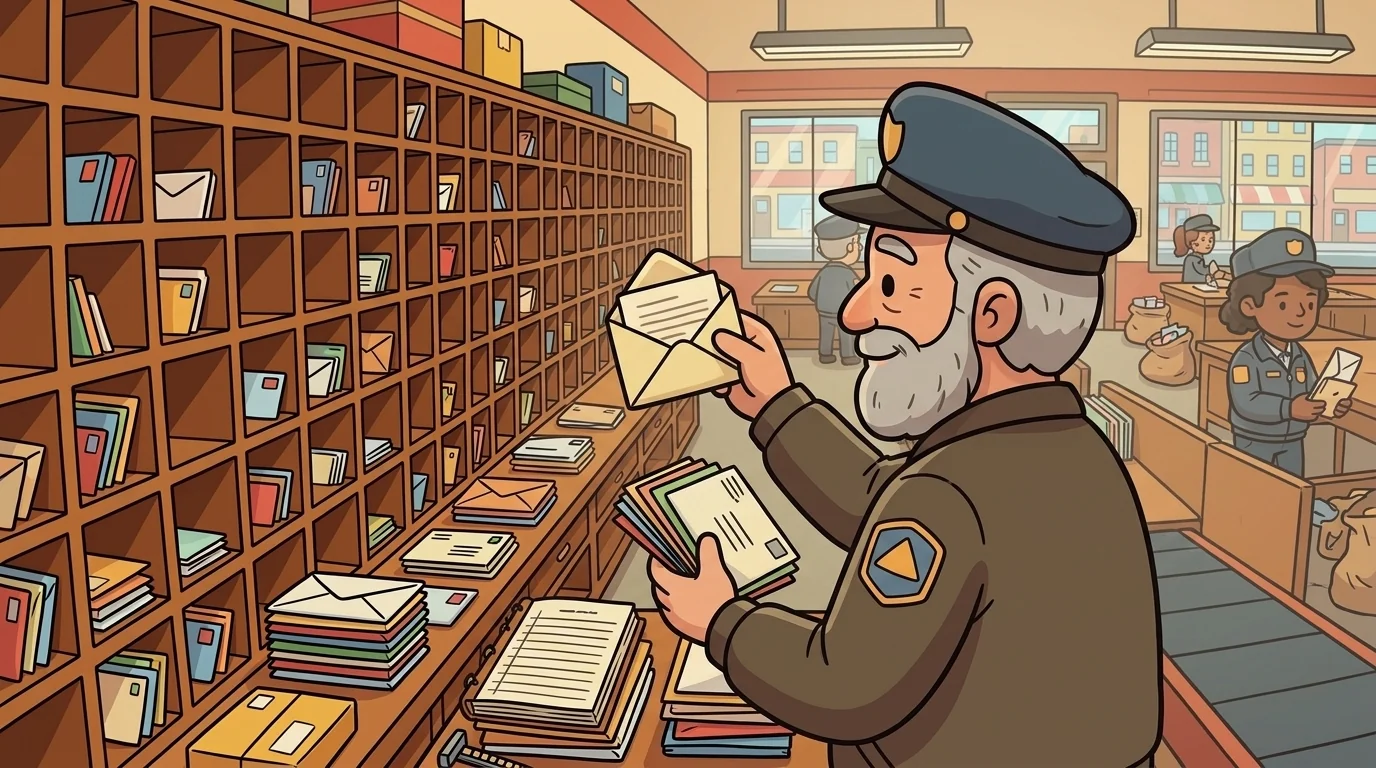
Perch counted them.
There were thirteen. The log said there had been twelve.
Perch held up the thirteenth letter to the light. It was the customer's lost letter. It had been folded inside another letter — pinched between two pages of a larger envelope — and had therefore been counted as one piece of mail instead of two.
Perch had used the pigeonhole principle to find a lost letter.
(The pigeonhole principle, in case you have not yet met it: if you put more items into a set of boxes than there are boxes, at least one box has more than one item. Perch had used a slight extension — if the count of items in a box is one more than the official log says it should be, then there is an extra item hidden in the box. This is, properly speaking, an extension of the principle. Perch developed it on the job.)
The customer was thrilled. The letter reached the sister. The post office sent Perch a formal commendation. Perch put the commendation in a drawer and went back to sorting.
But word got out.
A mathematician at the central university — who had been looking for someone to teach the pigeonhole principle at the ProofQuest academy — heard about the lost-letter story from a friend. She wrote to Perch. She invited Perch to teach.
Perch was sixty-three years old. Perch had been sorting letters for forty years. Perch was, Perch admitted, a little ready for a change. Perch accepted.
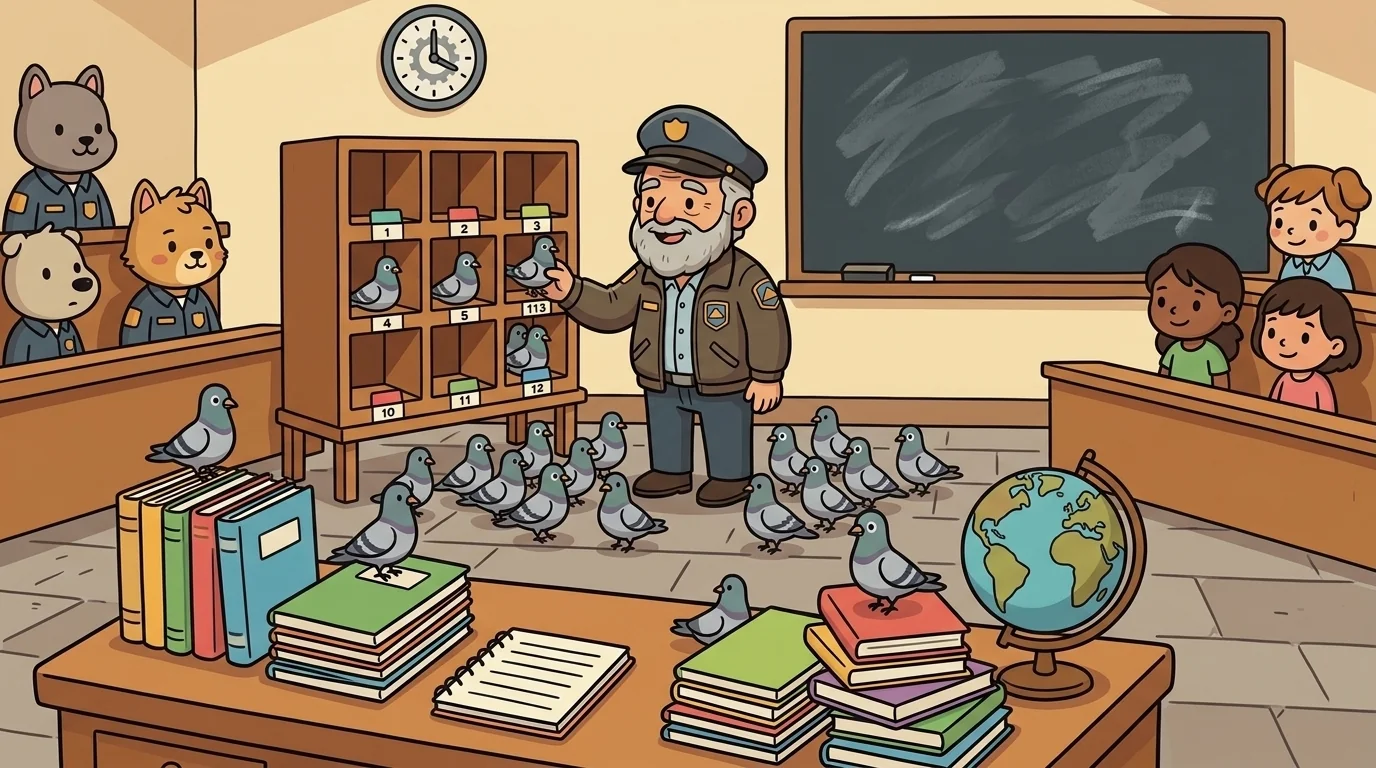
Perch has been teaching at the academy for seven years now. The classroom has, at the back, a small wooden replica of a wall of pigeonholes. Twelve pigeonholes. (Perch did not need the full two hundred and forty for teaching.) Perch uses the pigeonholes to show, over and over, the principle that if you have more things than holes, something has to double up.
Perch is quiet. Perch is methodical. Perch is, on the rare occasions Perch tells the lost-letter story, slightly proud.
The customer, by the way, still writes Perch a letter once a year. And every time one arrives, Perch feels a small, quiet warmth — the good kind, the kind that settles in your chest and stays. Forty years of sorting, and it turned out the thing Perch loved most was not being clever. It was being trusted, and calm, and glad to still be here doing careful work.
The ProofQuest ensemble
Pigeonhole Perch is part of ProofQuest's distributed-narrative cast. Each character embodies a different curricular primitive; together they teach the full subject.
-

Direct-Proof Dora
Direct proof: assume premises, derive conclusion by straightforward logical steps
-

Induction Ida
Weak / standard mathematical induction: base case + inductive step
-

Strong-Induction Sten
Strong induction: base case + assume all prior cases hold
-

Contradiction Cassius
Proof by contradiction (reductio ad absurdum): assume the negation, derive a contradiction
-

Construction Cole
Proof by construction: prove existence by explicit construction of an example
-

Exhaustion Edda
Proof by exhaustion / cases: enumerate every case and verify each
-

Counterexample Cricket
Disproof by counterexample — one exception topples a universal claim
-

Biconditional Bex
Biconditional proof — proving 'if and only if' in both directions
-

Uniqueness Una
Proof of uniqueness — suppose two, show they must be the same one
-

QED
Closing-mark mentor — the ∎ at the end of every proof; the gentle voice that names completion + invites the next problem