Contradiction Cassius
PROOF BY CONTRADICTION — assume the *opposite* of what you want to prove, follow the steps, arrive at a contradiction, conclude that your assumption was wrong.
Press play to listen along. The line being read lights up as you go.
Show full transcript
Loading transcript…

Cassius was a judge for twenty years. He worked in the third district, a hilly area with lots of small towns. And lots of small arguments. By his own count, Cassius heard ten thousand cases.
Ten thousand cases is a lot of listening.
After about two thousand of them, Cassius noticed something strange. The best arguments never started with "I'm right!" The best arguments started with, "Okay, let's pretend the other person is right."
The lawyer would walk down the path of the other person's story. They would follow it step by step. Patiently. Until the path cracked. Until it led to a place that made no sense. Until the story fell apart.
When that happened, Cassius could hear it. He had a special ear for it. He could hear a story crack the way a potter hears the exact moment her wheel slows down.
He would lean forward in his big chair. "I believe," he'd say, "your argument just broke."

Sometimes the lawyer would agree. Most of the time, they argued back. So Cassius would patiently walk them through their own story. He would show them the crack. Then they would see it. They would sit down. And Cassius would rule for the other side.
This way of winning has a special name. It’s called *proof by contradiction*.
Cassius didn't know it had a name in math. Not until he was forty-eight. His nephew, who was a student at the big university, came for dinner.
His nephew explained the idea. "It's a math trick, Uncle Cassius. You pretend the thing you want to prove is wrong. Then you follow the steps. If you end up with something impossible, like two plus two equals five, you've won! It means your first idea was a mistake. So the thing you wanted to prove must have been right all along."
Cassius set down his fork. "That," he said slowly, "is what I've been doing for twenty years."
"Yes, Uncle," his nephew said. "Lawyers and mathematicians are more alike than you think."
Cassius didn't quit his job right away. He thought about it for two more years. He still liked being a judge. He liked the heavy wooden gavel and his dark robe. He liked the quiet courtroom in the morning.

But something had changed. He couldn't stop thinking about proof. His nephew sent him math books. Cassius did the problems at night. He found that the listening he did in court was the same kind of listening he needed for math.
So, when he turned fifty, Cassius retired.
He gave his gavel to his clerk. (She became a judge later, too.) He gave his robe to the town's theater group. But he kept his best notebook and his favorite pen.
He walked to the ProofQuest academy. He arrived late in the afternoon, wearing his regular clothes. He carried a small bag with his notebook and pen. He asked the person at the gate if they needed a teacher.
The academy master looked at the older man. "What do you teach?" he asked.
"Contradiction," said Cassius.
"And where did you work before this?"
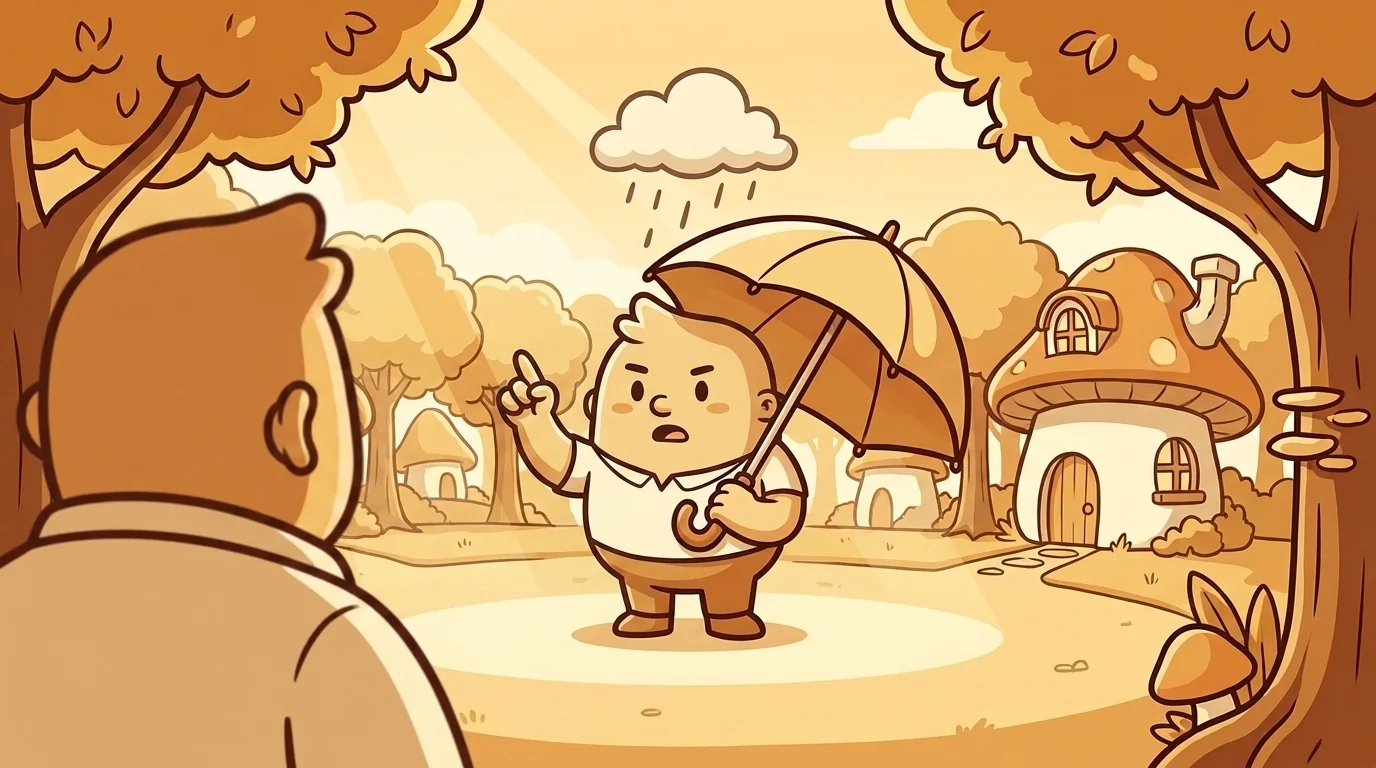
"In a courtroom," Cassius said. "For twenty years. I listened to arguments. I learned to hear the moment a story cracked."
The master was silent for a long moment. He looked Cassius right in the eye. "Mister Cassius," he said. "I believe we've been waiting for you."
He has taught at the academy for fourteen years now. He is a calm man. He always sits when he speaks. He says, "Suppose, for the sake of argument..." so much that the kids have started saying it too. He never, ever raises his voice.
He has a special nod. He does it right before a student's argument is about to break. It's a small, kind nod. It tells the student, "The crack is coming." They know it's coming even before they hear it. He learned that trick as a judge, not as a teacher.
He has a friendly argument going with another teacher, Direct-Proof Dora. She is his opposite. Dora thinks you prove something by walking straight down the right path. Cassius thinks you prove something by showing all the other paths are broken.
They have argued about this for years. They are always polite. Neither one has ever changed their mind. They still respect each other. They even sit together at dinner. They are both right, in their own way. Qed, the head of the academy, thinks their arguments are good for everyone.
Cassius still has the notebook from his first day. It's almost full now. On the last page he used, he wrote a little proof for himself.
"Suppose, for the sake of argument, that I did nothing for the last fourteen years.

This would mean I never taught seven hundred kids about contradiction.
But I did teach them. I saw them learn.
So my first idea must be wrong.
Therefore, I have not done nothing.
Therefore, I will keep teaching."
He underlined the last sentence.
He still keeps the notebook in his bag.
The ProofQuest ensemble
Contradiction Cassius is part of ProofQuest's distributed-narrative cast. Each character embodies a different curricular primitive; together they teach the full subject.
-

Direct-Proof Dora
Direct proof: assume premises, derive conclusion by straightforward logical steps
-
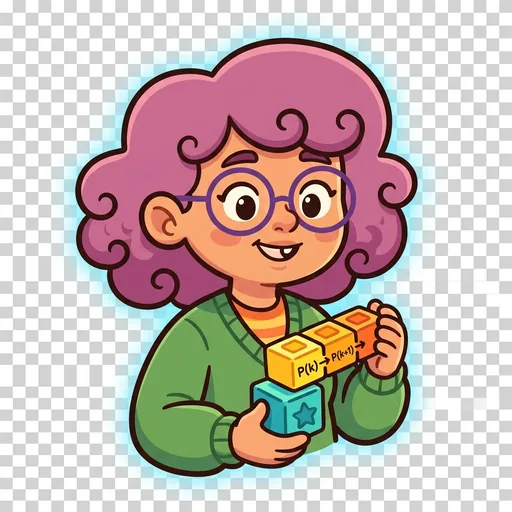
Induction Ida
Weak / standard mathematical induction: base case + inductive step
-

Strong-Induction Sten
Strong induction: base case + assume all prior cases hold
-

Construction Cole
Proof by construction: prove existence by explicit construction of an example
-

Pigeonhole Perch
Pigeonhole principle: if n+1 items are placed in n bins, at least one bin contains 2+ items
-

Exhaustion Edda
Proof by exhaustion / cases: enumerate every case and verify each
-

Counterexample Cricket
Disproof by counterexample — one exception topples a universal claim
-

Biconditional Bex
Biconditional proof — proving 'if and only if' in both directions
-

Uniqueness Una
Proof of uniqueness — suppose two, show they must be the same one
-

QED
Closing-mark mentor — the ∎ at the end of every proof; the gentle voice that names completion + invites the next problem