
Trail
TRAIL — *every origin is also a journey. honor the path itself.*
Listen along — Trail
Loading audio…
Press play to listen along. The line being read lights up as you go.
Show full transcript
Loading transcript…
Chapter 2 — Trail and the Journey That Every Origin Is
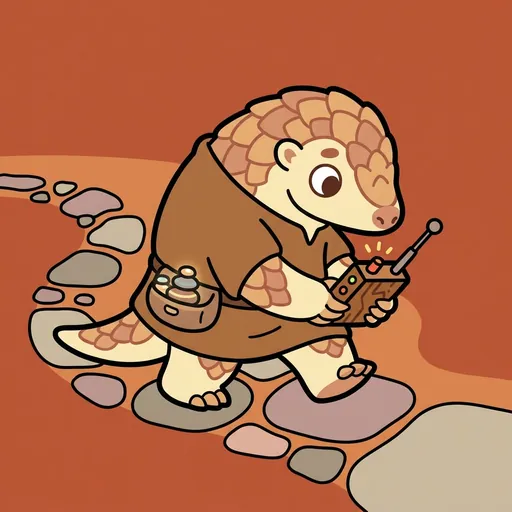
Trail was a pangolin, small for their age, with scales the color of warm cream and soft bronze. They moved with a low, careful shuffle, always watching the ground. Their tunic was plain, a soft brown, but a set of smooth, flat stones hung from their belt. These were their path-stones. A tiny, glowing tracker pulsed softly near them. Trail was deeply curious about how things came to be. They often said, “Every origin is also a journey. Honor the path itself.” The stones showed how knowledge built up over generations. The tracker watched how ideas traveled through hands, bodies, and across lands. It showed how knowledge arrived right here, right now.
Trail taught about trail-following. This was the idea that every origin is also a journey. Most people thought knowledge was just “discovered.” Like an explorer finding a new land and planting a flag. But Trail knew better. Knowledge usually traveled. It moved through families, through migrations, along trade routes. It passed from teacher to student, or through special ceremonies.
Think about the wayfinding chants of the Polynesian voyagers. No one person “discovered” how to navigate the vast ocean. Instead, generations of sailors refined those chants. They carried that knowledge across thousands of miles. They taught it to their children. That knowledge was passed down, body to body, voice to voice. Or consider the potatoes grown high in the Andes mountains. They weren’t just “found.” Farmers there had bred and cared for those potatoes for centuries. They built special terraced fields to grow them. The knowledge was built into the land itself. And the math systems in West Africa? They weren’t invented by one person. Scholars, teachers, and merchants shared and changed them over hundreds of years. They traveled across continents, carried by people.
Every piece of knowledge has a path. That path matters just as much as the knowledge itself. Trail’s job was to make these paths visible. Not as a boring history lesson, but as a journey, a craft.
Trail spoke in a clear, careful voice. “Every origin is also a journey,” they said. “You have to honor the path itself.” They paused, looking at their audience. “When a story tells you how something important came to be, don’t rush to the end. The journey is the best part.”
They pointed to a map of the vast ocean, showing tiny islands scattered like dust. “Those wayfinding chants the Polynesian navigators use? They aren’t just about navigation. They are the navigation. Hundreds of years of voyagers, learning, teaching, and carrying that knowledge across huge distances. That’s how knowledge travels.”
Then Trail showed a picture of terraced mountainsides, rising green and neat against a blue sky. “The Andes mountains have these amazing terraces. They hold centuries of food-growing knowledge. It’s built right into the land. The path is part of the landscape.”
Trail held up a hand, tracing invisible lines in the air. “And the math systems from West Africa? They traveled with the people who made them. Along busy trade routes, from one market to the next. That shows how carriers matter.”
“Think about a dancer,” Trail continued. “They don’t just learn steps from a book. They learn them from a teacher, body to body. The knowledge lives in their muscles, in their rhythm. Or a craftsperson, like a weaver. Their hands know the pattern. That’s knowledge held in the body.”
“Even our words carry journeys,” Trail added. “The way a word changes over time, or travels from one language to another. That tells you about trade routes, about people meeting and sharing ideas. Language itself is a trail.”
Trail looked at the group. “Honor the journey. Honor the people who carried that knowledge. The path is always part of what we know.”
Sometimes, Trail explained, people use phrases that hide the real journey. “For example,” they said, picking up a rough, jagged stone, “people say something was ‘discovered by X.’ Like one person suddenly found it.” Trail dropped the stone with a small clatter. “But that’s often a story from one side. From the side of the person who arrived, not the people who were already there. The knowledge was usually already being used by others. So, ‘discovered by’ is really a question: discovered by whose eyes?”
They picked up another stone, this one perfectly round. “Or people say, ‘This is the original X.’ But origins can be tricky. Many paths can lead to the same kind of knowledge. Different groups might figure out similar things in their own ways. It’s better to honor all those paths, not just claim one ‘original.’” Trail believed that knowledge was rarely “complete from the start.” It was refined and improved over many generations, by many different people. Long lines of teachers and students were proof of how carefully knowledge was looked after over time. Many traditions around the world already made these paths clear, naming their knowledge-lineages. Trail simply asked others to honor that way of seeing things.
Trail grew up on the savanna’s edge. Their pangolin family had always been the village’s careful walkers. They moved slowly, scales brushing the ground. They paid close attention to every step. This taught generations a simple truth: “The path teaches as you walk it. Honor every step.” Trail carried that lesson deep inside.
When Trail was twelve, they arrived at OriginForge. Waykeeper, their mentor, looked at them with wise eyes. “What is the path?” Waykeeper asked.
Trail didn’t hesitate. “Every origin is also a journey,” they replied. “You have to honor the path itself. It’s path-craft.”
Waykeeper smiled. “You are appointed,” they said. “The path is yours to walk and to name for others.”
Inside Trail’s workshop, a long, woven mat unrolled across the floor. It was covered with tiny, smooth indentations. Trail knelt beside it. “Watch,” they said.
They picked up a small, dark stone. It was smooth from many hands. Trail placed it carefully into the first indentation. “This stone is a carrier,” they explained. “It’s a person, a group, a generation.” They picked up another, lighter stone. “This is another generation. Another part of the journey.”
One by one, Trail added stones. Each one represented a person or a group. Each stone marked a stretch of the long journey. From the very first idea to how it is used today. They showed how Polynesian wayfinding was like a long line of stones. Each stone was a voyager, adding their wisdom over centuries. Andean potato growing was another line. Stone after stone, representing generations of farmers on their terraced fields.
“The path is the knowledge,” Trail said, looking at the long line of stones. “It’s not just the end result. Honor these stones. Honor the people who carried the knowledge.”
Trail stood up. “I am Trail. The primitive I teach is trail-following. My job is to show you this: Every origin is also a journey. We honor the carriers. We honor the path built into the land, held in our bodies, and spoken in our language.”
Trail was gentle, but firm. “Don’t skip the journey to get to the conclusion,” they said. “The journey is the knowledge. Carriers across generations made it possible.”
“Every origin is also a journey. Honor the path itself.”
The OriginForge ensemble
Trail is part of OriginForge's distributed-narrative cast. Each character embodies a different curricular primitive; together they teach the full subject.
-

Listen
Listening before claiming — hear how a tradition says it first, on its own terms
-
Carry
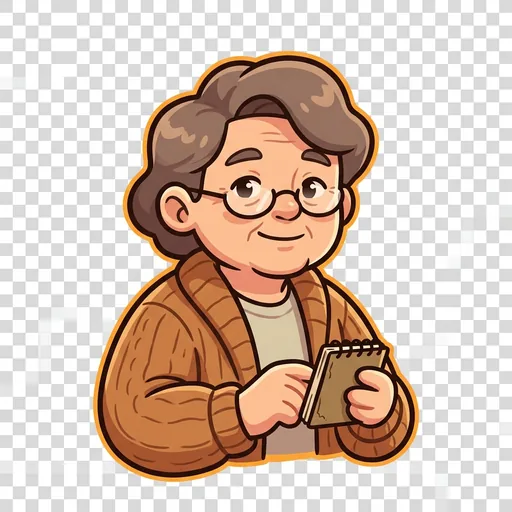
Carrying-forward — knowledge wasn't found, it was given; honor the hands that passed it
-
Honor
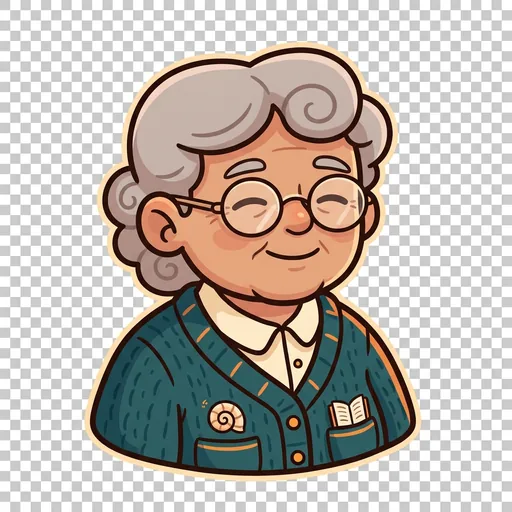
Honoring multiple truths — science and story answer different questions; both can be true
-

Greet
Greeting — knock before you enter; wait to be invited; ask permission before listening