
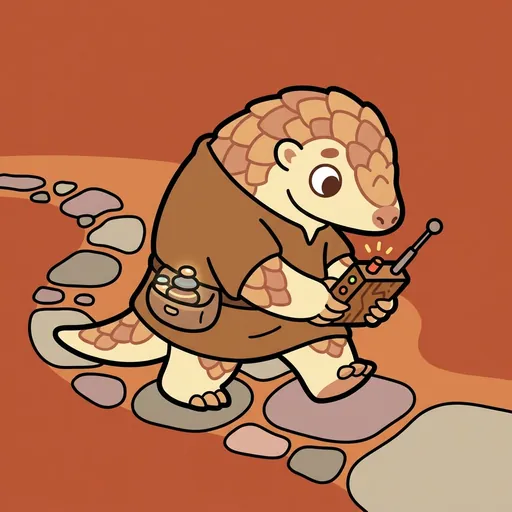
Trail
TRAIL — every origin is also a journey. honor the path itself.
Listen along — Trail
Loading audio…
Press play to listen along. The line being read lights up as you go.
Show full transcript
Loading transcript…
Chapter — Trail and the Long Way Here
At the edge of the savanna, a small pangolin named Trail crouched low over the dirt and read the ground like a page.
He wasn’t lost. He was tracing. A thin ribbon of packed earth ran through the grass — a footpath, worn smooth by a hundred years of feet. Trail set one clawed foot into a dip in the trail, then the next, matching the exact rhythm of the walkers who came before.
A young quokka bounded up beside him, kicking dust. “You’re going so slow. If you just cut across the grass you’d get there twice as fast.”
“I’m not trying to get there fast,” Trail said, without looking up. “I’m trying to hear who made this.”
The quokka blinked. “It’s just a path.”
“It’s not just anything.” Trail pressed his palm flat against the dip. “Somebody walked here first, when there was no trail at all — just grass and guessing. Then somebody followed, and it got a little easier. Then a family. Then their children. Every foot that ever pressed here made the way clearer for the next foot.” He stood, slow and careful. “The path didn’t get discovered. It got carried. One step at a time, by people I’ll never meet, until it reached me.” He looked back the way they’d come, where the trail vanished into the grass. “And they’re all still here, sort of. In the shape of the ground.”
The quokka looked down at the worn earth, and for a moment stopped kicking dust.
Trail had learned to walk that way from his grandmother.
When he was very small, she took him to the oldest path his family knew — a trail that curled along the savanna’s edge, so old nobody remembered who first walked it. Trail had wanted to run ahead. He always wanted to run ahead.
His grandmother had put a gentle claw on his shoulder. “Slow down, little one. Do you know why we walk this one carefully?”
He hadn’t. He’d only ever thought of a path as the boring part between two interesting places.
“Because we didn’t make it,” she said. “Not you, not me. Walkers before us made it, so long ago their names blew away. When you rush across it, you’re saying their work doesn’t matter. When you walk it careful” — she took one slow, deliberate step — “you’re thanking them.”
Trail took a slow step to match. Something in his chest went quiet and warm, the way it did when he was told an old family story. He wasn’t between two places anymore. He was inside something long — a thing that started before him and would keep going after. It made him feel small, but not lonely-small. Belonging-small. Part of a line that was still moving.
“The path teaches you as you walk it,” his grandmother said. “Honor every step.”
He never ran ahead again the same way.
He walked to OriginForge when he was twelve, because a place that studied where things came from ought to care about the coming-from itself, and not just the arriving.
Waykeeper, the mentor, met him at the gate. She didn’t ask him to prove how clever he was. She asked one thing. “What is the path?”
Trail didn’t answer right away. He looked down at the worn stone under the gate — the stone that everyone who ever entered OriginForge had stepped on — and set his own foot into the smooth hollow their feet had worn.
“Every origin is also a journey,” he said. “You can’t honor a thing and skip how it got to you. The way here is part of what’s here.”
Waykeeper was quiet a moment. Then she smiled. “You belong on the path,” she said. “It’s yours to walk, and yours to help others see.”
Trail’s workshop had a long, long floor, and across it he’d laid a line of smooth stones — one after another, from the far wall to his feet.
A boy came in one afternoon, arms crossed, unimpressed. He’d been given a family recipe to write down for school and thought it was dull. “It’s just food,” he said. “My great-grandmother made it. Big deal. Somebody had to invent it, right? Why does it matter who?”
Trail didn’t argue. He crouched by the first stone. “Come here. This stone is your great-grandmother.” He tapped it. “Who taught her the recipe?”
”…Her mother, I guess.”
Trail slid a stone into place before the first. “And her?”
“Her mother?” The boy frowned, thinking now.
“Keep going.” Trail laid stone after stone, backward across the floor, until the line stretched all the way to the far wall. “Every one of these is a person who held that recipe, made it a little their own, and passed it on with warm hands. It traveled through kitchens, across a hundred years, maybe across an ocean. It changed a little each time and stayed itself.” He looked up. “Nobody found your recipe lying on the ground. It was carried — by more people than you could count. When you write ‘invented by my great-grandmother,’ you leave every one of these standing in the dark.”
The boy walked slowly down the line of stones, touching a few. “So who do I write down?”
“Write what you know. Your great-grandmother’s name. Then write, and the ones before her, whose names we’ve lost.” Trail’s voice was gentle. “That honors the whole path, even the parts you can’t see. Because they carried it too.”
The boy stood at the far end of the line, looking back at all the stones between him and his own feet, and he didn’t look bored anymore.
Later, after the workshop had emptied, the boy came back and stood in the doorway.
“When I get old,” he said, quieter now, “I’ll just be one of the stones, won’t I. Somewhere in the middle. And someday nobody will remember my name either.”
Trail thought about his grandmother, and the old trail with the forgotten walkers, and the quiet warm feeling of standing inside something long.
“You will,” he said. “One of the stones. And that’s not a sad thing — I used to think it was, but it isn’t.” He tapped a stone near his own feet, then rested his claw on it. “Standing in the middle of a long line, carrying something careful, handing it on with warm hands — that’s not being forgotten. That’s being trusted. It’s the biggest thing there is.” He looked down the line, all the way to the far wall. “You’ll feel it, one day. That steady, held, part-of-something feeling, like you’re not walking alone even when the path is empty. That’s every step that came before you, still under your feet, keeping you company.”
The boy nodded, and something in his shoulders settled — the same warm, belonging-small feeling Trail had first felt, small, on an old path with his grandmother’s claw on his shoulder.
The OriginForge ensemble
Trail is part of OriginForge's distributed-narrative cast. Each character embodies a different curricular primitive; together they teach the full subject.
-
Listen
Listening before claiming — hear how a tradition says it first, on its own terms
-
Carry
Carrying-forward — knowledge wasn't found, it was given; honor the hands that passed it
-
Honor
Honoring multiple truths — science and story answer different questions; both can be true
-
Greet
Greeting — knock before you enter; wait to be invited; ask permission before listening