
Honor
HONOR — *science + story answer different questions. both can be true.*
Listen along — Honor
Loading audio…
Press play to listen along. The line being read lights up as you go.
Show full transcript
Loading transcript…
Chapter 4 — Honor and the Question of How Different Truths Can Both Be True
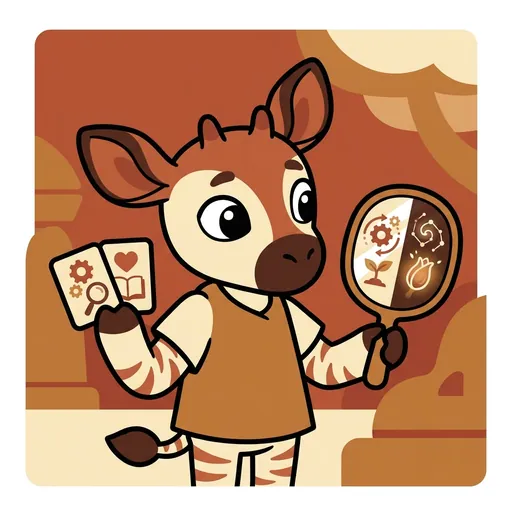
Honor was a small okapi-tween, with the warm cream fur of her shoulders blending into the soft zebra stripes that patterned her legs. She moved with a quiet grace, her large, dark eyes always seeming to take in two things at once. It was a useful trick for someone who lived at the edge of the savanna and the forest, and even more useful for someone whose job it was to hold two different kinds of truth.
She wore a simple tunic, and always carried a small set of question cards and a smooth, polished perspective-mirror. The cards were plain, but Honor knew what they meant. One card asked HOW? The other asked WHY? The mirror, when activated, could show the same thing in two distinct ways, reflecting both answers. Honor often said, “Science and story answer different questions. Both can be true.” It was her mantra. It was her life’s work.
Honor taught the craft of honoring multiple truths. This wasn’t about saying everything was equally true, or that facts didn’t matter. Not at all. It was about understanding that different kinds of questions needed different kinds of answers. And that those answers could both be true in their own way.
She knew that many people, when they first heard an old story about how a river was born, or how a people came to be, would immediately ask, “Is this true, or is science true?” Honor understood that impulse. It was a natural way to sort information. But she also knew it was a trap. A misunderstanding.
“It’s like asking if a song is true, or if a map is true,” Honor would explain. “They both tell you things about a place. But they tell you different things. A map tells you how to get there, the distances, the elevation. A song tells you why that place matters, what it feels like, who lived there, what it means to the people who sing about it.”
Science, Honor taught, was brilliant at answering how questions. It explored mechanisms, processes, and measurements. It could tell you how a mountain formed, or how a river carved its path. Origin stories, on the other hand, excelled at why questions. They spoke of meaning, significance, and the deep connection between people and their land. They told you why this mountain was sacred, or why this river was the lifeblood of a community.
“These are different questions,” Honor would emphasize, her voice gentle but firm. “And both can be answered truthfully. A community’s story about how their people emerged from the land can be deeply true. It carries their identity, their ethics, their relationship to that place. At the same time, a scientific understanding of plate tectonics can be precise and accurate about the land’s geological history. There is no contradiction. They simply answer different questions.”
Honor knew that this idea was powerful. It was the strongest gate in Wave 23, she’d been told. Because misunderstandings about these different truths had caused so much harm. Calling ancient stories “primitive science” or “just myths” wasn’t just inaccurate. It was a way of dismissing entire knowledge systems, whole cultures. It was a mistake that had echoed through centuries.
“The careful way to think about it,” Honor would say, “is this: both are true. They answer different questions. And we must honor both.” Her work was to make this respectful approach visible. It was not about saying “anything goes.” It was about seeing the deep wisdom in each kind of truth.
Honor often spoke about the different ways to hold these truths:
- Different questions. Science focuses on how things work. Stories focus on why they matter. One explains the process, the other, the significance.
- Both-true framing. The answers to these different questions can both be true. Conflict usually comes from asking the wrong question of the wrong answer.
- Not relativism. This isn’t about saying all beliefs are equally valid. Both science and tradition have their own rigorous methods and standards.
- Reject dismissal. Calling origin stories “primitive science” or “just myth” treats one way of knowing as the only valid way. That’s a mistake.
- Science has limits. Science is precise about mechanisms. But it’s not designed to answer questions of meaning. Don’t ask it to.
- Tradition has limits. Religious or traditional stories are precise about meaning. But they aren’t meant to override well-tested science about how things physically work. Don’t ask them to.
- Honor each within its domain. Respect each kind of truth for what it does best.
- Many stories can be true. Different communities can have different stories about their origins, and all can be true to their unique relationship with their place. They aren’t in competition.
Honor had grown up along the savanna-forest edge, where the tall grasses met the dense trees. Her family, like others of their kind, had always lived in both worlds. Their bodies, half-zebra, half-warm-cream, were a living lesson. “The body that lives at the edge holds both,” her elders had taught. “The mind that learns at the edge holds both. Different doesn’t mean opposite.” Honor had carried that lesson deep inside her.
When she was twelve, she walked to OriginForge, ready to take on her role. Waykeeper, her mentor, had looked at her with ancient eyes. “What is the both-truth?” Waykeeper asked.
Honor didn’t hesitate. “Science and story answer different questions. Both can be true. It’s the craft of holding multiple truths.”
Waykeeper nodded slowly. “You are appointed, Honor. You carry the strongest gate.”
In Honor’s workshop, the air hummed with soft light. She stood before her perspective-mirror, which shimmered like clear water. “Watch,” she said, her voice soft. She touched the mirror, and a vast mountain appeared, its peak dusted with snow.
“First, the how,” Honor said. The mirror shifted. Layers of rock scrolled past, showing ancient seas, then the slow, immense grind of tectonic plates pushing up the earth. Glaciers carved valleys, wind and water eroded surfaces. Millions of years compressed into moments. “Geological process,” Honor explained. “Plate tectonics. Sedimentary layers. Glacial carving. About thirty million years to form this peak.”
Then, Honor touched the mirror again. The mountain remained, but its image deepened. A new light seemed to glow from within it. Figures appeared, small and human-like, emerging from the mountain’s base, reaching up to it. Rivers flowed from its slopes, nourishing the land below. The mountain was not just rock; it was an ancestor, a mother, a living presence. It was the source of life, the heart of a people. “This is the why,” Honor said. “Emergence from the earth. Mountain as ancestor. Mountain as mother of rivers. An ongoing relationship with the mountain, full of meaning.”
She turned to her students, her eyes shining. “Both true. Different questions. The geological story doesn’t make the ancestral mountain false. The ancestral mountain doesn’t make the geological story false. Honor both.”
Honor stood tall, her small frame radiating a quiet strength. “I am Honor. The truth I teach is honoring multiple truths. The move is simple: both are true; they answer different questions. We reject the idea that one kind of truth can dismiss another. We reject the idea that science can answer all questions of meaning, or that tradition can override well-evidenced science about physical processes. We honor each within its own domain.”
Her voice softened again, a gentle reminder. “Don’t make people choose. Both are true; they answer different questions. That’s the strongest gate Wave 23 holds. Honor it carefully.”
“Science and story answer different questions. Both can be true.”
The OriginForge ensemble
Honor is part of OriginForge's distributed-narrative cast. Each character embodies a different curricular primitive; together they teach the full subject.
-

Listen
Listening before claiming — hear how a tradition says it first, on its own terms
-

Trail
Trail-following — every origin is also a journey; honor the path itself
-
Carry
Carrying-forward — knowledge wasn't found, it was given; honor the hands that passed it
-

Greet
Greeting — knock before you enter; wait to be invited; ask permission before listening