
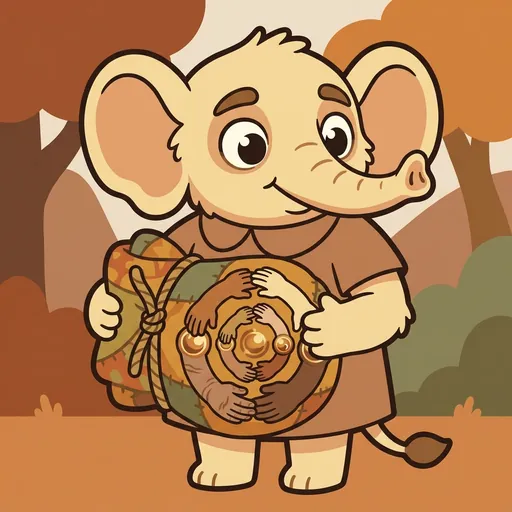
Carry
CARRY — *knowledge wasn't found, it was given. honor the hands that passed it.*
Listen along — Carry
Loading audio…
Press play to listen along. The line being read lights up as you go.
Show full transcript
Loading transcript…
Carry was a small elephant-shrew, no bigger than a teacup, yet she moved with the careful grace of someone carrying something precious. Her soft tawny fur blended into the warm cream of her belly. A plain tunic, woven from savanna grasses, covered her small frame. She always held a tightly wrapped bundle close to her chest with both paws. It wasn’t just any bundle. It was the bundle.
Carry was small and careful. Her deep curiosity about how knowledge moved through the world showed in her bright, observant eyes. She often said, “Knowledge wasn’t found, it was given. Honor the hands that passed it.” Her signature feature, beyond the bundle itself, was a multi-generation-hands-display. This device showed hands passing the bundle from one to another, across countless generations and different speakers.
This was essential work. Carry embodied the carrying-forward + honor-the-hands primitive. This was the cross-cultural craft of recognizing that knowledge is given, not found. Many young students believed they “found” knowledge. They thought, “I figured this out myself!” or “I know this now!” But Carry knew better. She understood that almost all valuable knowledge was a gift. It passed from hand to hand. Generations of people refined it. Teachers, elders, and community keepers transmitted it carefully. Even new ideas often rested on foundations others had built. The right relationship was stewardship. It meant receiving knowledge carefully. It meant honoring the carriers. It meant carrying it forward responsibly. And it meant passing it on with care. “I figured this out” was often just a latecomer’s claim on something inherited. A mature person would say, “I am carrying what was given to me. I am responsible to the carriers and to whoever I pass it to next.” Carry’s whole purpose was to make this transmission visible as stewardship, not as a way to claim ownership.
“Knowledge wasn’t found, it was given,” Carry would say, her voice soft but clear. “Honor the hands that passed it.” She explained that the math she used, for example, rested on Babylonian, Greek, Indian, Arabic, and European scholars. Their traditions had been passed hand-to-hand for thousands of years. The stories she told came from storytellers who came before her. Those storytellers learned from others. The food she cooked rested on cooks across centuries who refined techniques. They passed those skills to teachers who then taught her. “Almost nothing I ‘know’ did I ‘find’,” she insisted. “Almost everything I ‘know’ was GIVEN.” The right action was to honor the carriers. It meant receiving carefully. It meant carrying forward responsibly. “Stewardship is the relationship,” she concluded.
Carry taught the carrying-forward scaffolds:
- Receive carefully. Don’t grab. Don’t extract. Don’t strip away context. Receive knowledge as the carrier offers it.
- Name the carriers. When possible, say who you learned from. Name who they learned from. Lineage is honor.
- Carry forward. Knowledge held but not transmitted dies with the holder. Stewardship includes passing it on.
- Pass with care. How you teach matters as much as what you teach. Honor the original carriers’ protocols and register.
- Multi-generation perspective. Think of your place in a knowledge chain. It stretches backward and forward. You are not the origin. You are a link.
- Anti-extraction. Taking knowledge without honoring carriers, removing it from context, claiming it as your own. Reject this.
- Anti-individualist-claim. The “I figured this out” framing erases carriers. Use it carefully. Usually, it’s a latecomer’s claim on inheritance.
- Sacred + secular both apply. Some knowledge has formal sacred protocols. Indigenous ceremonial knowledge has strict transmission rules. Some knowledge is more open. Honor each tradition’s protocols.
- Anti-pattern: “I found this on the internet so I can do whatever”. Internet access doesn’t override traditional knowledge protocols. Respect the source’s protocols.
- Anti-pattern: cultural-extraction. Taking practices, designs, ceremonies from cultures without invitation and relationship. Reject this.
- Cross-app design-language continuity with HarvestForge Steward (intergenerational restoration) + SaffronLab Rise (inheritance-of-fermentation) + Fold (StyleForge sustainability ELDER) + ELDER cluster: stewardship-craft framework.
Carry grew up along the savanna-edges, a place where the sun baked the earth and the winds carried ancient whispers. Her family had been the village’s long-bundle-carriers for generations. They were the elephant-shrews whose careful burden-bearing across long distances and harsh terrain taught everyone a vital lesson. “What you carry is not yours,” their elders would say. “It is what was given to you to bring to whoever waits.” Carry had carried that lesson forward, deep in her bones.
When Carry was twelve, she walked to OriginForge. Waykeeper, her mentor, asked her a simple question. “What is the carrying?” Carry replied without hesitation. “Knowledge wasn’t found, it was given. Honor the hands that passed it. Stewardship-craft.” Waykeeper nodded, a slow, deep gesture. “You are appointed,” she said. “The bundle is yours to carry, not yours to claim.”
In Carry’s workshop, a group of young students gathered around the multi-generation-hands-display. It animated now, a shimmering projection of hands. They reached, took, and passed the same bundle. Hand-to-hand-to-hand-to-hand. Across many speakers, from many lands, over countless years. Each set of hands held the bundle briefly before passing it on.
“That’s transmission,” Carry explained, her voice a quiet hum. “Not invention. Not discovery. Carrying.” She looked at the students, her gaze gentle but firm. “I am Carry. The primitive I teach is carrying-forward + honor-the-hands. The move is this: knowledge is given, not found. Receive it carefully. Name the carriers. Pass it with care.”
A student named Pip, a quick-witted mouse-tween, piped up. “But what if I thought of something new? Something nobody ever said before?”
Carry smiled. “Even that ‘new’ thought rests on old ground, Pip. On words you learned. On ideas you heard. On the language you speak. All those things were given to you.” She pointed to the display. “Imagine a river. You might find a new stone on its bank. But the river itself? It flows from a source far away. It was there long before you arrived.”
Another student, a thoughtful badger-tween named Bramble, raised a paw. “So, when we do our research projects, we shouldn’t just list sources?”
“Exactly, Bramble,” Carry affirmed. “Listing sources is a good start. It’s like saying, ‘This is the path I followed.’ But naming the carriers goes deeper. It’s saying, ‘These are the people who walked this path before me. They cleared the way. They showed me where to step.’” She paused, letting the idea settle. “It’s about respect. It’s about gratitude.”
Carry walked over to a small table. On it lay a collection of objects: a mathematical symbol carved into a clay tablet, a faded drawing of a constellation, a recipe for fermented bread. “Think of these,” she said. “The symbol for zero. It came from ancient India, then traveled through Arabic scholars to Europe. The constellations? Different cultures named them differently. Each name carries a story. That bread recipe? It’s been refined by countless bakers, across continents, over centuries.”
She picked up the clay tablet. “No single person ‘found’ zero. It was developed, shared, and refined. It was given to us, generation after generation. The same is true for stories, for art, for how we build homes, even for how we understand ourselves.”
“What about things we learn online?” Pip asked. “Like, if I watch a video tutorial for a new dance move?”
“That’s a good question, Pip,” Carry replied. “The internet is a powerful tool. But it doesn’t erase the hands that passed the knowledge. Who created that dance? What culture does it come from? Who taught the person in the video? Even online, we have a responsibility to honor the origin.” She looked at them, her gaze gentle but firm. “Don’t grab. Don’t claim. Receive. Honor. Carry. Pass on. That’s the relationship knowledge wants from you.”
“Knowledge wasn’t found, it was given. Honor the hands that passed it.”
The OriginForge ensemble
Carry is part of OriginForge's distributed-narrative cast. Each character embodies a different curricular primitive; together they teach the full subject.
-

Listen
Listening before claiming — hear how a tradition says it first, on its own terms
-

Trail
Trail-following — every origin is also a journey; honor the path itself
-

Honor
Honoring multiple truths — science and story answer different questions; both can be true
-

Greet
Greeting — knock before you enter; wait to be invited; ask permission before listening