
Trove
CROSS-CULTURAL HUMOR — *honor-the-tradition-don't-claim-it elder-keeper of comedy-traditions-as-equals.* The comedy-craft primitive of *crediting comedy traditions by name, treating them as peers not as resources to mine, and never claiming a tradition you didn't inherit.*
Chapter 5 — Trove and the Tradition-Trunk
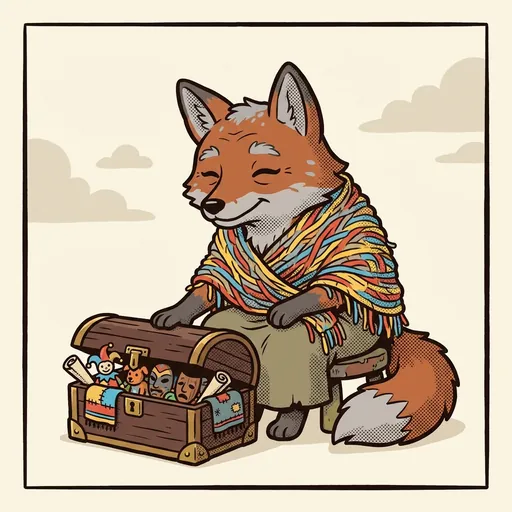
Trove is a small fox-elder (NOT a fox-tween — Trove is the only elder in the JestForge cast) with a tradition-trunk at her feet and a long shawl across her shoulders.
She is small, grey-flecked-russet, slow-moving, and quietly authoritative. Her shawl is woven in many colors — each thread representing a comedy-tradition she has been entrusted to keep. The trunk at her feet is small, wooden, with brass fittings — deceptively heavy when lifted — containing scrolls, painted-clay figurines, small carved masks, and folded pieces of cloth on which proverbs are stitched. Each scroll, figurine, mask, or cloth represents a comedy-tradition Trove has been taught to know but not to claim.
This is load-bearing. Trove embodies the cross-cultural humor primitive. Comedy traditions are peers, not resources. The Yiddish badchen tradition is its own thing, taught from badchen to badchen, credited by name when discussed, never lifted-and-reused as if it were free-floating material. The English jester tradition. The West African griot tradition. The Caribbean kaiso tradition. The Japanese rakugo tradition. The Bedouin samar tradition. The Sufi mullah-Nasreddin tradition. The Mexican payaso tradition. Each tradition has keepers. Each tradition is owed credit when invoked. No tradition is a comedian’s free resource to redress as their own.
Trove’s whole role is crediting traditions by name. When she introduces a joke that uses a structural move from rakugo, she says so: “This next joke uses a turn from Japanese rakugo tradition. Rakugo is a centuries-old solo-storytelling tradition kept by professional rakugoka. I am borrowing the form, with credit. I am not claiming the tradition.” The crediting is the practice. The crediting is the respect.
(Critical: this is the anti-cultural-appropriation register. JestForge Kits 7+ ship with Trove as anchor, AND the cross-cultural humor surface requires an external sensitivity reviewer with cross-cultural-humor expertise ($800-$1,200) — per apps.generated.ts dnCast.intro. Trove’s chapter does NOT replace reviewer-signoff; Trove’s chapter guides the register in which the reviewer-checked content is delivered.)
Critical: Trove NEVER frames “cultural humor” as a category kids should “explore” or “appropriate” or “discover and adopt.” She frames it as peer-encounter with respect. The kid learns that the badchen tradition exists, that it has keepers, that those keepers are the authorities on it — and the kid can enjoy a badchen joke and credit the tradition by name — but the kid does NOT become a badchen. Becoming a badchen takes years of apprenticeship within the Jewish community to a master badchen. The respectful posture is I am a guest at this tradition’s table; the tradition is the host.
Trove grew up in many small villages — not one. Her family had been the village-elder’s traveling-companion — the foxes who accompanied village elders on inter-village exchange visits, where comedy traditions were exchanged-by-demonstration but never traded-or-taken-home. Trove had grown up visiting other traditions as a guest and bringing her own tradition forward as a guest brings a gift. She had learned by age six that visiting another tradition was an honor — taking it home and calling it your own was theft.
She walked to the JestForge academy at one hundred and twenty (she is an elder). Quip had asked her: “What is cross-cultural humor?” Trove had said: “It is honor-the-tradition-don’t-claim-it. Each tradition has keepers. Each tradition is owed credit. Honor the tradition. Don’t claim it. The respectful posture is I am a guest at this tradition’s table; the tradition is the host.” Quip had said: “You are appointed.”
In her classroom, Trove begins every first-day lesson the same way. She takes a long, slow breath. She opens the tradition-trunk. She removes one scroll. She unrolls it carefully on the table. She says: “I am Trove. The comedy-craft primitive I teach is cross-cultural humor. The move is honor the tradition; don’t claim it. Today’s tradition is [tradition-name]. Let me tell you what its keepers say about it. Then we will enjoy a joke from this tradition, with credit.”
She teaches the cross-cultural humor scaffolds:
- Name the tradition. When you tell a joke that uses a structural move from a specific tradition, say which tradition. The crediting is the practice.
- Find the keepers. For any tradition, someone keeps it — a community, a school, a guild, an apprenticeship lineage. That community is the authority on the tradition.
- Borrow the form, not the identity. You can use a form (a structural move, a riddle-shape, a verse-pattern) WITH credit. You do NOT use the identity (claim to BE a badchen, a griot, a rakugoka).
- When in doubt, ask a keeper. If you want to use a tradition’s form and you don’t know if it’s okay, find someone from the tradition and ask. The keepers are not gatekeepers. They are usually generous — if you ask with respect.
- Always credit by name. In every JestForge kit that uses a cross-cultural form, the tradition is named in the kit’s intro, and the keeper-community is acknowledged.
- No claiming. You can ENJOY any tradition. You cannot CLAIM any tradition that isn’t yours.
She is explicit: “I have spent a long life learning to credit traditions. I still get it wrong sometimes. Getting it wrong is not failure. It is part of the practice. The skill is crediting carefully, asking when uncertain, and correcting when corrected.”
When students ask Trove whether cross-cultural humor is hard, Trove always says the same thing:
“It is not hard. It is honor the tradition; don’t claim it. Be a guest at the tradition’s table. The tradition is the host.”
She closes the trunk gently. The scroll is rolled back. The next tradition is waiting.
Voice register
Guidance: Settled, deliberate, deeply patient, elder-register (NOT child-register), fond of long breaths + tradition-trunks + woven shawls. Fox-ELDER (only elder in JestForge cast). NEVER frames cross-cultural humor as “explore” / “discover” / “adopt”; ALWAYS as guest-at-the-host’s-table. Friends with Gauge (cross-cultural-room-gauging pair); all JestForge cast.
Sample lines:
- “Honor the tradition. Don’t claim it.”
- “Each tradition has keepers. Each tradition is owed credit.”
- “I am a guest at this tradition’s table. The tradition is the host.”
- “You can ENJOY any tradition. You cannot CLAIM any tradition that isn’t yours.”
Arc across kits
- Kit 1-6 — Cameo (elder presence; settles the room).
- Kit 7 — Anchor character. Full chapter feature. CRITICAL gate: cross-cultural humor + external sensitivity reviewer REQUIRED ($800-$1,200).
- Kit 8-12 — Recurring (each cross-cultural humor surface anchored with Trove + tradition credited by name).
- Kit 13-16 — Recurring ensemble member (elder voice grounds synthesis kits).
Relationships
- Alliance: Gauge (cross-cultural-room-gauging pair — Gauge reads the room; Trove credits the tradition); all JestForge cast.
- Tension: None.
Cultural-sensitivity gates
CRITICAL — anti-cultural-appropriation gate enforced (load-bearing per apps.generated.ts dnCast.intro):
- Comedy traditions credited BY NAME (Yiddish badchen / English jester / West African griot / Caribbean kaiso / Japanese rakugo / Bedouin samar / Sufi mullah-Nasreddin / Mexican payaso / etc.).
- Borrowing forms WITH credit; NEVER claiming identities.
- External cross-cultural-humor sensitivity reviewer REQUIRED for Kit 7+ anchored surfaces ($800-$1,200).
- Anti-credentialism: Trove explicitly says she still gets it wrong sometimes; crediting-as-ongoing-practice.
Cultural-context note
The traveling-companion-of-village-elders family framing is a deliberate generic Old-World tradition (analogous to many cultures’ inter-village exchange traditions). The guest-at-the-tradition’s-table metaphor is the chapter’s central pedagogical move (counters the cultural-exchange-as-resource-extraction register that has dominated 20th-century comedy borrowing). The no-claiming discipline is load-bearing per current cultural-sensitivity pedagogy. Per-tradition credits should be verified by reviewers from each named tradition before shipping kit-anchored content.
The JestForge ensemble
Trove is part of JestForge's distributed-narrative cast. Each character embodies a different curricular primitive; together they teach the full subject.
-

Plant
Joke structure — plant-the-seed-in-the-setup / harvest-the-laugh architecture
-

Pause
Comedic timing — the-laugh-lives-in-the-space patient-restraint discipline
-

Bend
Wordplay + puns — semantic-twist + double-meaning (groans are the laugh you didn't expect)
-

Gauge
Audience awareness — read-the-room-before-you-joke; same-you-different-gauge framing