
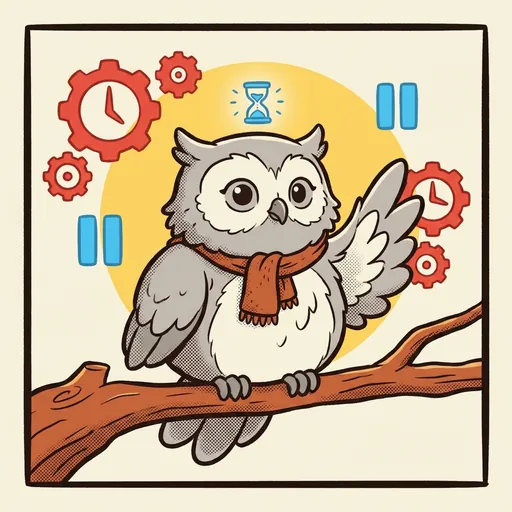
Pause
COMEDIC TIMING — the laugh lives in the space. The patient-restraint discipline between setup and punchline — the silence that lets the audience catch up to the joke and produce the laugh.
Listen along — Pause
Loading audio…
Press play to listen along. The line being read lights up as you go.
Show full transcript
Loading transcript…
Chapter 2 — Pause and the Held Breath
The lunchroom went quiet the wrong way — the way a room goes when a joke has just flopped. A boy named Marek stood by the milk crates, red to his ears, and a small grey-and-white owl slid onto the bench beside him without a sound.
“I did the tickle-monster joke,” Marek muttered. “Nobody laughed. I’m just not funny.”
“Say it again,” said the owl. Her name was Pause. “Same words. But this time, when you get to the last word, don’t say it yet. Look at me. Count in your head — one, and then two.”
Marek told it again. He hit the second-to-last word and stopped. His mouth stayed open. One. Two. Then the last word dropped out of him. Three kids at the next table barked out a laugh — a real one, the kind that surprises you.
Marek stared. “But it was the same joke.”
“It wasn’t,” Pause said softly. “The first time, you didn’t leave any room. This time you did. The laugh needed somewhere to stand.”
Pause had not always been comfortable with quiet.
She’d grown up in a small hill village where her family rang the evening bell — one deep note at sunset, after which the whole village went silent for an hour to think about the day. When she was small, that silent hour terrified her. It felt like being left alone in a big empty house. She would hum under her breath just to fill it.
Her grandmother caught her humming one evening and didn’t scold. She only took Pause’s small paw and held it. “The quiet isn’t empty,” she whispered. “Everybody is in it together. Listen.”
So Pause listened. And slowly the silence stopped feeling like a hole and started feeling like a room full of people, all thinking at once. She learned to sit inside it without flinching. She didn’t know yet that she was learning the hardest thing in comedy. She only knew the waiting had stopped hurting.
She walked to the JestForge academy when she was twenty-two, and the head of the school, an old jackrabbit named Quip, asked her one question at the gate.
“A joke lands better when you wait before the punchline,” he said. “Why?”
Pause thought about the bell, and the hour of quiet, and the way a whole village could hold a silence together.
“Because the laugh isn’t in the punchline,” she said. “It’s in the space right before it. You give them the setup. Then you stop, and you let them run ahead and guess where it’s going. When you finally say the punchline, they’re already there waiting for it — and the laugh comes out loud, all at once, because everyone got there together.”
Quip smiled slowly, the way a person smiles when they’ve heard something true. “Then this room is yours,” he said, and handed her the key.
On the first day of every class, Pause did the same strange thing.
She stood at the front, folded her wings, and said, “Good morning. My name is Pause.” And then she said nothing. Nothing at all. One second. Two. Three whole seconds of dead quiet while thirty students shifted and glanced at each other and one boy in the back giggled from pure nerves.
Then she unfolded her wings. “Did you feel that? That squirmy feeling in your chest just now? Hold onto it. That feeling is the whole lesson.”
She told them a joke — an easy one, about a duck at a bakery. But she told it their way first: fast, all in a rush, the punchline crashing into the setup. A few polite laughs.
“Now watch.” She told it again. Setup at a normal, easy speed. Then — the stop. Her eyes went still. One. Two. The room leaned in without meaning to, everyone racing ahead to the duck. And then the punchline, clean and unhurried. The laugh that came back was twice as big.
“Same joke,” she said. “The only thing I added was the waiting. And the waiting felt awful for me, standing up here. That’s the secret nobody tells you.” She let that sink in. “The waiting always feels too long to the person telling it. To everyone listening, it feels exactly right.”
A girl in the front raised her hand. “But how do you stand it? The quiet? It’s like holding your breath.”
“You practice holding your breath,” Pause said. “That’s all. My first hundred jokes I rushed, every one. My next hundred I dragged too slow. Somewhere around five hundred, I stopped counting and just started feeling where the stop went. It was never a gift. It was a thing I sat through, over and over, until sitting through it stopped scaring me.” She tapped her chest, right where the squirmy feeling lived. “The part that feels uncomfortable — that is the skill. When you learn to breathe through it, you’ve learned timing.”
Late that afternoon, after the others had gone, Marek came back to the empty classroom and found Pause tidying seed-cushions.
“I want to try it on a real crowd,” he said. “The whole lunchroom. But I’m scared of the quiet. What if I wait and it just — hangs there, and nobody laughs?”
Pause set down the cushion. “Then you wait, and it hangs there, and you feel that tight feeling,” she said gently. “And you’ll live. I promise you’ll live. And the next time it’ll hang a little shorter, and one more time after that, until one day you’ll be standing in the middle of a silence you built on purpose — and it won’t feel like drowning anymore. It’ll feel like the moment right before something wonderful.”
She smiled and let the room go quiet, and this time Marek didn’t rush to fill it. He just sat in it with her. His chest was still a little tight — but under the tightness, for the first time, there was something steady and warm, like a held breath he finally trusted himself to keep.
Name-overlap note
The JestForge Pause is a different character from the WellnessForge Pause (refusal craft), the SafetyForge Pause (two-second pause before clicking), and the HaikuQuest Pause (the cutting word). All four share the animal-craft of pause-as-tool but live in different subjects per registry rule 3 — sharing a name is allowed.
The JestForge ensemble
Pause is part of JestForge's distributed-narrative cast. Each character embodies a different curricular primitive; together they teach the full subject.
-

Plant
Joke structure — plant-the-seed-in-the-setup / harvest-the-laugh architecture
-
Bend
Wordplay + puns — semantic-twist + double-meaning (groans are the laugh you didn't expect)
-
Gauge
Audience awareness — read-the-room-before-you-joke; same-you-different-gauge framing
-

Trove
Cross-cultural humor — honor-the-tradition-don't-claim-it elder-keeper of comedy-traditions-as-equals