
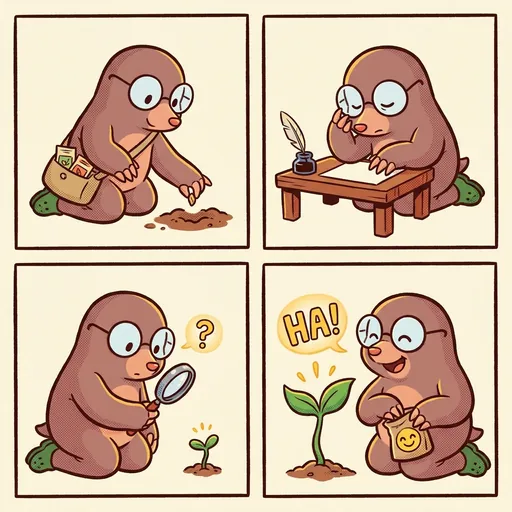
Plant
JOKE STRUCTURE — plant-the-seed-in-the-setup, harvest-the-laugh. The setup quietly plants the information the punchline will harvest — the joke works when the audience suddenly sees what was there all along.
Listen along — Plant
Loading audio…
Press play to listen along. The line being read lights up as you go.
Show full transcript
Loading transcript…
Chapter 1 — Plant and the Seed in the Setup
The comedy club was really just the back room of the community garden shed, with folding chairs and a wobbly stool for a stage. A girl named Deni stood on the stool, told a long, twisty joke with three surprises stacked on top of each other, and got total silence.
A small brown mole shuffled up afterward, seed-satchel bumping against her hip. Her round spectacles were slightly too big for her face.
“You planted three seeds,” the mole said kindly, “all at once, all on top of each other. Nobody could see any of them grow.”
Deni scowled. “I don’t get it.”
Instead of answering, the mole knelt on the shed floor, pressed one finger into an imaginary patch of soil, and dropped in a single invisible seed. She patted it gently. Then she looked up. “Watch me tell your joke,” she said. “But I’m only going to plant one seed. And I’m going to do it so quietly you won’t even notice I did it — until the very end.”
Her name was Plant, and she talked about jokes the way her family talked about gardens.
She’d grown up in a village of seed-keepers — moles who ran the seed-library, kept lists of what grew when, and taught new farmers which seeds went into which season’s soil. It was patient work. A seed you tucked in today might not flower for months. The harvest could be a whole year off.
By the time she was six, Plant already knew the seed-keeper’s secret: the moment everyone loved — the harvest, the sudden burst of color — wasn’t really the work. The work was the quiet part nobody watched. Choosing the right seed. Tucking it in at the right depth. Not fussing over it. Not pointing at the little patch of dirt and announcing to the whole village that something amazing was coming.
She used to watch travelers stop at the garden gate and gasp at a row of sunflowers, as if the flowers had appeared by magic. They never saw the planting. That, Plant decided, was exactly how a good joke should feel — like the laugh grew out of nowhere, when really it had been quietly planted all along.
She walked to the JestForge academy when she was twenty-two, and Quip, the old jackrabbit who ran it, met her at the gate.
“A joke has a setup and a punchline,” he said. “Which one does the real work?”
Plant looked at the dirt path for a moment, thinking about sunflowers.
“The setup,” she said. “Everyone thinks the punchline makes the joke. It doesn’t. The punchline just shows you the thing that was already sitting there. The real work happens in the setup — you slip in the one piece of information the joke will need, and you do it so lightly that nobody feels you doing it. Then, at the end, you turn it over — and they see it was there the whole time. That’s the harvest. But you can’t harvest what you never planted.”
Quip’s ears went up. He smiled. “Then this room is yours,” he said, and handed her a small iron key.
On the first day of every class, Plant opened her satchel and pulled out one seed-packet, holding it with the label turned away so no one could read it.
“My name is Plant,” she said, “and I teach one thing: how a joke is built.” She wiggled the packet. “Watch closely. I’m going to plant a seed, and I bet you won’t catch me doing it.”
Then she told a short, easy joke — a joke about a very small dog with a very large opinion. The setup sounded like ordinary chatter. The punchline landed clean, and the class laughed.
Then she turned the packet around. The label read: very small dog. The students gasped.
“See?” Plant said. “The seed was on the table the whole time. Right there in the setup. The punchline didn’t make the joke funny — it just dug up what I’d already buried.” She tucked the packet away. “Now let me tell you what goes wrong, because it’s almost never the punchline’s fault.”
She knelt by her low writing table and spread three fresh seeds on the wood, talking as she worked. “New joke-tellers plant three seeds when they should plant one — too many surprises crowded together, and none of them get room to grow. Or they water the seed too loudly.” She mimed leaning toward an imaginary crowd. “‘Watch this next part, it’s really funny!’ The second you point at the seed, you’ve dug it up before it’s grown. Say the setup plain. Say it easy. Like you’re talking about the weather.”
A boy near the window frowned. “But what if I plant it right and it still doesn’t grow?”
“Then you plant it in one person’s soil first,” Plant said. “Tell it to one friend you trust before you tell it to thirty strangers. If it won’t grow for one, it won’t grow for the crowd. That’s not failure — that’s a gardener checking the dirt.”
After class, Deni — the girl from the garden-shed club — waited by the door, chewing her lip.
“My cousin says I’m just not a funny kid,” she said quietly. “That some people have it and I don’t.”
Plant set down her satchel and looked at her over the too-big spectacles. “There’s no such thing as a born-funny kid,” she said. “Some kids get told they’re funny, so they keep trying, so they get better. Other kids get told they’re not, so they stop. And then everybody agrees the first kid ‘had it.’” She shook her head. “Funny isn’t a thing you’re handed. It’s a thing you grow. My first jokes were terrible. My twentieth were okay. My hundredth started to land. You can’t skip the ninety-nine — but there’s no ninety-nine you can’t walk.”
She pressed her small seed-packet into Deni’s hand. “Plant one seed. Say it plain. Wait for it. And when it grows — that’s yours. Nobody gave it to you.”
Deni closed her fingers around the packet. Something small and green and hopeful settled in her chest — the same warm feeling every kid gets who was once told they weren’t funny, and just found out they might grow into it after all.
The JestForge ensemble
Plant is part of JestForge's distributed-narrative cast. Each character embodies a different curricular primitive; together they teach the full subject.
-

Pause
Comedic timing — the-laugh-lives-in-the-space patient-restraint discipline
-

Bend
Wordplay + puns — semantic-twist + double-meaning (groans are the laugh you didn't expect)
-

Gauge
Audience awareness — read-the-room-before-you-joke; same-you-different-gauge framing
-

Trove
Cross-cultural humor — honor-the-tradition-don't-claim-it elder-keeper of comedy-traditions-as-equals