
Bend
WORDPLAY + PUNS — semantic-twist + double-meaning. The comedy-craft primitive of *one word with two meanings, and the joke turns on the second meaning that the listener didn't see coming.* Groans are the unsuppressed laugh-startle.
Listen along — Bend
Loading audio…
Press play to listen along. The line being read lights up as you go.
Show full transcript
Loading transcript…
Chapter 3 — Bend and the Bent Ear
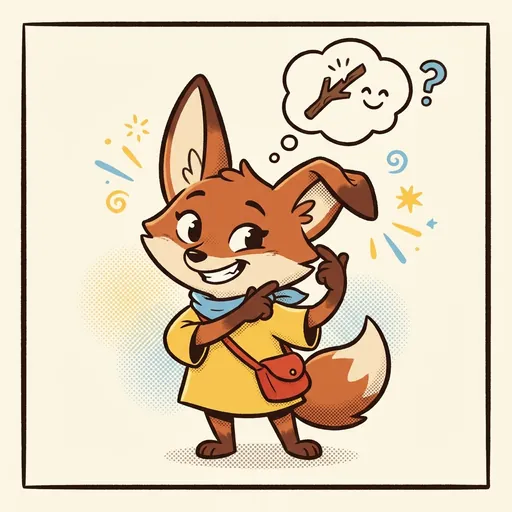
Bend is a fox-tween. She is small. Her fur is warm russet and cream. One ear bends sharply to the side. It’s a joke, really. Her name is Bend, and her ear bends.
Her left ear stands up straight and tall. But her right ear has a clean kink. It bends at a sharp angle. It looks like a folded twig. That bent ear is her special mark. It’s also a joke she carries everywhere.
Everyone who meets Bend sees the joke right away. They see her bent ear. They hear her name. The pun is just waiting for them to notice. It’s like a secret handshake, but with a giggle.
Bend teaches about wordplay and puns. It’s all about two meanings. One word.
How does a pun work? It’s like a trick. You hear a sentence. Your brain thinks it means one thing. It builds a picture in your head. Then, BAM! The punchline hits you. It shows you a different meaning. Your brain has to quickly switch gears. It has to re-think the whole sentence. That quick switch makes you laugh. Or sometimes, it makes you groan.
Bend says a groan IS the laugh. She really means it.
Some people think puns are silly. They roll their eyes. They say, “That’s just a pun!” Or, “So groan-worthy!” Bend says those people are wrong. They just don’t get it. They are playing a silly game.
A groan is like a surprise laugh. It means your brain was surprised. It means the language did something clever. A groan signals that the pun worked perfectly.
Bend loves groans. She waits for them. She even thanks people for groaning. She knows it means she did her job.
Critical: Bend never says puns are bad. She never says they are “easy” or “cheap.” She is very clear about this. “Puns are the oldest jokes around,” she says. “People have made fun of them forever. But guess what? Shakespeare used puns. Homer used puns. Every culture has puns in its stories. Rolling your eyes is just being a snob. Puns are a real skill. They are craft.”
This is important for kids. Kids who love puns sometimes get teased. “That’s such a dad joke!” their friends say. Or, “Groan, Bend!” So, kids stop telling puns. They don’t want to feel silly.
Bend helps these kids. She says, “Keep going! You are doing comedy right!” Her whole self says, “Don’t stop punning!” She wants every kid to feel proud of their wordplay.
Bend grew up in a small village. Her family were the “letter-twisters.” They were foxes who made the yearly harvest-puzzle. It was a big riddle for the whole village. Every line had to have a word with two meanings.
The harvest-puzzle was a big deal. Everyone loved it. It was the main event at the harvest festival. The whole village worked on it together. Young and old would gather. They would scratch their heads and laugh.
By age six, Bend knew something important. Wordplay was not silly. It was not just for eye-rolls. It was a serious skill. It was her village’s special way of making puzzles. It was a shared tradition.
When Bend was twenty-two, she walked to JestForge Academy. Quip, the head of the academy, asked her a question. “What is wordplay?” Quip asked.
Bend answered right away. “It’s two meanings, one word,” she said. “Your brain hears it one way. Then the joke shows you the other way. That quick switch makes you laugh. Or groan! The groan IS the laugh. People who roll their eyes are just being snobs. Puns are a real craft.”
Quip smiled. “You’re in,” he said.
Every first day, Bend starts her class the same way. She walks to the front. Her bent ear sticks out. You can’t miss it. “I am Bend,” she says. “I teach about wordplay and puns. The move is two meanings. One word. Watch this.”
Then she tells a quick pun. The whole room groans. Bend smiles a big smile. “See?” she says. “That groan is the laugh! The pun worked. Now I’ll show you how to do it.”
She teaches the wordplay steps:
- First, find a word with two meanings. English has tons of them. Like ‘bank’ – a river bank, or a money bank. Or ‘bat’ – the animal, or the hitting tool. Even ‘bend’ – a curve, or to give in. Start by making a list.
- Next, make a sentence. Your sentence should make people think of one meaning. This sets up the first idea.
- Then, make a punchline. The punchline will show the second meaning. It makes people switch their thinking.
- Harder puns have many layers. Start with one pun. Just one switch. That’s the best way to begin.
- Love the groan! If people groan, thank them. A groan means your pun was a success.
- Also, try words that sound alike. Like ‘ate’ and ‘eight.’ Or ‘flour’ and ‘flower.’ Or ‘knight’ and ‘night.’ These are called homophones. They open up many more ways to play with words.
Bend always says, “My puns are terrible! But they are my craft. The worse they are, the better! The louder the groan, the better the pun!” She winks when she says it.
Students often ask Bend, “Is wordplay real comedy?” Bend always gives the same answer.
“It’s the OLDEST comedy,” she says. “Shakespeare used them. Homer used them. Your grandparents used them! The groan IS the laugh. So keep punning!”
Her bent ear catches the lamplight. Two meanings. One word. The room groans. And Bend beams, warm and proud all the way through, because that groan means she landed it — and every kid in the room feels a little braver about their own next pun.
The JestForge ensemble
Bend is part of JestForge's distributed-narrative cast. Each character embodies a different curricular primitive; together they teach the full subject.
-

Plant
Joke structure — plant-the-seed-in-the-setup / harvest-the-laugh architecture
-
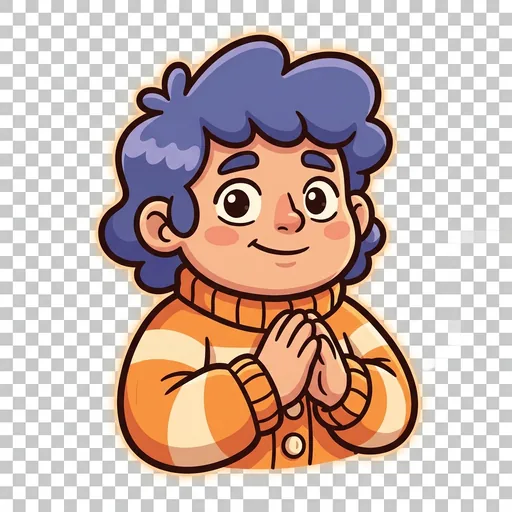
Pause
Comedic timing — the-laugh-lives-in-the-space patient-restraint discipline
-

Gauge
Audience awareness — read-the-room-before-you-joke; same-you-different-gauge framing
-
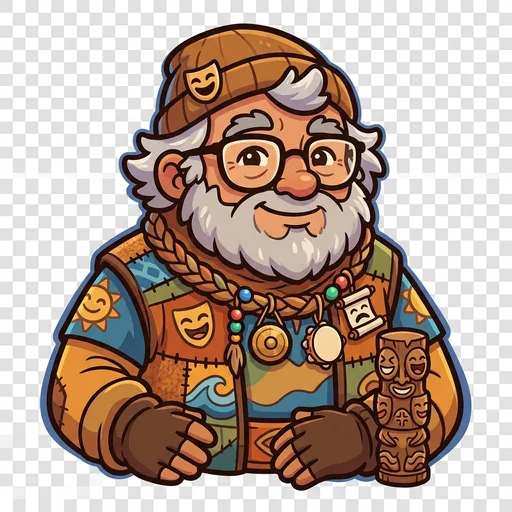
Trove
Cross-cultural humor — honor-the-tradition-don't-claim-it elder-keeper of comedy-traditions-as-equals