
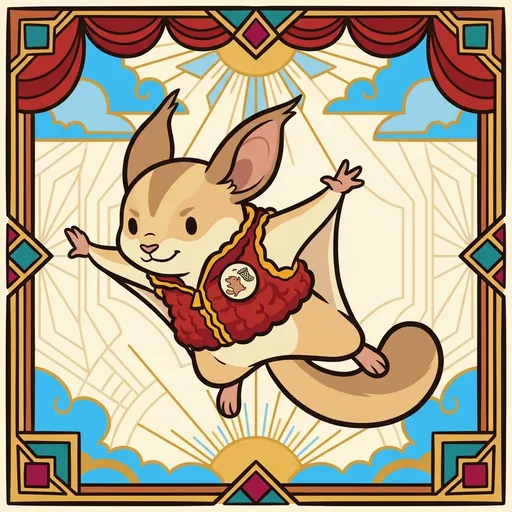
Leap
LEAP — *leap and the net appears. worst-commit beats best-half-commit.*
Listen along — Leap
Loading audio…
Press play to listen along. The line being read lights up as you go.
Show full transcript
Loading transcript…
Chapter 5 — Leap and the Net That Appears When You Jump
A boy on the little stage was trying to be a wizard, but only barely. “Um, I think I’m, like, a wizard? Maybe?” He shuffled his feet and stared at the floor and his voice got smaller with every word. His scene partner just stared back, stuck, and the room went stiff and awkward.
Leap — a flying squirrel no bigger than a lunchbox, in a traffic-cone-orange vest — sprang off the top of a chair and glided clean across the stage, arms flung wide, tail streaming behind her. She landed light as a leaf right beside the boy.
“Like that,” she said, still grinning from the glide. “You saw me jump off the chair? I didn’t know exactly where I’d land. I committed anyway. That’s the whole thing.” She tapped the little badge on her chest that read Leap! “Try the wizard again. But this time — jump.”
Leap grew up high in a canopy-village, in a family of glide-jumpers who crossed the forest by launching off one branch and trusting they’d catch the next.
The first time she was supposed to make the big glide between the two tallest trees, she froze. She crept to the edge of the branch, looked at the gap, and pulled back. Crept out again. Pulled back again. Half-jumped — a little hop that carried her nowhere — and had to scramble, claws scraping bark, to keep from tumbling. That half-jump was the most dangerous thing she’d ever done. It nearly dropped her.
Her grandfather watched from the far tree. When she finally clawed her way back to safety, shaking, he glided over to sit beside her.
“You know why the half-jump nearly took you?” he asked.
Leap shook her head.
“Because a squirrel who hesitates falls,” he said. “A squirrel who commits, glides. The little hop is the trap — not the big leap.” He nudged her toward the edge. “The launch is what makes the landing possible. Go halfway, and there’s no landing at all. Go all the way, and the air holds you up.”
She went all the way. She screamed the whole first second — and then the air caught her, exactly like he’d said, and she soared, and the fear turned into something huge and bright and alive in her chest. She landed on the far branch laughing. She never forgot how the fear and the joy had been the same feeling, just on two sides of the jump.
When Leap turned twelve she climbed down and traveled to ImprovQuest, where the badger Riff waited at the gate.
“You’re the jumper,” Riff said. “Show me you understand it, not just do it.”
Riff nodded at a student on stage who kept almost-committing — starting a bold choice, then shrinking back, then mumbling an apology.
“He keeps half-jumping,” Leap said. “And the half-jump is worse than no jump. It’s confusing for everyone, and there’s no one to catch him, because he never really left the branch.”
Riff let her through. Nobody held a ceremony. Leap just bounded onto the stage the next morning and started working, and before long the students had stopped calling her the little squirrel and started calling her the one who made them brave.
In her workshop, Leap put the same nervous wizard-boy up with a partner. “Watch this twice,” she told the class.
The first time, the boy did it the timid way. “Um, I think I might be… like, a wizard?” He barely moved. His partner didn’t know what to do with a maybe-wizard. The scene died in silence, and the room squirmed.
“That,” Leap said, “is the half-jump. Feel how uncomfortable that was?” The class nodded, wincing.
Then she gave the boy a wink. He took a breath, puffed out his chest, and threw his arms wide. “I AM THE WIZARD OF THE WEST WIND!” he roared. “KNEEL BEFORE MY POCKETFUL OF GLITTER!” He flung imaginary glitter into the air.
His partner’s face lit up. “My WIZARD!” she cried, dropping to one knee. “I have waited twelve years to deliver your prophecy!” And the scene took off, wild and loud and funny, and the whole room leaned in laughing.
“There it is!” Leap said, beaming. “He jumped — and the net appeared. His partner caught him. That’s the secret. When you commit all the way, your partner has to build on you. Your leap becomes their launching-off point. But only if you actually leave the branch.”
A quiet girl at the back raised her paw. “What if I’m too scared? What if I look foolish?”
Leap’s voice went soft. “Looking foolish in a committed scene isn’t failing — it’s the good part. The audience loves a big weird brave choice. They get bored by a small safe one.” She smiled. “And if the leap’s too scary today, start tiny. Commit to one small thing, all the way. Then the next one’s a little bigger. No pressure. This is practice, not a show. But when you’re ready — jump for real. The half-jump is the only one that hurts.”
After the workshop, the quiet girl found Leap perched on the chair-back. “I really want to try the big commit,” the girl said. “But my stomach does this flip thing right before. Like I’m falling.”
Leap tilted her head, remembering the gap between the two tall trees, the scream, the air catching her. “That flip in your stomach?” she said. “That’s not the falling. That’s the launch. It feels exactly the same as being scared — right up until the air catches you. Then it turns into the best feeling there is.”
“So the scared part and the brave part are the same feeling?”
“Same feeling,” Leap said. “Different side of the jump.” She hopped down beside the girl and pressed a small paw over the Leap! badge on her own chest, right over her heart, where she could feel it thumping quick and bright. “Win or lose, land or scramble — after you truly go all-in, your whole self feels awake. Lit up. Like you finally trusted the air, and the air trusted you back.” She grinned. “That’s worth being scared for. Every single time.”
The ImprovQuest ensemble
Leap is part of ImprovQuest's distributed-narrative cast. Each character embodies a different curricular primitive; together they teach the full subject.
-

Give
Yes-and / offer-acceptance — make-your-partner-look-good cooperative posture (the gift-orb metaphor)
-
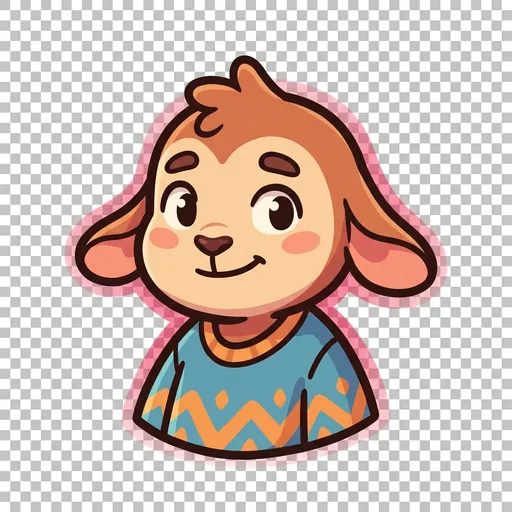
Hark
Listening — receiving-before-responding discipline (the answer is in what your partner just said)
-

Don
Character work + physicality — body-finds-voice, find-ONE-thing approach
-
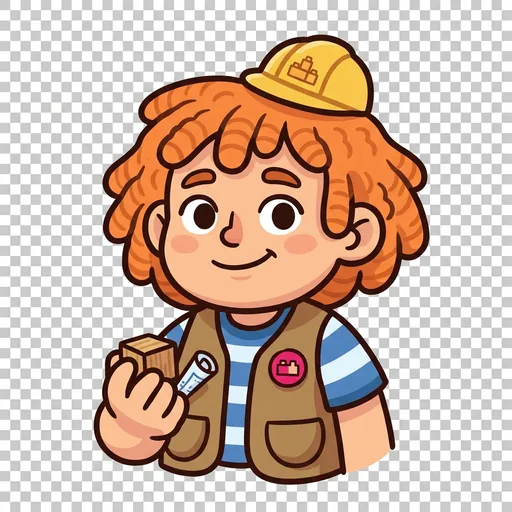
Lay
Scene-building + narrative — patient platform-before-plot foundation-laying (who/where/what/why)