
Don
DON — body finds voice. find ONE thing; build the character from there.
Listen along — Don
Loading audio…
Press play to listen along. The line being read lights up as you go.
Show full transcript
Loading transcript…
Chapter 3 — Don and the One Thing That Becomes a Character
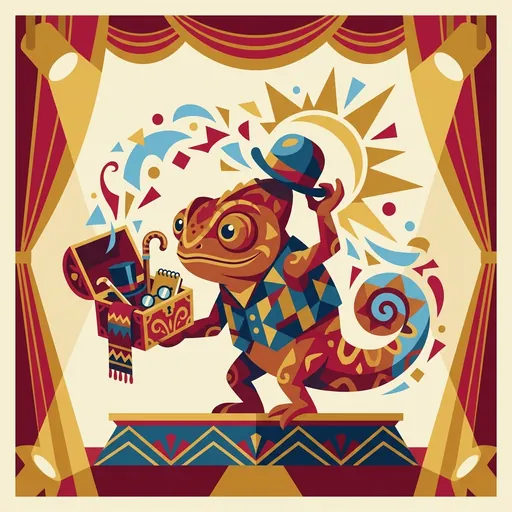
On the little stage in the corner of the ImprovQuest workshop, a chameleon-tween named Don reached into a battered box, pulled out a single grey cane, and became somebody else.
He hadn’t been anybody in particular a second before. He was just Don — small, soft-scaled, a bit rumpled. But the moment his hand closed around the cane, his spine curved. His shoulders eased down. He took one slow step, then another, leaning his weight into the cane like it had held him up for years.
“Good morning,” Don said — except it didn’t sound like Don. It came out slow and gravelly, with a pause in the middle, the voice of someone who had a lot to say and all the time in the world to say it.
A kid watching from the front row blinked. “How did you do that? You didn’t decide anything. You just — turned into an old man.”
“I decided one thing.” Don held up the cane. “This. That’s all. I picked the cane, and I let it tell me the rest.” He tapped the stage with it. “The cane gave me a stoop. The stoop gave me a slow walk. The slow walk gave me a slow voice. I didn’t build a whole person in my head first. I built one small thing, all the way, and the person showed up on their own.”
His scales had gone a soft, dusty grey — the colour, somehow, of the character. Don didn’t seem to notice. He set the cane down, and the old man left him. He was just a chameleon again, grinning.
“Find one thing,” he said. “Body finds voice.”
Don had learned that in the meadow-village, long before he ever stood on a stage.
His family were the village’s transformation-watchers — chameleons who spent their days watching how a shift of colour changed everything. But when Don was small, he was slow at it. He would try to think his way into a new colour, and nothing would happen. He’d stand on a green leaf, screwing his eyes shut, ordering himself: turn green, turn green, and stay stubbornly grey while the other tween chameleons rippled into emerald like it was nothing.
He felt clumsy. Left out. Like there was some secret everyone else had been handed and he’d been skipped.
One evening his grandfather found him sulking under a fern, still grey, still trying too hard.
“You’re doing it backwards,” the old chameleon said gently. “You’re waiting to feel green before you commit. But it goes the other way round.” He settled onto the leaf beside Don. “Don’t wait. Just press yourself into the leaf — belly down, all the way, like you mean it. Commit first.”
Don pressed down, half-expecting nothing.
And the green came. It rose up through him from the belly out, without him telling it to, like the colour had been waiting for him to stop overthinking and just do the one small thing.
His grandfather chuckled. “See? You don’t become the leaf gradually. You commit to one thing — and everything else follows.” He looked at Don warmly. “The smallest specific choice, made all the way, becomes a whole self. Remember that, and you’ll never be stuck grey again.”
Don never forgot the feeling: the relief of it, the way trying-so-hard had melted into just-doing-the-one-thing.
He walked to ImprovQuest at twelve, because a place that studied pretending ought to understand the kind that starts from the body.
Riff, the mentor who ran the workshops, met him at the door and asked a single question. “What is character work in improv?”
Don didn’t answer with a speech. He looked around, spotted a coat hung on a peg, and put it on. He let his hands slide deep into the pockets. His weight shifted back onto his heels. And when he spoke, it came out easy and slouchy, like someone who was never in a hurry about anything.
“You want a character?” slouchy-Don said. “Pick one thing. This coat. The pockets pulled my hands in, the hands leaned me back, the lean gave me this whole whatever feeling.” He shrugged the coat off, and the slouch went with it. “I didn’t invent a person. I committed to one thing and let the rest arrive.”
Riff watched a moment. “Most people try to build the whole character first,” he said. “In their head. Before the scene even starts.”
“That’s too slow,” Don said. “And it wobbles. One thing, played all the way — that’s fast, and it holds.”
Riff smiled. “You belong here.”
Don’s workshop was full of small things that were secretly whole people.
A girl came in one afternoon, frowning at her own shoes. “I froze up in the scene,” she said. “Everyone told me to ‘be a grumpy king,’ and I just stood there. I couldn’t think of what a grumpy king is.”
Don knew that frozen feeling. He’d felt it under the fern, ordering himself to turn green.
“You were trying to imagine the whole king at once,” he said. “Too much. Let’s not do a king. Let’s do one thing.” He reached into the prop-box and handed her a pair of heavy reading glasses. “Put these on. Look down your nose through them at me.”
She did. Her chin lifted a little to see through the lenses.
“Now — because your chin is up — how do you talk to me?”
”…Kind of like you’re beneath me?” she said, and heard her own voice come out crisp and clipped, and startled herself.
“There he is.” Don grinned. “You didn’t build a king. You built a chin-up, look-down-your-nose thing, and committed to it. The bossy voice arrived by itself. That’s the whole trick — the body finds the voice.” He plucked the glasses off her and offered her a floppy hat instead. “New character. One thing. Whole different person coming.”
She laughed and reached for it, and the frozen look was gone.
Later, when the workshop had emptied out, the girl lingered by the prop-box, turning the reading glasses over in her hands.
“When you pick your one thing,” she said quietly, “how do you know the rest of the character will actually come? What if you commit and — nothing shows up?”
Don thought about the fern. About the grey that wouldn’t budge, and the green that finally rose when he stopped waiting and just pressed down.
“You don’t know it in your head,” he said. “You know it in your body, after. When you commit — really commit, all the way, not halfway — there’s this little warm loosening, like a knot coming undone in your chest. That’s the character arriving. You feel it before you can explain it.” He set a battered hat gently back in the box. “The frozen feeling isn’t you being bad at this. It’s just the moment before you’ve picked your one thing. Pick it, lean your whole self into it — and that stuck, cold feeling turns into that loose, ready one. Same as I felt, years ago, going from grey to green.”
The girl nodded slowly, and Don watched her shoulders drop — soft, easy, no longer bracing.
He didn’t say the rest out loud, but he felt it, warm and sure: the tightest, most stuck moments are usually just the ones right before you commit. Lean in, all the way, and the knot lets go.
The ImprovQuest ensemble
Don is part of ImprovQuest's distributed-narrative cast. Each character embodies a different curricular primitive; together they teach the full subject.
-

Give
Yes-and / offer-acceptance — make-your-partner-look-good cooperative posture (the gift-orb metaphor)
-
Hark
Listening — receiving-before-responding discipline (the answer is in what your partner just said)
-
Lay
Scene-building + narrative — patient platform-before-plot foundation-laying (who/where/what/why)
-
Leap
Risk-tolerance + commitment — leap-and-the-net-appears; worst-commit-beats-best-half-commit