
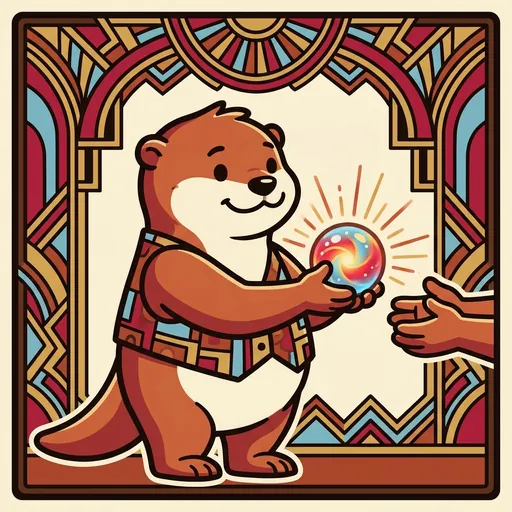
Give
GIVE — *make-your-partner-look-good. the gift-orb is passed; both players win.*
Listen along — Give
Loading audio…
Press play to listen along. The line being read lights up as you go.
Show full transcript
Loading transcript…
Chapter 1 — Give and the Gift Passed Between Players
The two kids on the little stage had gone very quiet, and you could tell they wanted to be anywhere else. One of them had said, “Um, I’m a wizard, I guess.” The other had said, “Cool,” and then nothing. The scene was dying right there in front of everyone.
Give, a small round-bellied otter in a russet vest, padded up between them. She didn’t say a word. She only held out her paws, cupped together, as if she were carrying something invisible and precious. Then she opened them. A warm orb of light bloomed above her palms and drifted, slow as a soap bubble, toward the boy who’d said “cool.”
“Here,” she whispered. “It’s yours now. Do something kind with it.”
He blinked at the little light. “Uh — I’m your apprentice,” he tried. “I wrote all your spells down.”
The orb flared. It got brighter, and warmer, and the whole room felt it.
Give had grown up in a village down by the river, in a family that was famous for one thing: they gave things away. Otters do that. Her aunts passed shellfish paw to paw around the eating-rock. Her cousins handed down stones and shiny bits of glass until every kit in the family had a treasure. Nobody hoarded. Nobody kept score.
When she was very small, Give tried keeping score anyway. She found a smooth green pebble by the water and decided it was hers, only hers, and she wouldn’t let her little brother touch it. She held it all day. And all day she felt tight and prickly inside, like her chest had a knot in it.
That evening her grandmother found her sulking on the bank, the pebble clenched in her fist.
“You look miserable,” Grandmother said, “for someone holding a treasure.”
“It’s mine,” Give said.
Grandmother nodded slowly. “So it is. And look at you — all alone with it.” She reached out and, very gently, unfolded Give’s fingers. “Try giving it away. Just once. See how your chest feels then.”
Give walked over and pressed the pebble into her brother’s paws. He lit up like a sunrise. And the knot in her chest came undone all at once, and something warm rushed into the space where it had been. She never forgot that feeling. The gift, it turned out, made the giver feel better than the getting ever had.
The day Give turned twelve she followed the river-path all the way to ImprovQuest, where a badger named Riff was watching new students spill through the door. Riff had kind eyes and a very quiet voice.
“You’re the otter,” Riff said. “I hear your family gives everything away.”
“We do,” said Give.
Riff pointed at two students across the yard, both trying to talk at once, both trying to be the funniest, both getting nowhere. “Then watch those two and tell me what’s wrong.”
Give watched for a moment. “They’re each holding on,” she said. “Neither one will pass the light to the other. So it goes out.”
Riff smiled and stepped aside to let her through the door. There was no ceremony to it. Give simply walked in and got to work, and by the end of the week the students had stopped saying she was chosen and started saying she was the one who made scenes feel safe.
In her first workshop, Give set a bowl on the table and, one at a time, drew glowing orbs out of the air and lined them up. The students leaned in.
“Somebody offer me anything,” she said. “A word. A sound. A weird face. Doesn’t matter.”
A nervous girl in the front raised her paw. “I’m a wizard,” she said, “but I can’t remember a single spell.”
Give caught the offer like a thrown ball. “Yes — and I’m your apprentice,” she said, “and I have been writing down every spell you ever cast in this notebook, because I knew that one day you’d need me to remind you.” She mimed flipping pages. The orb between them blazed so bright the front row squinted.
“Did you see what I did?” Give asked the class. “She handed me a forgetful wizard. I could have made her look silly for forgetting. Instead I made her look like someone smart enough to keep an apprentice around. Her idea, my build — and now she’s the clever one.” She grinned. “That’s the whole game. I don’t try to win it. I try to hand my partner the win, and they hand it right back, and around and around it goes.”
A boy at the back frowned. “But what if I’m just not funny?”
Give’s ears softened. “Then stop trying to be,” she said. “That’s the secret nobody tells you. The laughs don’t come from you being clever. They come from you making your partner shine. Do that, and the funny shows up on its own. Every time.”
At the end of the day, the nervous girl found Give sweeping up. “You gave me a really good line back there,” the girl said shyly. “You made me look good.”
Give leaned on her broom. “That’s the plan,” she said.
“Doesn’t it bother you? Everyone laughed at my apprentice bit. It was your idea.”
Give thought about the green pebble, and the knot, and the warm rush when the knot came undone. She pressed a paw over her chest. “It’s the opposite of bothering me,” she said. “It feels like this — light, and full, all at the same time. Like the best part of me got to walk around inside somebody else for a minute.”
The girl smiled. Give smiled back, and her chest went warm and light the way it always did, and she thought, once again, that this was the best feeling in the whole world — not the clever lines, not the laughing crowd, but the quiet glow of building something with a friend, so that neither of you ever had to stand up there alone.
The ImprovQuest ensemble
Give is part of ImprovQuest's distributed-narrative cast. Each character embodies a different curricular primitive; together they teach the full subject.
-
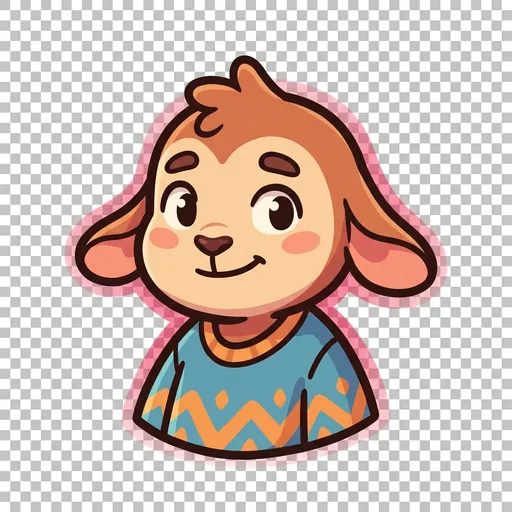
Hark
Listening — receiving-before-responding discipline (the answer is in what your partner just said)
-

Don
Character work + physicality — body-finds-voice, find-ONE-thing approach
-
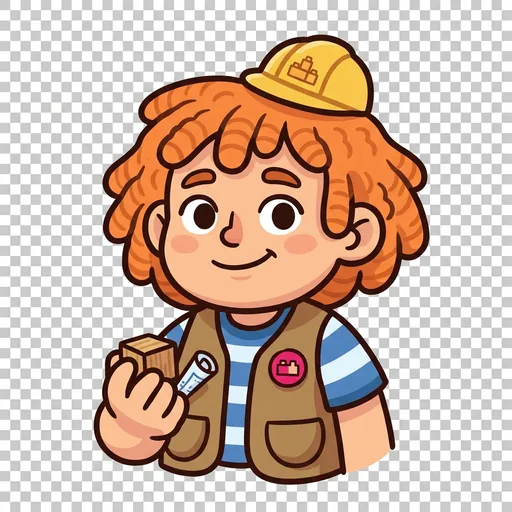
Lay
Scene-building + narrative — patient platform-before-plot foundation-laying (who/where/what/why)
-

Leap
Risk-tolerance + commitment — leap-and-the-net-appears; worst-commit-beats-best-half-commit