
Hark
HARK — *receiving-before-responding. the answer is in what they just said.*
Listen along — Hark
Loading audio…
Press play to listen along. The line being read lights up as you go.
Show full transcript
Loading transcript…
Chapter 2 — Hark and the Answer Hidden in What Was Said
A boy stood on the little stage with his mouth already open, waiting to talk, so busy waiting that he missed what his partner said. His partner had offered, “I haven’t slept since the bears moved in next door.” And the boy, who had a joke ready, just barreled ahead with, “Nice weather, huh?” The scene wobbled and fell flat.
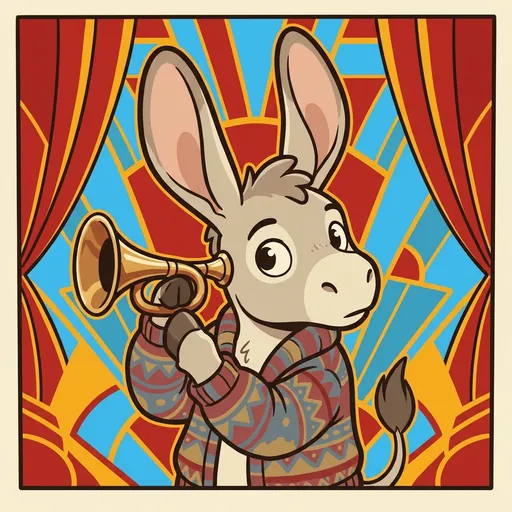
Hark, a warm-grey donkey with enormous soft ears, ambled up. He didn’t scold anyone. He simply raised a battered brass ear-trumpet to one ear, aimed it at the boy’s partner, and tilted his head, listening so hard that the whole room went still to hear along with him.
“Say it again,” Hark murmured to the girl. “The bear part.”
“I haven’t slept since the bears moved in next door,” she repeated.
Hark closed his eyes. “Bears,” he said softly. “Next door. Can’t sleep.” He opened his eyes and turned to the boy. “There. She handed you three gifts and you walked right past them. The answer was already inside what she said.”
Hark grew up in the travel-yard at the edge of the village, where the pack-donkeys carried messages across the hills. His family had done it for longer than anyone could remember, and they were prized not for being fast but for being careful.
His grandfather taught him the first real lesson. A merchant had come tearing into the yard, breathless, and rattled off a message so fast the words tumbled over each other. Young Hark started off up the trail immediately, proud to be quick. He came back an hour later with the message delivered — to the wrong house, with half the words wrong.
His grandfather didn’t get angry. He sat Hark down under the fig tree and said, “You listened for the sound of your own hooves leaving. You didn’t listen to the man.” He tapped Hark’s big ear. “These aren’t for show. Take in the whole thing first. Then carry it. A message half-heard is worse than no message at all.”
The next merchant, Hark let finish. He said the words back to make sure. Only then did he go. And he got it right, and the merchant’s face lit up because he’d been truly heard. Hark felt that light land on him too. It felt good — steadying, somehow — like the difference between guessing and knowing.
When Hark turned twelve he walked the long trail to ImprovQuest, where the badger Riff met the new students at the gate.
“The listener,” Riff said, looking at those ears. “Show me you’re more than the ears.”
Riff nodded toward two students rehearsing nearby. One kept interrupting the other, cutting in with better ideas, never letting a sentence land.
“That one,” Hark said, “keeps talking over her partner. So she never actually hears the gift her partner is trying to give. She’s building on nothing.”
Riff let him pass. There was no grand appointment — Hark just picked up his ear-trumpet and started teaching, and within a few days the students had stopped calling him the donkey with the big ears and started calling him the one who made you feel understood.
In his workshop, Hark made a great show of raising the ear-trumpet before he spoke. “Somebody offer me something strange,” he called. “I’m going to listen to it all the way down.”
A shy girl stepped up. “My bicycle has been talking to me at night,” she said.
Hark aimed the trumpet at her and let a slow beat pass. The class fidgeted, itching to fill the silence. Hark didn’t. “Bicycle,” he said at last, tapping the trumpet. “Talking. At night.” He looked up. “Those three little things — that’s my fuel. I don’t need a joke ready. I just need what she actually said.”
Then he answered. “Yes — and it’s been complaining about the rust, the rust I keep meaning to scrape off, and honestly I knew this day would come.” The girl giggled and covered her mouth.
“See what happened?” Hark asked the class. “I built my whole line out of her words. Not mine. Bicycle, talking, night — I caught all three and handed them back bigger. And she looks brilliant, because her weird idea suddenly makes sense.”
A tall boy raised a hoof. “But I always have my next line ready. That’s good, right?”
Hark shook his head, gently. “That’s the trap. The second you start writing your line in your head, your ears switch off. You stop hearing. Let the pause happen — it’s only half a second. In that half-second, you catch the gift. And the answer you needed was in there the whole time, waiting for you to slow down enough to find it.”
After class, the shy girl lingered by the door. “You really listened to my bicycle thing,” she said. “Like, actually listened. Nobody does that.”
Hark set the ear-trumpet down on the table. “It’s the whole job,” he said.
“It made me feel…” She searched for the word. “Safe. Like I could say anything and you’d catch it.”
Hark’s big ears warmed at the tips, the way they always did when someone said that. He thought about the merchant under the fig tree, about being truly heard and how it had steadied him. “That’s the part nobody talks about,” he said quietly. “Everyone thinks improv is about the funny lines. But underneath the funny is this — one person leaning in, catching every word, so the other one never has to feel alone up there.” He smiled. “When you feel that? When someone truly hears you? It’s like coming home.”
The girl smiled back. Hark picked up his trumpet, gave it a little polish, and settled in to listen to the next one.
The ImprovQuest ensemble
Hark is part of ImprovQuest's distributed-narrative cast. Each character embodies a different curricular primitive; together they teach the full subject.
-

Give
Yes-and / offer-acceptance — make-your-partner-look-good cooperative posture (the gift-orb metaphor)
-

Don
Character work + physicality — body-finds-voice, find-ONE-thing approach
-
Lay
Scene-building + narrative — patient platform-before-plot foundation-laying (who/where/what/why)
-
Leap
Risk-tolerance + commitment — leap-and-the-net-appears; worst-commit-beats-best-half-commit