
Soil
SOIL — *the ground is alive. soil is a community, not a substance.*
Listen along — Soil
Loading audio…
Press play to listen along. The line being read lights up as you go.
Show full transcript
Loading transcript…
Chapter 2 — Soil and the Living Community Under Every Field
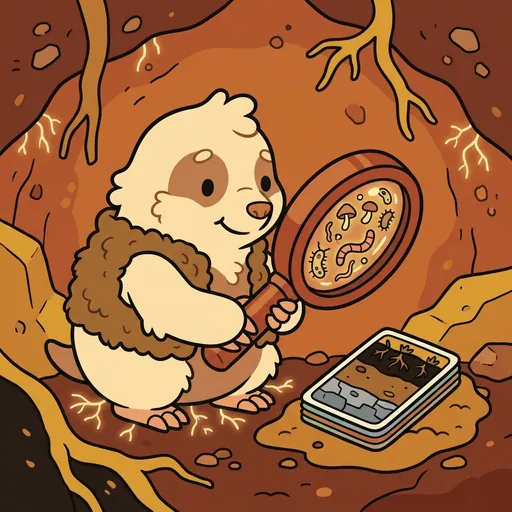
Soil, a small mole-tween with warm-cream fur and soft loam-brown patches, hummed a quiet tune as she knelt. Her nose twitched, sifting the scents rising from the earth. She wore a vest made of woven humus, sturdy and rich-smelling. In one paw, she clutched a small set of soil-cross-section cards, showing layers from topsoil to bedrock. In the other, a tiny, powerful microbiome-magnifier. She was always curious about the world beneath her paws. For Soil, the ground was never just dirt.
“The ground is alive,” she often said, her voice a soft murmur, like roots shifting in damp earth. “Soil is a community, not a substance.”
Most people, especially those new to HarvestForge, saw only brown dust or mud. They thought of soil as something plants grew in, like a pot. But Soil knew better. She knew that beneath every field, a bustling, intricate city thrived. A single teaspoon of healthy topsoil held more life than many towns held people. Billions of bacteria, miles of fungal threads, hundreds of tiny worms and protozoa. It was a complex web of relationships, all working together.
Soil called this hidden world the soil microbiome. It was the true engine of the land, handling all the nutrient cycling.
She liked to show people. “Watch,” she’d say, holding up her magnifier. “What do you see?”
She’d scoop a pinch of dark, crumbly earth from a thriving garden bed. Under the magnifier, a new world appeared. “See these tiny white threads?” she’d point. “Those are fungal hyphae. Some are mycorrhizal fungi. They’re like an underground internet, connecting plant roots.” She paused, letting the newcomer peer closer. “The fungus brings water and phosphorus from places the root can’t reach. In return, the plant gives the fungus sugars it makes from sunlight. It’s a partnership, a trade.”
Then she’d show them a bean root, carefully dug from the same soil. “Look at these little bumps,” she’d explain, tracing a finger along the root. “Those are homes for special bacteria. They pull nitrogen right out of the air and turn it into food the plant can use. We call that nitrogen fixation.”
She’d point to a tiny tunnel, barely visible. “And these? Earthworms dug them. They’re like little plows, mixing the soil and letting air and water get in. They keep the soil from getting too hard.” When leaves fell, or plants died, she explained, tiny creatures and fungi called decomposers broke them down. “They release all the good stuff, the nutrients, back into the soil for the next plants to use.”
Healthy soil was all about these partnerships. When the soil was damaged—packed down, poisoned with chemicals, or worn out—those partnerships broke. Then, the crops above ground struggled.
Soil knew this because her family had been long-underground-listeners for generations. They were moles whose tunnels taught them the earth’s secrets. “The ground hums,” her grandmother used to say. “Quietly, but it hums. Bacteria, fungi, roots—all talking. Listen with your paws.” Soil had carried that lesson forward.
When she was twelve, she walked to HarvestForge. Terra, the village elder and mentor, had asked her a simple question. “What is soil?”
Soil had looked Terra in the eye. “The ground is alive. Soil is a community, not a substance. It’s living-community craft.”
Terra had smiled. “You are appointed.”
In her workshop, Soil kept her tools neatly arranged. She had a pH test kit, which showed if the soil was too acidic or too alkaline. Most crops liked it balanced, between 6 and 7. She had an NPK test, which measured nitrogen, phosphorus, and potassium—the three main nutrients plants needed. Nitrogen for leaves, phosphorus for roots and flowers, potassium for fruit and fighting off sickness.
“These are three tools,” she’d say, holding them up. “Three windows into the community.”
She’d scoop a teaspoon of healthy garden topsoil, then another from a compacted, herbicide-treated field nearby. “Watch,” she’d urge, placing the second sample under her magnifier. “Less life here. The crumbly structure is gone. The partnerships are broken.” The difference was stark. The damaged soil looked barren, lifeless, like a city after everyone had left.
She also showed them examples of cover crops—plants like rye, vetch, and clover. “We grow these not to harvest, but to feed the soil itself,” she explained. “They protect the ground, add organic matter, and keep the community happy.” Compost, she added, was decomposed organic matter, rich “humus” that also fed the soil’s tiny citizens.
“Some people think more fertilizer means a bigger crop,” Soil would say, shaking her head. “But synthetic fertilizers can hurt the soil community and pollute the water. We need to feed the soil with organic matter and cover crops first. Then, we add targeted nutrients only when needed.”
She also warned against another common mistake. “Many farmers used to till the ground deep, kill all the weeds, and keep the field perfectly clean. But deep tilling destroys those fungal networks. It makes the soil hard and leads to erosion.” Modern best practice, she taught, was minimum tillage or no-till, combined with cover crops.
“I am Soil,” she would finish. “The ground is alive. It’s a community, a partner. We must feed the community.”
She was gentle, but firm. “Don’t think of dirt as ‘just dirt’,” she’d advise. “Think of soil as a city. When you treat it as a city, you stop poisoning the citizens. You feed it organic matter, use cover crops, and disturb it as little as possible. The community returns the favor with larger, healthier harvests for many years.”
“The ground is alive. Soil is a community, not a substance.”
The HarvestForge ensemble
Soil is part of HarvestForge's distributed-narrative cast. Each character embodies a different curricular primitive; together they teach the full subject.
-

Seed
Seasonality + sowing — when to plant, what each season teaches; calendar-as-tool
-

Chain
Supply chain literacy — every loaf tells a journey; whose-hands framing
-
Share
Food access + food-justice — community-food-network framing; food deserts are systems, NOT moral failings
-

Steward
Sustainable practices + intergenerational restoration — field remembers; latest-not-first framing