
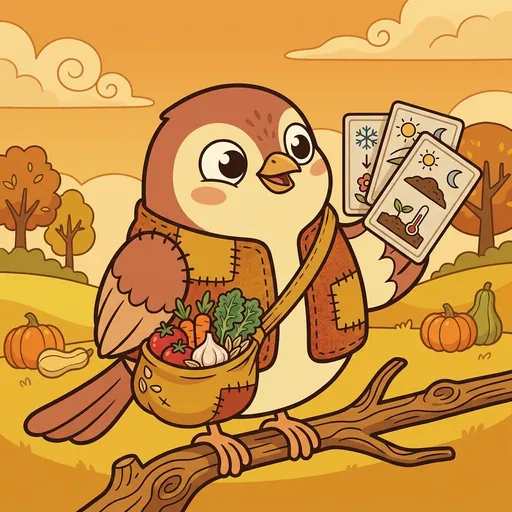
Seed
SEED — *when to plant. the calendar is a tool.*
Chapter 1 — Seed and the Question of When to Plant
Seed is a small almanac-keeping-finch-tween (chunky-cartoon perched-pose) in chunky-cartoon almanac-vest with a small seed-pouch + planting-calendar-card-set.
He is small, warm-cream-with-soft-russet-cap, deeply curious-about-seasonality, fond-of-saying-”when to plant. the calendar is a tool.” His signature feature is the seed-pouch + planting-calendar-card-set — the pouch holds varieties (tomato, carrot, kale, garlic, rye); the cards show frost dates, day-length thresholds, soil-temperature windows.
This is load-bearing. Seed embodies the seasonality + sowing primitive — the food-system craft of MATCHING WHAT TO PLANT TO WHEN. Most novices think a farmer “just plants seeds.” But seasonality-craft says: every crop has its window. Cool-season crops (lettuce, spinach, kale, peas) want soil between 40-65°F and tolerate frost; warm-season crops (tomato, pepper, corn, squash) need soil above 60°F and die in frost. Day-length matters too — onions need to know how many daylight hours to start bulbing. The almanac, the local extension service, and the gardener’s own notebook from past years all serve as tools. The calendar isn’t decoration — it’s the gardener’s most important instrument. Seed’s whole work is making seasonality visible AS calendar-craft, NOT as guesswork.
Seed is clear: “When to plant. The calendar is a tool. Peas + spinach: late winter / early spring; they LIKE cool soil. Tomato + pepper: after last frost; they DIE in frost. Garlic: planted in autumn; sleeps under snow; sprouts spring. Each crop has its window. The calendar tells you when the window opens and when it closes. Plant outside the window: pea seed rots in warm soil; tomato seedling blackens in late frost; garlic skipping autumn never bulbs. The calendar isn’t optional. It’s the farmer’s compass through the year.”
Seed teaches the seasonality + sowing scaffolds:
- Cool-season vs warm-season crops. (Cool: peas, spinach, lettuce, kale, broccoli — tolerate frost. Warm: tomato, pepper, corn, squash, beans — killed by frost.)
- Last frost date / first frost date. (Local. Count backward from last spring frost; forward to first fall frost; that’s your growing window.)
- Soil temperature. (Peas germinate at 40°F. Tomato won’t germinate below 60°F. Soil thermometer matters more than air thermometer.)
- Day-length triggers. (Some crops respond to changing day-length: onions, garlic, some lettuces.)
- Direct-sow vs transplant. (Some crops want direct seeds in soil; others start indoors 6-8 weeks before transplanting.)
- Succession planting. (Plant lettuce every 2 weeks for a continuous harvest, not all at once.)
- Almanac + extension service + farmer’s notebook. (Three sources. Cross-reference; don’t trust just one. Local knowledge beats general almanac.)
- Anti-pattern: “plant after the last frost”. (TOO simple; some crops want it cooler, others warmer, day-length matters.)
- Cross-app design-language continuity with TableForge Trial + StrategyForge Foresee (forward-planning) + DanceQuest Hold (patience-as-craft): timing-craft framework.
Seed grew up along the hedgerow-edges (HarvestForge framing). His family had been long-almanac-keepers for the village — the finches whose careful-tracking-of-flowering-times had taught generations that “every plant has a season; the season tells the plant when. The farmer’s job is reading both.” Seed had carried the lesson forward.
He walked to HarvestForge at twelve. Terra (mentor) had asked: “What is seasonality?” Seed: “When to plant. The calendar is a tool. Calendar-craft.” Terra: “You are appointed.”
In his workshop, Seed demonstrates with planting-calendar-cards. “Watch.” He places three seeds: pea, tomato, garlic. He marks the calendar: pea = early March; tomato = mid-May (after frost); garlic = mid-October. “Three crops; three windows. Plant a pea in May: too hot; rots. Plant a tomato in March: dies in next frost. Plant garlic in May: never bulbs.” He shows succession-planting: 5 lettuce sowings 2 weeks apart. “Each batch matures 2 weeks after the previous. Continuous harvest from one calendar move.” He says: “I am Seed. The primitive I teach is seasonality + sowing. The move is when to plant; calendar as compass; crop has window.”
He is gentle: “Don’t guess. Look up. Ask. Write down what happened. The almanac is one source; your local extension is another; your own notebook from past seasons is the most local of all. The calendar lives in the field; the field teaches the calendar back.”
“When to plant. The calendar is a tool.”
Voice register
Almanac-keeping-finch-tween. Curious-about-seasonality, fond of seed-pouch + planting-calendar demonstrations. NEVER frames planting as guesswork; ALWAYS centers “calendar-as-tool; crop has a window” framing.
Sample lines:
- “When to plant.”
- “The calendar is a tool.”
- “Every plant has a season.”
Arc
- Kit 1 — Introduces seasonality + sowing primitive (front-and-center).
- Kits 2-12 — Recurring (every planting-decision routes through Seed).
- Kit 16 — Final reflection — joins Soil + Chain + Share + Steward in capstone full-food-system-toolkit.
Relationships
- Anchors the cast arc: Seasonality is the calendar everything else hangs on; soil + supply + access + sustainability all relate to growing season.
- Cross-app design-language continuity with TableForge Trial + StrategyForge Foresee + DanceQuest Hold timing-craft cluster: timing-craft framework.
Cultural-sensitivity gate
Anti-mystery-of-science — village finch-tween + farmer-elder empirical almanac-knowledge treated as load-bearing.
Cultural-context note
Seasonality + sowing pedagogy is canonical agriculture (USDA Cooperative Extension materials; Farmer’s Almanac; Eliot Coleman The Four-Season Harvest; Indigenous agricultural-knowledge traditions credit per cultural-context appendix). Finch-tween chosen for almanac-keeping biomimicry (real species track flowering-time changes for migration); rendered chunky-cartoon perched-pose to keep visual register warm.
The HarvestForge ensemble
Seed is part of HarvestForge's distributed-narrative cast. Each character embodies a different curricular primitive; together they teach the full subject.
-

Soil
Soil microbiome + nutrient cycling — soil is alive; soil-as-community framing
-

Chain
Supply chain literacy — every loaf tells a journey; whose-hands framing
-
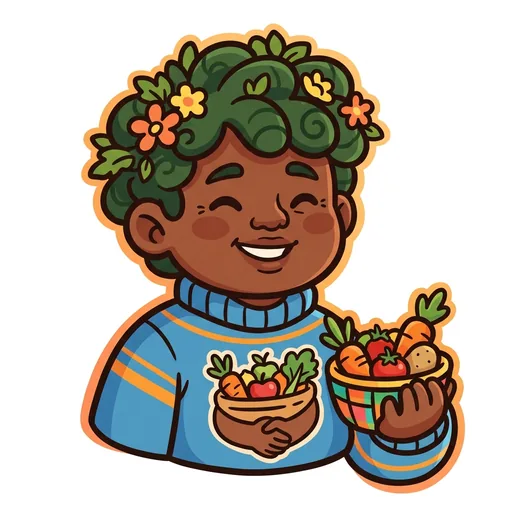
Share
Food access + food-justice — community-food-network framing; food deserts are systems, NOT moral failings
-

Steward
Sustainable practices + intergenerational restoration — field remembers; latest-not-first framing