
Share
SHARE — food access is about systems, not worthiness. neighbors feed neighbors.
Listen along — Share
Loading audio…
Press play to listen along. The line being read lights up as you go.
Show full transcript
Loading transcript…
Chapter 4 — Share and the Map That Had No Store
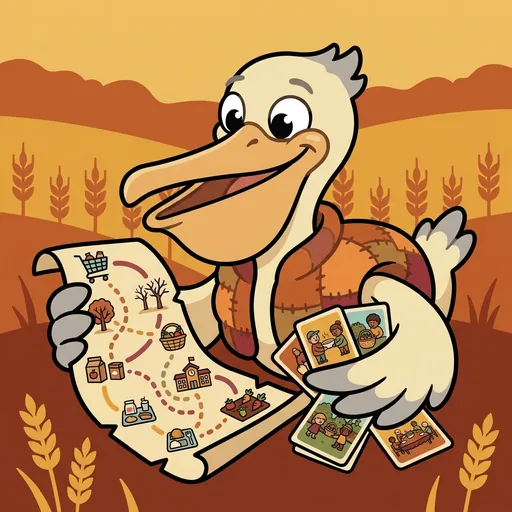
On market day in the coastal village, a pelican-tween named Share unrolled a big paper map across two crates and started marking it up.
She drew little green boxes where the grocery stores were, and little green tents for the farmers markets. Then she stepped back and frowned. Half the map — the whole east side, where the tide-flats families lived — had no green on it at all.
A gull hopped over to look. “Why’s your map lopsided?”
“It’s not lopsided,” Share said. “It’s honest. Watch.” She tapped the west side. “Three stores. Two markets. A bus that runs every twenty minutes.” Then she tapped the empty east side. “Same number of families. Same hungry chicks. Same need for good food. And” — she circled the emptiness — “nowhere to buy any. The nearest store is an hour’s walk with no bus.”
“So they just… don’t eat?”
“They eat what’s there. Which is the one corner shop that only stocks chips and soda, because that’s what keeps on a shelf.” Share smoothed the map flat. “Everybody looks at the east side and thinks the families made bad choices. But look at the map. You can’t buy a fresh fish where nobody’s allowed to sell one.” She let out a slow breath. “The problem isn’t the people. It’s the map.”
Share learned to read maps like that when she was small, and hungry, on the wrong side of her own.
There’d been a winter when the fish ran thin and the tide-flats village went quiet in a way that scared her. She remembered standing outside the shuttered market, her pouch empty, feeling something hot and awful crawl up her throat. Not just hunger. Shame. Like the empty pouch meant something bad about her — like she’d failed at being a pelican.
Her grandmother found her there and didn’t fuss. She just settled beside her and looked at the same locked door.
“You feel small, don’t you,” her grandmother said. “Like it’s your fault the door is shut.”
Share nodded, too tight in the chest to speak.
“Little one. You didn’t shut that door. The people who decided where the market goes, and where the boat lands, and who gets paid what — they shut it. And they’ll never stand out here feeling the way you feel right now.” Her grandmother’s voice stayed warm. “In our colony, when the catch comes in, it belongs to the whole colony first. No chick eats alone. That isn’t charity. That’s how any of us survives the lean years at all.” She nudged Share gently. “Being hungry is nothing to be ashamed of. It only means the map failed you. And a failed map can be redrawn.”
The hot, awful feeling didn’t vanish. But it had a shape now, and the shape wasn’t me. The shape was the map. Somehow that made it something Share could carry, and later, something she could fight.
She walked to HarvestForge at twelve, because a place that studied food ought to care where the food actually reaches.
Terra, the mentor, met her at the gate and asked one question. “What is food justice?”
Share didn’t answer with a speech. She pulled out her map and laid it on the ground between them. She pointed to a green, store-dotted district, then to a bare one.
“Same people,” she said. “Same need. One neighborhood can walk to good food. The other can’t get there.” She looked up. “It isn’t that anyone chose wrong. It’s that the map was built wrong. Food justice is redrawing the map — and cheering on the neighbors already feeding each other while we do it.”
Terra studied the two districts for a long moment. “You belong here,” she said.
Share’s workshop filled up with kids who thought the empty pouch was their fault.
A boy came in one afternoon with his shoulders around his ears. His family got food from the church pantry on Thursdays, and someone at school had laughed about it. “I did all the right things,” he mumbled. “We still don’t have enough. It feels like I’m the thing that’s broken.”
Share knew that slump. She’d felt it outside a locked door.
“Come here,” she said, and spread the map. “Show me where you live.”
He pointed. No green anywhere near it.
“Now. Your family works, yes?” He nodded. “Long hours?” Another nod. “And the rent goes up, and the wages don’t, and the good store is an hour away with no bus.” She traced the gap between his home and the nearest green box. “You want to tell me that empty stretch of road is your fault?”
”…No. It’s just a road.”
“Right. So knock the shame off it.” She pulled out a second set of cards and laid them over the empty district: a little pantry, a school with a breakfast tray, a community garden, a market stamped EBT welcome. “And look — your neighbors didn’t wait for the map to fix itself. Somebody started a pantry. Somebody made sure school breakfast was free. Somebody planted a garden on a vacant lot.” She tapped the Thursday pantry. “That thing you’re ashamed of? That’s the colony feeding its chicks. That’s the oldest, most honorable thing there is.”
The boy stared at the cards. “So it’s not… me being bad at money.”
“It’s a system that doesn’t add up for millions of families, and a whole lot of neighbors refusing to let each other go without.” Share smiled. “Both things are true. We push to redraw the map — better wages, real transit, a store that’s actually allowed to open. And we hold each other up in the meantime. Neighbors feed neighbors.”
The boy sat up a little. The shame slid off him — she watched it go, the same way, years ago, hers had.
Later, when the workshop was quiet, the boy came back with one more question.
“When you’re the one getting the food,” he said, softer now, “and not the one giving it — does that make you less?”
Share thought about the locked door, and the empty pouch, and her grandmother’s steady voice.
“No,” she said. “The colony that catches the fish and the chick that eats it are the same colony. Today you’re the chick. Some year you’ll be the one filling somebody else’s pouch — that’s just how it goes around.” She rolled up her map slowly. “There’s no shame in being fed. There’s only the warm, held feeling of belonging to people who won’t let you fall through the gap.”
The boy nodded, and Share felt it settle over both of them — that quiet, cared-for warmth, the exact opposite of a hot throat outside a shut door. Not fixed, not finished. Just held. Enough for now.
The HarvestForge ensemble
Share is part of HarvestForge's distributed-narrative cast. Each character embodies a different curricular primitive; together they teach the full subject.
-
Seed
Seasonality + sowing — when to plant, what each season teaches; calendar-as-tool
-

Soil
Soil microbiome + nutrient cycling — soil is alive; soil-as-community framing
-
Chain
Supply chain literacy — every loaf tells a journey; whose-hands framing
-
Steward
Sustainable practices + intergenerational restoration — field remembers; latest-not-first framing