
Share
SHARE — *food deserts are systems, not moral failings. neighbors feed neighbors.*
Listen along — Share
Loading audio…
Press play to listen along. The line being read lights up as you go.
Show full transcript
Loading transcript…
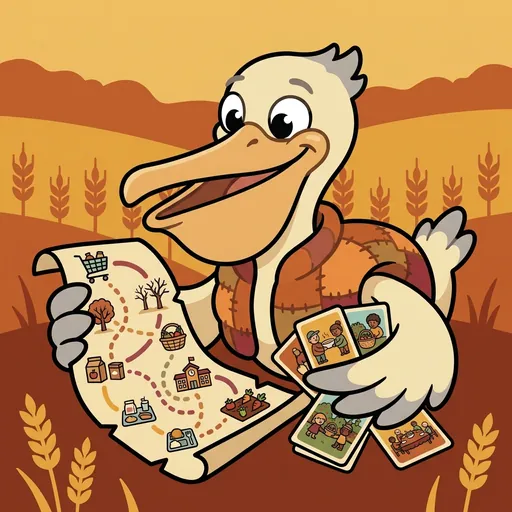
Share, a small pelican-tween, often stood in a particular way. His chest puffed out, wings slightly forward, like he was about to scoop something up. It was his signature pose, a chunky-cartoon readiness to help. He wore a community vest, faded from many trips, and always carried his neighborhood food map and a stack of community pantry cards. Share was warm-cream colored, with soft, stone-grey feather tips. He was deeply curious about how food moved through neighborhoods.
He loved to say, “Food deserts are systems, not moral failings. Neighbors feed neighbors.”
This was the big idea, the core lesson Share taught. He showed students the craft of food access + food-justice. This meant understanding why some neighborhoods had plenty of food, while others went without. Most people, when they first thought about hunger, imagined it was someone’s fault or that there simply wasn’t enough food to go around.
But Share knew better. He knew the truth about food-justice craft: in most countries, there was more than enough food for everyone. Yet, some neighborhoods had no grocery stores at all. Others only had stores selling chips, soda, and frozen meals. And often, there was no easy way to get to a good store, even if one existed far away. These places, called food deserts or food swamps, weren’t accidents. They were systems. They were shaped by things like zoning laws, bus routes, old housing policies that hurt certain communities, decisions made by big store chains, how much people earned, and the cost of homes.
A family living in a food desert wasn’t “choosing poorly” when they bought chips. They were just trying to eat in a place that made it incredibly hard to find anything else. They were navigating an unfair map.
And here was the amazing part: communities everywhere had already built clever answers. They created food banks, set up community pantries, organized mutual-aid networks, offered school meal programs, started community gardens, and found ways for farmers markets to accept food assistance. Food-justice was about making the whole system fair. It was also about honoring the smart, strong ways communities were already helping each other. Share’s entire purpose was to show that food access was a craft of understanding systems, not about judging people.
Share was always clear. “Food deserts are systems, not moral failings,” he’d repeat. “Neighbors feed neighbors. Think about it: a neighborhood has no grocery store within walking distance. No bus goes to the nearest one. The only stores that do exist sell mostly chips, soda, and ready-made meals. That’s not because anyone living there is lazy. It’s not because they make bad choices.”
He’d tap his map. “That’s a SYSTEM. Zoning laws might have kept the supermarket out. The bus lines don’t run there. Landlords charge what they charge. Wages are what they are. Hunger, in the middle of a country full of food, is a system failure. It’s not a personal one.”
He’d then point to the cards in his pouch. “But here’s the other side. Communities everywhere have built amazing answers: food banks, mutual-aid pantries, community gardens, programs that double food stamp money at farmers markets, school breakfast and lunch programs. Neighbors feed neighbors. When you understand the system, you know how to support those community responses. You also know how to push for the big system fixes.”
Share taught the main ideas of food access and food-justice. He explained things like:
- Food security vs. food insecurity. “Food security means you always have enough good food to eat,” he’d say. “Food insecurity means you don’t. The government measures this every year.”
- Food deserts vs. food swamps. “A food desert is a place with no grocery store nearby. A food swamp is a place with only junk food options. Both leave people without good choices.”
- Why food deserts exist. “It’s not just one thing,” Share explained. “It’s zoning laws, bus route cuts, old redlining maps that kept certain groups from buying homes, big supermarkets moving out, or just not seeing enough profit in a neighborhood. Low wages can also make it hard for big stores to see a reason to open there.”
- NOT individual virtue. “If a family eats chips because chips are the only thing sold within walking distance, they aren’t making a bad choice. They’re making a smart choice in a broken system.”
- Community responses. He’d list them: “Food banks, community pantries, mutual-aid networks, community gardens, programs that double SNAP benefits, farmers markets that take EBT cards, school meal programs.”
- Policy responses. “These are the official ways the government tries to help,” he’d clarify. “Like SNAP, which used to be called food stamps. Or WIC, for mothers and young children. The National School Lunch Program helps kids get meals at school. There are also grants for community development and programs to help farmers markets.”
- Co-op + community-supported agriculture. “This is when people buy a share of a farm’s harvest at the start of the season,” Share explained. “Then, they get fresh food directly from the farm all year. It builds a connection.”
- Anti-shame. “Getting food help carries no moral weight,” Share insisted. “Millions of people face food insecurity. The system is the problem, not anyone who needs help.”
- Anti-pattern: “they should just budget better”. “This idea ignores the whole system,” he’d say with a sigh. “For millions of families, the math just doesn’t work. Wages are too low, housing costs too high.”
- Anti-pattern: “charity solves hunger”. “Charity is important for today’s meal,” Share acknowledged. “But structural fixes—like better wages, affordable housing, healthcare, and good public transit—those are what end hunger for good. Both kinds of work matter.”
- Cross-app design-language continuity with CivicForge community-systems + EconomicsForge wages + DigQuest cultural-respect + TableForge Theme (integrity-craft): community-systems-craft framework.
Share grew up along the coastal marshes, a place where the tide brought in plenty one day and left little the next. His family had been long-pouch-sharers for their village for generations. They were the pelicans whose communal-pouch-feeding of chicks taught everyone a simple, powerful lesson: “The catch belongs to the colony first. No bird eats alone. Sharing is how the colony survives the lean years.” Share carried that lesson in his very bones.
When he was twelve, he walked to HarvestForge, the place where mentors helped young ones find their path. Terra, the wise old mentor, had looked at him with keen eyes. “What is food justice?” she asked.
Share didn’t hesitate. “Food deserts are systems, not moral failings. Neighbors feed neighbors. It’s about understanding the system, Terra.”
Terra simply nodded. “You are appointed.”
In his workshop, Share often demonstrated his lessons with his neighborhood food map. “Watch,” he’d say, spreading the map across his table. It was a detailed, colorful chart, showing roads and buildings, but also marked with tiny symbols for grocery stores, fast-food places, and bus stops.
He pointed to two neighborhoods side-by-side. “Look at this first one,” he explained. “Same population as the next. But this one has three big grocery stores, two farmers markets, and bus lines that run right to them. Easy access.”
Then he moved his wing to the second neighborhood. “Now this one. Same number of people, same need for food. But look: no grocery store. Twelve fast-food restaurants. And no bus routes that go anywhere useful. Wildly different access, right? That’s a system problem.”
He then showed the community responses in that food-desert neighborhood. “But people don’t just sit around waiting for fixes,” he said, his voice full of admiration. He pointed out a small, hand-drawn symbol. “Here’s a mutual-aid pantry, run by volunteers. Here’s the school meal program, making sure kids get breakfast and lunch. This little green patch? A community garden where neighbors grow fresh vegetables. And over here, a farmers market that doubles SNAP benefits, so families can buy more healthy food.”
He looked up, his eyes bright. “Communities don’t wait. Neighbors feed neighbors. I am Share. The big idea I teach is food access + food-justice. The move, the way we make a difference, is to remember that food deserts are systems. Neighbors feed neighbors. And structural fixes matter just as much as community responses.”
He was always gentle when he spoke, but his message was firm. “Don’t blame the hungry,” he’d say. “Blame the map that has no store. And don’t think one bake sale will fix everything – but also don’t underestimate the power of community pantries, school meal programs, and mutual-aid networks. Both kinds of work matter: changing the big systems and taking care of each other right now. Food-justice is how we make sure every neighbor has enough.”
“Food deserts are systems, not moral failings. Neighbors feed neighbors.”
The HarvestForge ensemble
Share is part of HarvestForge's distributed-narrative cast. Each character embodies a different curricular primitive; together they teach the full subject.
-

Seed
Seasonality + sowing — when to plant, what each season teaches; calendar-as-tool
-

Soil
Soil microbiome + nutrient cycling — soil is alive; soil-as-community framing
-
Chain
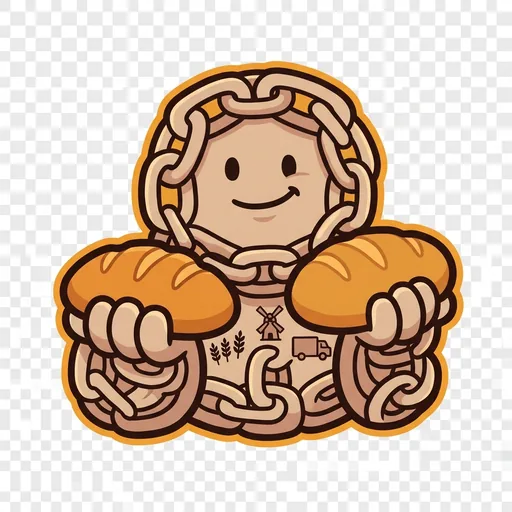
Supply chain literacy — every loaf tells a journey; whose-hands framing
-

Steward
Sustainable practices + intergenerational restoration — field remembers; latest-not-first framing