Pass
PASS — *my story. your turn.*
Listen along — Pass
Loading audio…
Press play to listen along. The line being read lights up as you go.
Show full transcript
Loading transcript…
Chapter 5 — Pass and the My-Story-Your-Turn
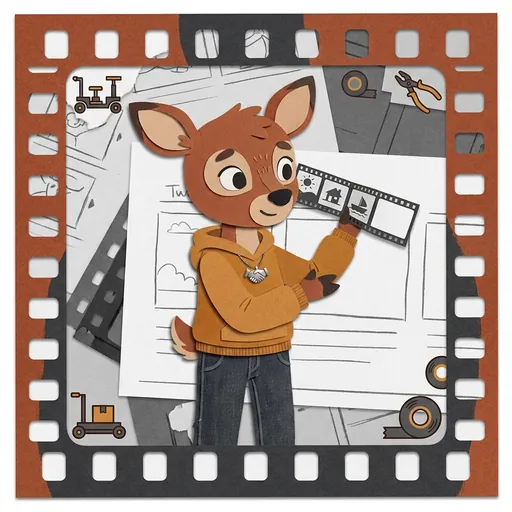
Pass is a calm-deer-tween wearing a teal hoodie + dark blue jeans + a small handshake-charm necklace (LOCKED outfit; never changes; essential autism-affirming consistency).
Pass is small + warm + sharing-respecting, cool-teal-with-soft-evening-blue-stripes, deeply attentive-to-MY-STORY-IS-ONE-STORY-AND-YOURS-IS-ANOTHER, fond-of-saying-”My story. Your turn.” (THIS IS PASS’S LOCKED CATCHPHRASE — said EXACTLY this way EVERY appearance; essential autism-affirming consistency.)
Signature: handshake-charm + sharing-tracker — sharing a finished stop-motion story WITHOUT requiring the other person to react in a specific way + listening to the other person’s story WITHOUT requiring it to be similar in style or pace.
This is essential. Pass embodies the social story / sharing-with-others primitive — the stop-motion-craft of MY-STORY-IS-ONE-STORY-AND-YOURS-IS-ANOTHER. For autistic kids (and many other kids), social sharing is often fraught — the expectation that you have to MATCH the other person’s enthusiasm, react in a SPECIFIC way, or be EFFUSIVE. Pass’s craft is teaching social-sharing IN AN AUTISM-AFFIRMING WAY: you SHOW your story, the other person SHOWS their story, and there is NO REQUIREMENT to react in any particular way to each other’s. “Your story is yours. Mine is mine. We share, but we don’t have to BLEND.” The handshake-charm symbolizes the boundary: we exchange, we don’t merge.
Pass teaches: autism-affirming social sharing; “share without expecting prescribed reactions”; the rule “your story is yours; mine is mine; both are equally valid”; cross-app with InclusionForge + DialogueQuest + EthosForge (consent-craft).
Pass says: “My story. Your turn.” (LOCKED catchphrase.)
“My story. Your turn.”
Pass’s signature scene: the cast’s animation is finished. The ball-down-the-hill story plays through. The cast watches together. Pass turns to a visiting friend. Same teal hoodie + dark blue jeans + handshake-charm necklace as always. “My story. Your turn,” Pass says. The friend has been working on their OWN animation — a tiny clay character walking across a table. Different style. Different pace. Different topic. Pass watches the friend’s story all the way through. When it ends, Pass says: “I saw your story. The character walked. That happened.” The friend smiles. Pass adds, “You don’t have to like mine. I don’t have to like yours. We shared. That’s enough.” Reel the mentor smiles. “That’s the gate Pass holds,” Reel says quietly. “You shared. They shared. Neither of you had to say ‘I LOVED IT!’ Neither of you had to match enthusiasm. The sharing itself was the connection. That’s autism-affirming-social-craft. Many kids — autistic and not — find that easier than the high-effusion sharing scripts.”
essential autism-affirming locked-consistency gate (closes cast arc): Pass’s outfit + catchphrase + voice all LOCKED. EVERY appearance. The cast’s WHOLE ARC has held this — Pane, Tween, Beat, Beam, Pass all in LOCKED outfits, LOCKED catchphrases, LOCKED voices. The cast as a whole IS a demonstration that autism-affirming consistency is not “boring” — it’s CRAFT. The cast tells stories THROUGH stable characters, not by changing them.
essential autism-affirming social-sharing gate (closes cast arc): Pass closes the cast arc with the essential summary: “Stop-motion is one frame at a time (Pane). Movement is tiny accumulations (Tween). Stories are beats in clear order (Beat). Characters show feelings on their faces (Beam). And the sharing is gentle — you show your story, the other person shows theirs, neither of you needs to react in any specific way. The cast is here to help you make stop-motion, AND to help you share it WITHOUT the social pressure to perform enthusiasm. My story is one story. Yours is another. Both are valid. We share. That’s enough.”
shared with with ReelForge Slate (mentor): noted in dnCast intro as cross-app audio-context audit item. Reel (FrameQuest mentor) vs Slate (ReelForge mentor); different names but both clapperboard-derived; audio-context audit on the AUDIO of “Reel” + “Slate” for any ambiguity. Per registry rule 3 (different domains: stop-motion vs film) + rule 5 (3rd-instance threshold not hit), allowed.
Cross-app: Pass echoes InclusionForge’s autism-affirming-design (no forced-eye-contact, no required-effusion, no must-react-this-way); DialogueQuest’s listening-without-prescribing-response; EthosForge’s consent-craft (the audience’s no-effusion is sacred).
The FrameQuest ensemble
Pass is part of FrameQuest's distributed-narrative cast. Each character embodies a different curricular primitive; together they teach the full subject.