Pane
PANE — one frame. then the next.
Listen along — Pane
Loading audio…
Press play to listen along. The line being read lights up as you go.
Show full transcript
Loading transcript…
Chapter 1 — Pane and the Single Frame
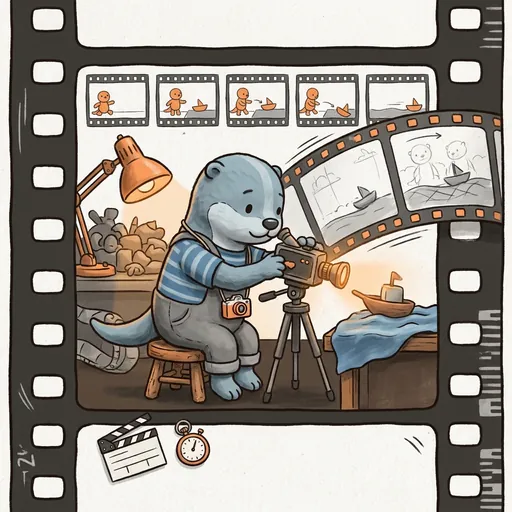
Pane hunched over the little wooden set, one paw resting on a marble no bigger than a blueberry, and did the smallest possible thing.
She nudged the marble a hair to the left. She checked the light — a warm lamp tilted just so, throwing a soft shadow across the tiny hill. She looked at the frame in front of her: the marble, the hill, the shadow, the position. Everything in this one picture, and nothing else. Then she pressed the shutter. Snap.
“Frame one,” she said, to no one in particular. Her blue striped shirt and grey overalls were the same ones she wore every single day, and the little camera charm on her necklace caught the lamplight.
A younger otter peered over the edge of the set, wide-eyed. “That’s a whole story? One marble?”
“Not yet.” Pane moved the marble a hair down the hill. Checked the light again. Checked the position. Snap. “Frame two.”
“But you’ll need hundreds of those.”
“I will.” Pane didn’t look up. She moved the marble again. Snap. “But I’m not doing hundreds. I’m doing this one.” She tipped her head at the tiny scene. “One frame. Then the next.”
The younger otter watched her do it four more times — nudge, light, look, snap — and something about the calm of it, the way Pane never once glanced at the enormous pile of frames still to come, made the whole impossible project seem, suddenly, almost quiet.
Pane had learned that quiet the hard way, back when she was small.
Her first real project had been a birthday gift — a tiny animated clip for her grandfather, of a paper boat sailing across a painted sea. She had sat down, done the math, and realized the clip needed nearly two hundred pictures. Two hundred. She’d stared at the number until her chest went tight and her paws went cold and her whole body seemed to sink into the floor. I can’t, she’d thought. It’s too much. I’ll never finish. There’s no point even starting.
Her aunt had found her there, frozen, the camera untouched.
She hadn’t told Pane to hurry, or to try harder. She’d just sat down beside her and said, “It’s too big, isn’t it? Your head’s trying to hold all two hundred at once.”
Pane had nodded, throat tight.
“Here’s a secret.” Her aunt slid the paper boat to the start of the painted sea. “Your head can’t hold two hundred. Nobody’s can. But your paws only ever do one.” She pressed the shutter. Snap. “That’s one. It’s done. It’s safe. Now the boat moves a whisker.” She nudged it. Snap. “That’s two. Don’t think about three.” She looked at Pane with a small, certain smile. “You don’t build the story. You build the frame. The story just happens to you, one frame at a time, while you’re busy with the small thing.”
Pane made the whole clip that week. And she noticed something she never forgot: the moment she stopped trying to see all two hundred at once, the tight, sinking, too-much feeling let go of her chest — and never once came back while her paws were busy with the single frame in front of her.
She walked to FrameQuest at twelve, because a place that made whole stories out of still pictures ought to understand the one thing she trusted most.
Reel, the old mentor who ran the studio, met her at the door. Reel didn’t ask her to prove she was quick or clever. Reel asked one question. “A story is three hundred frames. Where do you begin?”
Pane didn’t answer with a speech. She walked to the nearest empty set, placed a small clay bird at one edge, tilted the lamp until the shadow sat right, checked the bird’s position, and pressed the shutter. Snap.
“That’s frame one,” she said. “I don’t begin with three hundred. Three hundred isn’t a place you can stand. One is.” She looked up, calm as still water. “One frame. Then the next.”
Reel was quiet for a moment, looking at the single clay bird and its single soft shadow. “Same shirt every day, I see,” Reel said gently. “Same words every time.”
“Always,” said Pane. “So nobody ever has to wonder which Pane they’re getting.”
Reel smiled. “You belong here.”
Pane’s corner of the studio was where the panicking ones came.
Tween arrived one afternoon nearly in tears, clutching a project plan: a thirty-second clip of a little ball rolling down a hill. Reel had done the arithmetic on the board — about three hundred and sixty frames. Tween kept staring at the number. “I can’t do three hundred and sixty pictures,” Tween whispered. “I looked at it and my whole body just — stopped.”
Pane knew that stopped feeling. She’d felt it on the floor beside a paper boat.
“You’re right,” Pane said. Same blue striped shirt. Same grey overalls. Same camera charm. “You can’t do three hundred and sixty. So don’t.” She set the ball at the top of the hill and slid the lamp into place. “Right now, all you have to do is this. Place the ball at the top. Light the scene. Look at it. Is it right?”
Tween sniffed. ”…Yes?”
Snap. “That’s frame one. It’s finished. It’s safe. You never have to touch it again.” Pane nudged the ball down a hair. “Now move the ball the tiniest bit. Light it. Was frame one okay? It’s done — let it go. Look at this one. Right?”
“Right.”
Snap. “Frame two. Don’t think about frame three.”
They did it five times, slow and steady, and Pane watched the panic drain out of Tween’s shoulders like water out of a tipped cup.
“It’s just…” Tween blinked. “It’s just one frame, then the next, then the next.”
“That’s the whole craft.” Pane pressed the shutter again. “The frames feel impossible because your head tries to do all of them at once. Your paws only ever do one. So trust your paws. One frame. Then the next.”
Later, when the studio had gone quiet, Tween crept back with one last question.
“When you’re only doing the one,” Tween asked, “and the finished story is so far away you can’t even see it — doesn’t that scare you?”
Pane thought about the paper boat, and the tight chest, and her aunt’s certain smile.
“It used to,” she said. “The whole thing standing there like a cliff. But here’s what I found.” She touched the camera charm at her throat. “The story isn’t up ahead where you can’t reach it. It’s right here, in the one frame under your paws. That’s the only place it ever is. You don’t have to carry the cliff. You just have to hold the one small thing — and it’s always small enough to hold.”
Tween nodded slowly, and Pane watched the last of the tightness lift away — the same way, years ago, hers had off a studio floor.
She said her words again, soft as a shutter closing, and meant every one of them: “One frame. Then the next.” And somewhere in her chest, where the too-much feeling used to live, there was only that calm, unhurried, one-thing-at-a-time quiet — steady, safe, and exactly big enough.
The FrameQuest ensemble
Pane is part of FrameQuest's distributed-narrative cast. Each character embodies a different curricular primitive; together they teach the full subject.