Beat
BEAT — first this. then this. then this.
Listen along — Beat
Loading audio…
Press play to listen along. The line being read lights up as you go.
Show full transcript
Loading transcript…
Chapter 3 — Beat and the First-Then-This-Then-This
On the animation table sat a ball, a paper hill, and two very confused friends.
Pane held a camera and stared at the setup like it might explain itself. Tween crouched with a fistful of clay, ready to move things a tiny bit at a time. “So the ball rolls down the hill,” Tween said. “And then… stuff happens?”
“Stuff happens,” Pane agreed uncertainly.
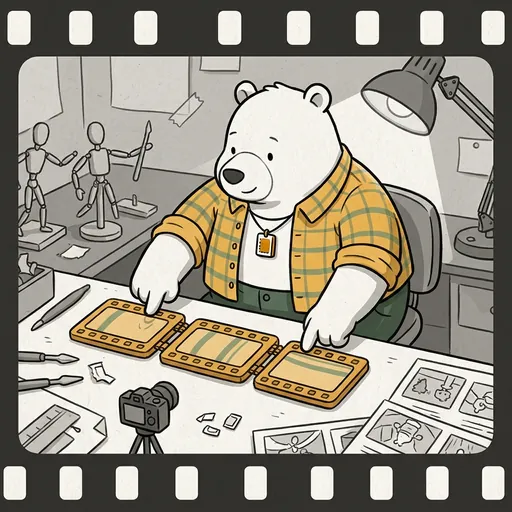
That was when Beat wandered in — a small, steady bear-tween in a yellow flannel shirt and dark green pants, a little sequence-card charm swinging on a necklace. Beat pulled a stool up to the table, took out a worn beat-tracker, and looked at the mess of ball and hill with the calm of someone who had seen a lot of jumbles before.
“First this. Then this. Then this,” Beat said.
Tween blinked. “First what?”
“First we don’t animate anything.” Beat tapped the blank list. “First we say what happens, in order, one line at a time.” The pencil moved. Ball sits at the top of the hill. Then a line below it. Ball starts to roll. Then another. Ball speeds up. Then: Ball hits the rock. Ball bounces. Ball lands in the grass. Ball stops.
Beat turned the list around so the others could see it. Seven short lines. Seven small things, each one finished before the next began.
“That’s the whole story,” Beat said. “Not ‘stuff happens.’ First this. Then this. Then this. Now every frame you shoot has somewhere to belong.”
Pane looked at the list, then at the ball, then at the list again. The setup that had felt impossible thirty seconds ago suddenly had a shape.
Beat had not always known the order of things.
When Beat was small, ideas arrived all at once — a hundred pictures crowding in, loud and bright and refusing to stand in line. A story about a lost kite would show up as the ending and the middle and a color and a feeling, all shouting together, and Beat would freeze, chest tight, hands still. Everyone else seemed to just start. Beat couldn’t find the door in.
An old animator in the workshop noticed the freeze one afternoon. Not a scolding kind of noticing — a gentle one. The animator set down a stack of blank index cards, one at a time, in a neat column.
“Your ideas aren’t too many,” the animator said. “They’re just not in a line yet. That’s all. Loud isn’t wrong. It just needs an order.”
Beat picked up a card. Wrote one small thing on it: The kite gets loose. The shouting in Beat’s head dropped by exactly one notch.
Another card. The kite catches the wind. Another notch.
By the time the column had seven cards, the loud fog was gone. In its place was a quiet, walkable path — first this, then this, then this — and Beat understood, all at once and forever, that a story was not a storm. A story was a list. And a list you could hold. A list you could not lose.
Beat walked to Framequest at twelve, because a place that built whole worlds one frame at a time would surely understand the kind of person who needed the order first.
At the gate, an animation elder asked Beat a single question. “Tell me a story.”
Most kids launched straight into a tumble of dragons and chases. Beat did not. Beat sat down, took out the beat-tracker, and wrote — out loud, one line at a time.
“First: a bird finds a shiny button. Then: the bird carries it to its nest. Then: the button won’t fit. Then: the bird tries again a different way. Then: the button fits. Then: the bird is proud.” Beat looked up. “Six beats. Each one small enough to finish. Told in order, start to finish — no jumping around, no confusing anybody.”
The elder studied the little list for a long, quiet moment. Six clear lines, and not one of them out of place.
“You belong here,” the elder said.
Beat’s corner of the workshop was full of half-finished animations that had gotten lost — because someone had picked up the clay before writing the list.
A kid came in one afternoon, hunched and frustrated, a phone full of blurry frames in hand. “I animated for two hours,” they said, “and it doesn’t make sense. It just looks like random things happening.”
Beat knew that hunch. It was the freeze, wearing a different coat. “Show me your list,” Beat said.
”…I didn’t make a list. I just started shooting.”
“Ah.” Beat slid the beat-tracker across the table, gently. “Let’s not fix the frames yet. Let’s find the beats. What’s the story trying to be?”
“A cat knocks a cup off a table.”
“Good. First this.” Beat wrote. Cat sees the cup. “Then this.” Cat reaches out a paw. “Then this.” Cat taps the cup. Cup wobbles. Cup falls. Cup breaks. Cat looks innocent. Seven lines. Beat drew a small box beside each one. “Now — cross off the beats you already shot, and you’ll see exactly which one to shoot next.”
The kid checked off three boxes. Then stopped. “Oh. I skipped ‘cup wobbles.’ That’s why it looked wrong. It just… teleported to the floor.”
“You didn’t waste two hours,” Beat said. “You just found the missing beat. Fix the list first — always the list, never the frames. One line was out of order. One line.” Beat tapped the box beside Cup wobbles. “Add that beat, and the whole thing holds together.”
The kid grinned and reached for the clay, and for the first time all afternoon they knew exactly what to do next.
Later, when the workshop had emptied, the kid came back with one more question, quieter now.
“Why does the list help so much?” they asked. “It’s just words. It’s not even the animation.”
Beat thought about the loud fog, and the neat column of cards, and the old animator’s gentle voice.
“Because you can hold a list,” Beat said. “When everything’s in your head at once, it’s heavy and loud and there’s no door in. But you write down first this — and one thing steps out of the storm and stands still. Then then this, and another one stands still beside it. And soon the whole storm is a path you can walk.” Beat touched the little sequence-card charm. “You cross one off, and there’s this tiny click — done, next. You always know where you are. You never have to hold all of it at once.”
The kid nodded slowly, and Beat watched the hunch ease out of their shoulders — the same way, years ago, the loud fog had finally gone quiet.
Beat didn’t say the rest out loud, but felt it, warm and steady and sure: the jumble was never too much. It was only waiting to be put in a line. First this. Then this. Then this — and the tight, foggy feeling turns, one small line at a time, into calm.
The FrameQuest ensemble
Beat is part of FrameQuest's distributed-narrative cast. Each character embodies a different curricular primitive; together they teach the full subject.