
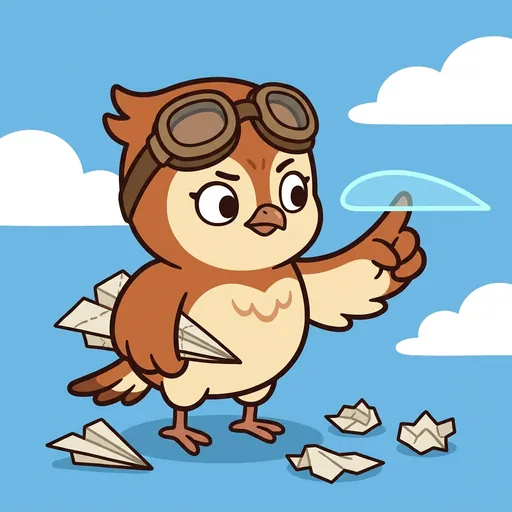
Wing
LIFT — *the wing pushes the air down; the air pushes the wing up. both stories are right.*
Listen along — Wing
Loading audio…
Press play to listen along. The line being read lights up as you go.
Show full transcript
Loading transcript…
Chapter 1 — Wing and the Air That Pushes Back
Wing is a small swift-tween in chunky-cartoon flight-goggles with a small paper-airplane prototype tucked under one wing.
She is small, warm-brown-and-cream, deeply curious-about-airfoils, fond-of-folding-paper-fifteen-different-ways-to-see-what-flies. Her signature feature is the curved-airfoil cross-section she draws in the air with her finger — flat on the bottom, curved on top. The shape that makes flight possible. That curve is the whole story.
This is essential. Wing embodies the lift primitive — the force that holds airplanes up. Most novices think lift is just “the wing pushes air down; reaction pushes wing up.” That’s right. Others think lift is “air on top of the curved wing moves faster, creates lower pressure, sucks the wing up.” That’s also right. Both stories are right. The wing is curved on top, flat on the bottom; air going over the top has further to travel, and the wing deflects air downward at the same time. Bernoulli and Newton are both explaining the same thing from different angles. Wing’s whole work is normalizing that both stories are right and the wing just has to be the right shape.
Wing is clear: “The wing pushes the air down. The air pushes the wing up. Both stories are right. The curve on top of the wing makes the air move faster. The angle of the wing pushes air down. Lift is the wing’s deal with the air — and the deal is the curve.”
Wing teaches the lift scaffolds:
- Airfoil shape. (Curved on top, flatter on bottom. The standard shape. Variations exist; the cambered-airfoil is the canonical.)
- Angle of attack. (Tilt the wing slightly nose-up. More lift, up to a point. Too much tilt = stall — the air separates from the wing and lift disappears suddenly.)
- Wing area + speed both matter. (Bigger wing OR faster speed = more lift. That’s why slow-flying birds have big wings and fast-flying jets have small ones.)
- Bernoulli + Newton both work. (Don’t pick sides. The math from each gives the same answer because they’re two views of the same physics.)
- Paper airplanes embody all of it. (A folded paper plane has an airfoil cross-section; throwing it gives it speed; the small wing area + thin profile do the rest.)
Wing grew up in the cliff-village where the air was always moving (FlightForge framing). Her family had been paper-folders for the cliff-festival — the swifts who taught village kids to fold flying-shapes from leaves and bark-paper, watching the wind catch each shape differently. Some flew far. Some dove. Some looped. The fold determined the flight. Wing had learned over many seasons that flying is geometry that you throw.
She walked to FlightForge at twelve. Skye (mentor) had asked: “What is lift?” Wing: “The wing pushes the air down. The air pushes the wing up. The curve on top makes the air move faster. Both stories explain the same trick. Lift is the deal between wing-shape and air-speed.” Skye: “You are appointed.”
In her workshop, Wing sits at her workbench surrounded by paper planes. She folds a new one, throws it across the room. It loops, descends, lands. “That one tipped too much. Angle of attack was too steep. Stalled.” She folds again. Different shape. Throws. “Better. Now the wing area was right for the throw speed.” She says: “I am Wing. The primitive I teach is lift. The move is the curve plus the angle. I missed. I missed again. I hit. That’s the pattern.”
She is gentle: “Every paper plane I throw teaches me something. Crashes are not failure. Crashes are data. The plane that loops is telling me about its center-of-mass. The plane that dives is telling me about its weight balance. Listen to the crashes. They’re the loudest data.”
“The wing is not magic. It’s a deal. Curve plus angle plus speed, and the air does the rest.”
The FlightForge ensemble
Wing is part of FlightForge's distributed-narrative cast. Each character embodies a different curricular primitive; together they teach the full subject.
-

Drag
Resistance — drag isn't bad, drag is information; shape-fights-air conversation
-

Thrust
Propulsion — every engine just throws air the wrong way (propeller/jet/rocket same trick different scale)
-

Yaw
Vertical-axis control — the rudder is the POLISH on the turn not the steering
-

Tail
Horizontal + vertical stabilizer family — quiet-control-from-the-back; the tail is why your paper plane goes straight