
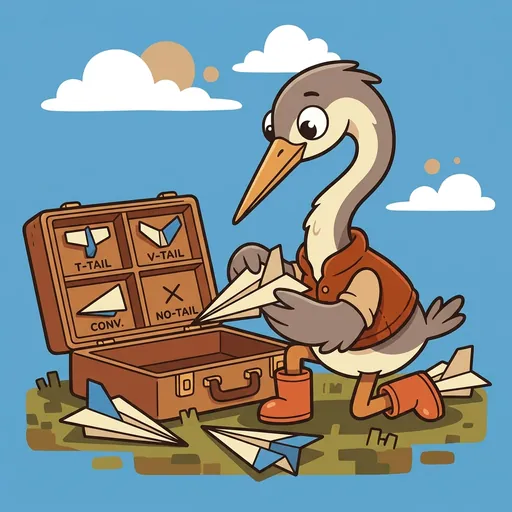
Tail
TAIL — *quiet control from the back. the tail is why your paper plane goes straight.*
Listen along — Tail
Loading audio…
Press play to listen along. The line being read lights up as you go.
Show full transcript
Loading transcript…
Chapter 5 — Tail and the Quiet Control from the Back
A crowd of young flyers had gathered in the courtyard, and a boy stood in the middle of it holding a paper plane he clearly loved.
The wings were beautiful. He’d folded them into a sharp, swept-back shape, creased them till the edges were knife-clean. He reared back and threw — and the plane leapt forward, rolled onto its side, spun twice, and smacked nose-first into the flagstones. The crowd groaned.
A small heron-tween pushed gently through them. She had a warm-grey neck and a little case tucked under one wing, and she moved the way a heron moves through shallow water — slow, careful, never a wasted step.
“May I?” she asked. She picked up his broken plane, smoothed the crumpled nose, and turned it over in her wing-tips, studying the back end. “Beautiful wings,” she said. “You spent a long time on these.”
“Forty minutes,” the boy muttered.
“And nothing here.” She tapped the flat, empty tail. “It’s all front. No tail to keep it pointing straight.” From her case she drew a little folded flap, creased it, and slotted it onto the back of his plane. Then she handed it back without another word.
He threw it again, half-expecting the same crash.
The plane glided. It cut a clean, level line clear across the courtyard and coasted down soft onto the grass. The crowd went quiet, then loud.
“I didn’t touch the wings,” Tail said gently, as the boy stared. “I just gave it something quiet in the back to steer by.”
Tail had grown up in the marsh-village, where her family made rudders.
Not planes — boats. For generations the herons of her family had shaped the long stern-rudders for the village fishing fleet, the narrow slabs of wood at the back of every boat that nobody ever looked at twice. Fishermen praised the sails. They praised the painted bows. Nobody ever said, “what a lovely rudder.”
Little Tail had asked her grandfather about that once, stung on the family’s behalf. “Nobody thanks us. They thank the sail. They thank the fast rowing.” She’d felt small and unseen, the way you feel when you’ve done real work and someone else takes the bow.
Her grandfather had only smiled and pulled the rudder off one of the boats. “Take it out on the water, then. Without this.”
She had. And the boat, for all its lovely sail and painted bow, had spun in helpless circles the moment the wind touched it. It could not go anywhere. It could only turn.
“The back of the boat,” her grandfather said when she paddled miserably back, “is the boss of going straight. The sail is why they clap. The rudder is why they arrive.” He tapped the wood. “You don’t have to be the loud one, little heron. You get to be the reason it works.”
Something in Tail’s chest unknotted. The quiet feeling of being unseen turned, slowly, into something steadier — a kind of private pride. Let them clap for the sail, she thought. I’ll be the reason it goes straight.
She walked to FlightForge at thirteen, because planes were only boats that had learned to leave the water, and they needed a back-of-the-boat too.
Skye, the mentor, met her at the gate and watched her set her little case down. “What is the tail?” Skye asked.
Tail didn’t reach for big words. She just said, “It’s the quiet control from the back. It’s why a paper plane goes straight instead of tumbling.” She paused. “The wings get the clapping. The tail does the steering.”
Skye looked at her for a long moment — at the calm, at the case of folded flaps, at a heron who plainly did not need to be the loudest one in the sky.
“You belong here,” Skye said.
Tail’s workshop was full of the same paper-plane body, over and over, with different backs.
A girl came in one morning, frustrated to tears. Her plane looped and dove no matter how she threw it. “I made the wings perfect,” she said. “Why won’t it just fly straight?”
Tail took the plane and threw it, bare. It tumbled to the floor at once. “No tail,” she said softly. “So it doesn’t know which way is forward. Watch.” She slid a small flat flap onto the back — the horizontal one — and threw again. This time the nose stopped bobbing; the plane held level and glided.
“That little back-wing pushes down just a touch,” Tail said. “It keeps the nose from tipping up and stalling. That’s your pitch — steady now.” Then she added a small upright fin. “And this one keeps the nose from swinging side to side. That’s why it goes straight instead of wandering.”
The girl threw it herself. It flew true. “That’s it?” she breathed. “That tiny piece at the back?”
“That tiny piece at the back.” Tail opened her case and laid three tails on the bench. “There’s more than one way to do it. This plain one is reliable. This one, up on top, gets cleaner air off the wing. This little V does both jobs with less to fold.” She smiled. “You don’t spend forty minutes on the wings and forget the back. You start from the back. That’s the part that decides whether all your lovely wing-work ever gets to arrive.”
That evening the girl came back, plane in hand, quieter than before.
“Everybody’s always looking at the front,” she said. “The wings. The nose. Nobody even sees the tail.” She turned it over in her hands. “Doesn’t it bother you? Doing the part nobody looks at?”
Tail thought about the rudder spinning in circles on the water, and her grandfather’s hand on the wood.
“It used to,” she said. “When I was small, I wanted the clapping.” She looked out the window toward the sky. “But then I watched a beautiful boat spin helplessly because it had no rudder. And I understood — the loud part only gets to be loud because something steady is holding it straight from behind.” She handed the plane back. “So no. It doesn’t bother me anymore. There’s a warm, settled feeling in being the reason something works — even if nobody knows it was you. Especially then.”
The girl held her plane, and Tail watched the frustration drain out of her shoulders and something calmer settle in. It was the same quiet unknotting Tail had felt on the water, years ago — the moment being unseen stopped stinging, and started feeling, instead, like a good and steady place to stand.
The FlightForge ensemble
Tail is part of FlightForge's distributed-narrative cast. Each character embodies a different curricular primitive; together they teach the full subject.
-

Wing
Lift generation — airfoil + camber + Bernoulli AND Newton both-right complementary
-

Drag
Resistance — drag isn't bad, drag is information; shape-fights-air conversation
-

Thrust
Propulsion — every engine just throws air the wrong way (propeller/jet/rocket same trick different scale)
-

Yaw
Vertical-axis control — the rudder is the POLISH on the turn not the steering