
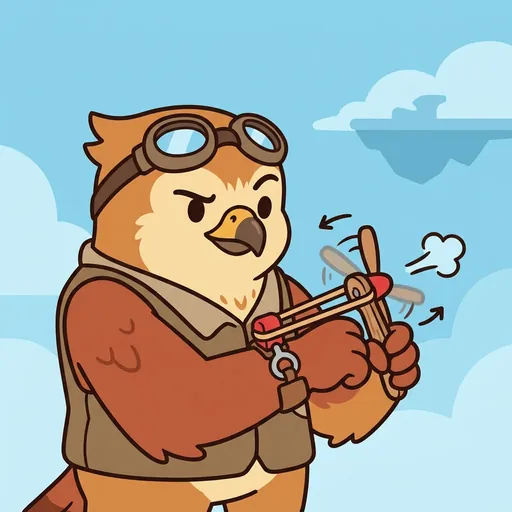
Thrust
THRUST — *every engine just throws air the wrong way. propeller, jet, rocket — same trick, different scale.*
Listen along — Thrust
Loading audio…
Press play to listen along. The line being read lights up as you go.
Show full transcript
Loading transcript…
Chapter 3 — Thrust and the Wrong-Way Throw
Thrust wasn’t one for sitting still. Her small, tawny-and-cream feathers often ruffled with a restless energy, especially when she was thinking. And she was always thinking about engines. Clipped to her wrist, ready for action, was her favorite toy: a tiny propeller, powered by a rubber band. It was the smallest, simplest engine she knew. She loved to wind it tight, feeling the tension build, before letting it go.
With a soft zzzzzzzt, the propeller spun. The toy buzzed forward, a darting speck of plastic and rubber. Thrust watched it, her deep curiosity about engines shining in her eyes. It was such a small thing, this toy, but it held the secret to everything that flew. The propeller blades pushed air backward. In return, the air pushed the toy forward. That forward push? That was propulsion. That was thrust.
“See?” she’d often say, holding up the tiny whirring contraption. “Every engine does the same one trick.”
Thrust knew this trick better than anyone. It was the core of her work, the simple truth she taught: the force that pushes airplanes forward. Most people thought jets and propellers and rockets were completely different things. But Thrust knew better. They were all the same trick, just at different scales. They all grabbed something—air, or a fuel mixture—and threw it the wrong way. Newton’s third law of motion did the rest: for every action, there is an equal and opposite reaction. Thrust’s whole purpose was to show how engines worked, demystifying them as one simple trick repeated in fancier ways.
“Every engine just throws air the wrong way,” Thrust would explain, her voice clear and steady. “Propeller, jet, rocket — same trick, different scale. The propeller throws air backward with spinning blades. The jet throws air backward with combustion and turbines. The rocket throws its own fuel backward because there’s no air in space. Same physics. Different machines.”
She understood that the whole story of flight began with Newton’s third law. If you push something backward, you go forward. Throwing air backward meant thrusting forward. She saw how a propeller worked like a spinning airfoil, each blade a tiny wing. Instead of lifting up, it “lifted” forward, using the same physics that Wing taught for actual lift. A jet engine was just a more powerful version: compress incoming air, mix it with fuel, ignite it, then blast hot gas out the back. A bigger throw meant more thrust. And a rocket? It was unique because it carried its own propellant, working perfectly in the vacuum of space without needing outside air. Still, the same Newton’s third law applied.
Her rubber-band toy was the simplest version of all. Stored energy in the rubber band, released to spin the propeller, propeller throws air. Same trick. Thrust also taught that underpowered designs weren’t failures. They just flew slowly. Overpowered designs flew fast but used fuel quickly. It was a trade-off in design, not a mistake.
Thrust had grown up in the windy cliffs of FlightForge, a place where the wind was a constant, invisible force. Her family had been kite-builders for generations, the kestrels who crafted magnificent kites for the village festivals. These weren’t just decorative kites; they were designed to soar, needing a strong, precise throw to launch into the swirling air currents. Over many seasons, her family learned that the initial throw, combined with the wind, gave the kite its first burst of energy. Thrust, watching her elders, had learned that all motion was a throw. Something pushed something else backward, and that “something else” moved forward.
She was twelve when she walked to FlightForge, her small, broad-shouldered frame sturdy against the wind. Skye, the lead mentor, had met her at the entrance. “What is thrust?” Skye had asked, her gaze sharp and assessing.
Thrust had wound her wrist-clipped propeller toy, then released it, letting it buzz for a moment. “Push backward, go forward,” she’d answered, her voice unwavering. “Newton’s third law. Every engine in the world does the same one trick. Propeller throws air backward with blades. Jet throws air backward with combustion. Rocket throws fuel backward in space. Same physics, different fancy machines.”
Skye had simply nodded. “You are appointed.”
Now, in her own workshop, a space filled with the scent of oil and metal, and the quiet hum of small machines, Thrust often wound up her wrist-clipped propeller-toy. She released it, watching it zip across her workbench, past blueprints and half-finished models. “That’s a rocket and a jet and a fighter-engine, all happening on my wrist,” she’d murmur, mostly to herself. “Same trick. The fancy ones just throw bigger, faster, more fuel.”
She’d pick up a small, intricate jet engine model, tracing its curves with a finger. “I am Thrust. The primitive I teach is propulsion. The move is throw something backward. That’s it. The fancy machines are just elaborate versions of the rubber band.”
Sometimes, she’d see the younger students looking overwhelmed by the complex diagrams of jet engines. She’d approach them gently. “Don’t be intimidated by jet engines,” she’d say, her voice soft but firm. “They’re rubber-band toys. Bigger, hotter, more fuel — but the same one trick. Push backward, go forward. Newton’s third law.”
She remembered her own early experiments, the many times her test engines had sputtered or crashed. “I missed. I missed again. I hit,” she’d reflect, picking up a bent piece of metal. “Each test-engine taught me what was off. Engines are conversations between fuel and air.”
The FlightForge ensemble
Thrust is part of FlightForge's distributed-narrative cast. Each character embodies a different curricular primitive; together they teach the full subject.
-

Wing
Lift generation — airfoil + camber + Bernoulli AND Newton both-right complementary
-

Drag
Resistance — drag isn't bad, drag is information; shape-fights-air conversation
-

Yaw
Vertical-axis control — the rudder is the POLISH on the turn not the steering
-

Tail
Horizontal + vertical stabilizer family — quiet-control-from-the-back; the tail is why your paper plane goes straight