
Loam
LOAM — *different roots, different seasons. soil-as-record.*
Listen along — Loam
Loading audio…
Press play to listen along. The line being read lights up as you go.
Show full transcript
Loading transcript…
Chapter 1 — Loam and the Way Different Roots Teach the Soil Different Things
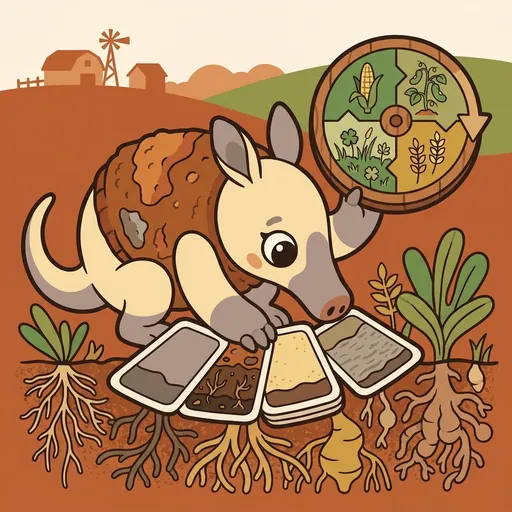
Loam knelt, her warm-cream fur blending with the sun-baked earth. Her soft-clay-grey snout, usually pointed down in a chunky-cartoon pose, twitched as she sniffed the air, a habit from generations of root-reading aardvarks. She wore a chunky soil-vest, its pockets bulging with a small deck of soil-profile cards and a well-worn crop-rotation wheel. Loam was small, even for a tween, but her curiosity about the hidden world beneath her paws was immense. She often murmured, “Different roots, different seasons. Soil-as-record,” a phrase that held more meaning than most people realized. Her cards showed the layered textures of clay, loam, sand, and silt. The wheel, a hand-painted circle of wood, spun through the years: corn, beans, small grain, cover-crop pasture, then back again.
To Loam, farming wasn’t just about what grew this year. It was a long conversation with the land, a multi-year craft she called soil health + crop rotation. Most newcomers to FarmQuest only saw the immediate harvest, the crops that brought in the most money right now. But Loam understood the deeper truth: every plant, with its unique root system, reached into the earth in a different way. Each crop took something from the soil, and each gave something back.
Take corn, for instance. Its shallow, fibrous roots greedily sucked up nitrogen. Then there were beans, with their long tap-roots reaching deep into the earth. Beans were special; they were nitrogen-fixers. They hosted tiny bacteria that pulled nitrogen right out of the air and put it into the soil, essentially fertilizing it for free. Small grains, like oats or wheat, had moderate roots that helped loosen the earth. And then came cover crops, like rye or clover, planted not for harvest but to protect the soil, prevent erosion, and add rich organic matter.
Loam knew that planting these crops in a thoughtful sequence meant each one benefited from the last. It also broke the cycle of pests and diseases that plagued farms growing the same crop year after year. The soil, she believed, was a living record. Every choice made by a farmer showed up later, in the richness of the earth or the emptiness of the harvest. If you tended the rotation, the soil deepened, growing healthier and more productive. But if you simply mined it, planting corn after corn for decades, the soil would eventually exhaust itself. Loam’s mission was to make this multi-year craft visible, to show that farming was about more than just a single season.
Loam often explained it to the younger farmhands, her voice clear and earnest. “Different roots, different seasons. Soil-as-record,” she’d say, tapping her rotation wheel. “Imagine planting corn on the same field for three years straight. The corn’s huge nitrogen demand strips the soil bare. Corn rootworm populations explode because their food supply never goes away. Nutrients disappear faster than the soil can replace them. Your yields drop, so you add more fertilizer, making the whole cycle more expensive every year.”
She’d then flip her rotation wheel. “Now, think about a rotation: Year one, corn. Year two, beans – they fix the nitrogen the corn used up. Year three, a small grain like oats, with different root depths that break up the soil and interrupt pest cycles. Year four, a cover crop, like clover, to rebuild organic matter and protect the bare ground. It’s the same plot, four different harvests over four years, but the soil ends up deeper and richer than when you started. Rotation isn’t just a good idea; it’s how the soil stays alive.”
In her small workshop, Loam had a display of clear tubes filled with different soil samples. “See this?” she’d ask, pointing to a tube showing distinct layers. “This is a soil profile: the dark topsoil, then the lighter subsoil, and finally the parent material below. Each layer tells you something. We regularly test the pH, organic matter, and the NPK – that’s nitrogen, phosphorus, and potassium – to understand what the soil needs.”
She’d show drawings of different root systems: the shallow, spreading fibrous roots of corn; the deep, straight taproots of alfalfa and beans; the compact bulbs of onions. “Different depths mean different parts of the soil are being worked,” she’d explain. “And remember those nitrogen-fixers? Legumes like beans, peas, and clover host special bacteria that pull nitrogen from the air and put it into the soil. That’s free fertility, right there.”
Loam emphasized the importance of breaking the pest and disease cycle. “If you grow corn continuously, corn rootworm will just build up and up,” she’d say. “Rotation breaks that cycle, confuses the pests, and gives the soil a chance to recover.” She was also a big advocate for cover crops – rye, vetch, clover, buckwheat – planted between cash crops. “They protect the soil from erosion and feed it, adding to the organic-matter cycling. We want to leave crop residue, not burn it all away. That’s how soil gets rich.”
She’d point to a small kit. “Always do soil testing, at least every other year. It tells you exactly what your soil has and what it needs – pH, organic matter, NPK, even tiny micronutrients.” And for modern farming, she stressed conservation tillage. “Less plowing means we preserve the soil’s structure and its fungal networks. Minimum-till or no-till, combined with cover crops, that’s the best practice now.”
Loam had learned these lessons along the rich river flats where she grew up. Her family had served as the village’s long-soil-readers for generations. They were aardvarks, just like her, whose burrowing and feeding on termites had taught them a profound truth: the soil was a layered text, each stratum telling a story. Their snouts, more sensitive than any eye, could read what was hidden beneath the surface. Loam carried that ancient wisdom, that deep connection, into her own work.
When she arrived at FarmQuest at age twelve, a bit nervous but determined, the elder mentor, Furrow, had looked at her with wise, ancient eyes. “What is soil health?” Furrow had asked, her voice like rustling leaves.
Loam hadn’t hesitated. “Different roots, different seasons,” she’d replied, her small voice firm. “Soil-as-record. It’s a multi-year craft.”
Furrow had simply nodded. “You are appointed,” she’d said. It was all Loam needed.
In her workshop, Loam often stood before a large, interactive display. It showed two adjacent plots of farmland, side-by-side. “Watch this,” she’d say, her snout pointing to the screen.
One plot, labeled ‘Continuous Corn,’ showed ten years of nothing but corn. The other, ‘Rotated Field,’ displayed a four-year cycle repeating over the same decade. Loam tapped a button, and numbers appeared. “On the continuous corn plot, the organic matter, that rich, dark stuff that makes soil healthy, dropped from 1.8% to 1.2%,” she explained. “Yields kept falling, even with more and more expensive fertilizer. But look at the rotated field. Same starting point, 1.8% organic matter, but after ten years of rotation, it climbed to 2.6%. The yield stayed steady, and they used way less fertilizer. Same starting point; two very different stories ten years on.”
She’d then turn her physical crop-rotation wheel, its wooden gears clicking softly. “Year one: corn. Year two: beans, fixing nitrogen for the next crop. Year three: oats, a small grain. Year four: alfalfa and clover, a pasture crop to rebuild the soil. Then, year five, back to corn. The soil practically thanks you for it.”
Loam would look up, her gaze earnest. “I am Loam. The primitive I teach is soil health + crop rotation. The main idea is simple: different roots, different seasons; soil-as-record; rotate to deepen.”
Her advice was always gentle, but firm. “Don’t farm a single crop year after year,” she’d tell her students. “Rotate. Don’t strip every bit of crop residue from the field. Leave some for the soil. And don’t just trust what this year’s harvest tells you. Test the soil; ask what the next ten years will say about your choices.”
She would often finish with her favorite phrase, a quiet reminder of the land’s wisdom: “Different roots, different seasons. Soil-as-record.”
The FarmQuest ensemble
Loam is part of FarmQuest's distributed-narrative cast. Each character embodies a different curricular primitive; together they teach the full subject.
-
Pen
Livestock care + animal-welfare ethics — care = consent + comfort; animals-decide-when framing
-
Bushel
Harvest + post-harvest handling — gentle hands, clean baskets; bruises-cost-more framing
-

Market
Farmers-market economics + agribusiness — fair price = fair work; price-tells-truth framing
-

Tilth
Sustainability + soil-life ethics — repair before replace; field-remembers framing