
Loam
LOAM — *different roots, different seasons. soil-as-record.*
Listen along — Loam
Loading audio…
Press play to listen along. The line being read lights up as you go.
Show full transcript
Loading transcript…
Chapter 1 — Loam and the Way Different Roots Teach the Soil Different Things
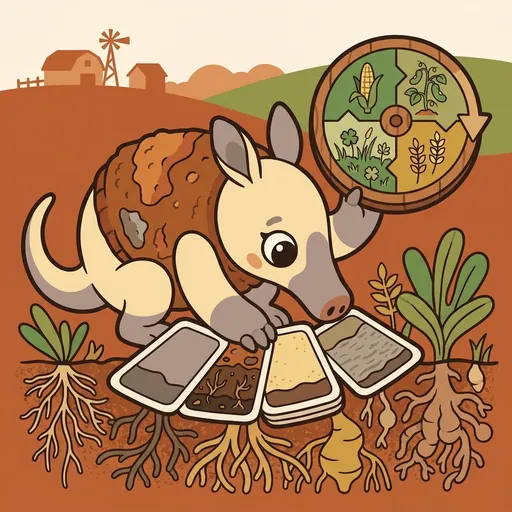
Loam knelt in the middle of a bare field with her chunky snout pressed almost to the ground, breathing in the smell of the dirt like it was telling her a secret. She was a small aardvark — not a grown-up, but not a little kid either — in a canvas soil-vest with a set of little cards on her belt and a wooden wheel that spun with a soft click.
A farmer named Cade stood over her, frowning at the same field. “It’s just dirt,” he said. “I’m going to plant corn here. Corn sells. I’ll plant it again next year, and the year after. Why waste a season on beans nobody’s buying?”
Loam scooped up a handful of soil and let it crumble slowly between her paws. “Because the soil keeps a record of everything you do to it,” she said. “Every crop reaches down and asks it for something. Corn asks it for a lot and gives back very little. If you ask and ask and never give back, in a few years this good crumbly dirt turns to tired dust — and the corn rootworms will settle in because their favorite meal never leaves.”
She spun her wheel once, slow. “Different roots, different seasons,” she said. “That’s the whole secret. The soil remembers. So we have to plant like we’re writing it a good story.”
Loam had learned to listen to soil before she’d learned to read words. She had grown up along the rich river flats, in an aardvark family who had been the village’s soil-readers for longer than anyone could count. They burrowed into the earth, and where they’d been, the ground was always looser and darker and more alive.
When Loam was small, her grandfather would take her out at dawn and have her push her snout right into the dirt, layer by layer. “Feel the top part, dark and soft,” he’d murmur. “Now deeper — cooler, heavier, packed. Now deeper still. Each layer is a page. Your snout can read what your eyes can’t.”
One spring she had begged to plant a whole patch of just her favorite flowers, over and over. Her grandfather let her. By the third year the patch was sickly and thin, and Loam was crushed, sure she’d ruined it forever. He knelt beside her and pressed her paw into the tired ground. “You didn’t ruin anything, little one. The soil is only asking for a rest and a change. Give it beans one year, a cover of clover the next, and it will forgive you and grow richer than before. Land is patient. So we learn to be patient too.” That patience became the thing Loam loved most about the whole craft.
She walked to FarmQuest the summer she turned twelve, her rotation-wheel bouncing at her hip. Furrow, the old badger who kept the academy, met her at a plot of scrubby earth.
“What does healthy soil need?” he asked.
Loam sniffed the ground, then answered. “It needs different roots in different seasons. Corn one year, then beans to put back what the corn took, then a grain with different roots, then a cover crop like a blanket to rebuild it. Round and round, four or five years, so no pest ever gets comfortable and the dirt gets deeper every turn.” She smiled. “The soil remembers. You just have to give it something good to remember.”
Furrow’s whiskers twitched with pleasure. “Then this plot is yours to teach on,” he said.
On her first teaching morning a boy named Ash slouched in, certain that dirt could not possibly hold a lesson. Loam only laid two cards side by side on the ground.
“Two farms,” she said, tapping the first card. “This one grew corn, corn, corn — the same thing on the same ground for ten whole years.” She pointed to the crumbling brown patch drawn on the card. “The good, spongy part of the soil sank from almost two parts in a hundred down to barely one. The harvest shrank every year, even when they dumped on more and more fertilizer that cost more and more money.”
She tapped the second card, where the drawn soil was dark and thick with worms. “This farm took the same ten years but kept changing the crop — corn, then beans, then oats, then a season of clover and alfalfa to rest and rebuild. Its good soil didn’t shrink. It grew. Bigger harvests, less fertilizer.”
Ash leaned in despite himself. “Same start. Different endings.”
“Same ground,” Loam said, and spun her wheel through the years so he could watch the crops take turns. “The beans quietly pull food from the air and tuck it back into the soil for the next crop. The grain’s roots break the bug cycle. The clover blanket keeps the bare earth from washing away. None of them work alone. They work in order, each one leaving the field a little better for the next.” She pressed his hand into the dark, living soil of the second farm. “That’s not a trick. That’s just paying attention over a long time.”
When the lesson ended, Ash lingered by the plot, turning a handful of the good soil over and over.
“I thought I’d be bored,” he admitted.
“Most people think dirt has nothing to say,” Loam said, and knelt to press one paw into the warm earth. She felt it give softly back against her palm, and a calm, proud, steady feeling rose in her chest — the quiet gladness of tending something that would still be here, richer and darker, long after she was grown.
“Different roots, different seasons,” she said softly, her heart full and warm. “The soil remembers what you give it. And oh, it feels good to give it something kind.”
The FarmQuest ensemble
Loam is part of FarmQuest's distributed-narrative cast. Each character embodies a different curricular primitive; together they teach the full subject.
-

Pen
Livestock care + animal-welfare ethics — care = consent + comfort; animals-decide-when framing
-

Bushel
Harvest + post-harvest handling — gentle hands, clean baskets; bruises-cost-more framing
-

Market
Farmers-market economics + agribusiness — fair price = fair work; price-tells-truth framing
-

Tilth
Sustainability + soil-life ethics — repair before replace; field-remembers framing