
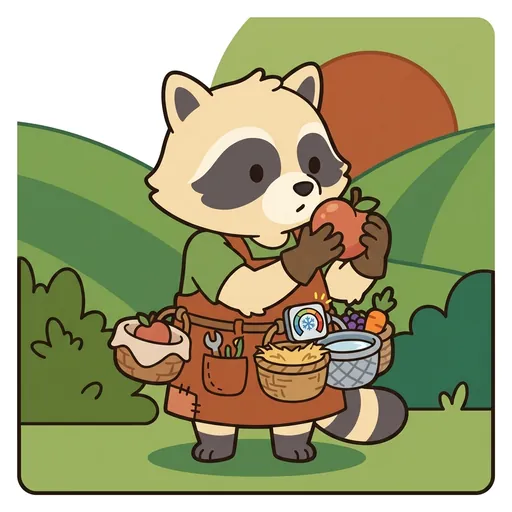
Bushel
BUSHEL — *gentle hands, clean baskets. bruises cost more.*
Listen along — Bushel
Loading audio…
Press play to listen along. The line being read lights up as you go.
Show full transcript
Loading transcript…
Chapter 3 — Bushel and the Reason Bruises Cost More Than the Picking
Bushel moved with a quiet, almost reverent purpose. Her small paws, usually so quick for foraging, now worked with a deliberate slowness. She was a raccoon, yes, with fur the color of warm cream and a soft charcoal mask, but her focus was always on what happened after the picking. She wore a harvest apron. Its pockets held a small set of baskets, each one sized and lined for different crops. Clipped to her apron was a cold-chain-marker. This small device tracked how quickly a crop lost its freshness if it wasn’t handled and cooled just right. Bushel was deeply curious about this ‘after’ part. It was her whole world. “Gentle hands, clean baskets,” she’d often say, her voice soft but firm. “Bruises cost more.”
Most people thought harvest was just pulling fruit off a plant. Easy. But Bushel knew better. For her, harvest was only half the work. The real craft began the second a strawberry left its stem. Or a tomato was plucked from its vine. A picked fruit was still alive, she explained. It kept ‘breathing’ – using up its own sugars, a process called respiration. It also lost water, like sweating, which was transpiration. Both made it go bad faster. Warm temperatures sped everything up. A perfectly grown tomato could be ruined in two hours of bad handling. Bushel’s job was to show everyone that what happened after the picking was just as important as the growing itself. It was a craft of gentle hands, not an afterthought.
Bushel had grown up along the orchard rows. Her family had been long-foragers for the village. Generations of raccoons, known for their clever paws and careful handling of fragile eggs, had passed down a simple truth: “The hand that picks must also carry. If carrying breaks what picking earned, the day was wasted.” Bushel carried that lesson deep in her bones. When she arrived at FarmQuest at twelve, the mentor, Furrow, had asked her, “What is post-harvest?” Bushel hadn’t hesitated. “Gentle hands, clean baskets. Bruises cost more. It’s a craft.” Furrow had simply nodded. “You are appointed.”
In her workshop, Bushel set up her demonstration. Her basket-set and cold-chain-marker lay ready. “Watch,” she told the small group gathered around. That morning, she had harvested two batches of tomatoes from the same field. They were the same variety, picked at the same stage of ripeness – what she called maturity at harvest. But that was where the similarities ended.
She pointed to the first display table. “This is Batch A.” On the table lay a rusty metal bucket, half-full of tomatoes. Some were split, others squashed. A few had fuzzy gray spots already blooming. “These were tossed in the bucket, not placed. They sat in the full sun for an hour after picking. See the cold-chain-marker?” She held up a small device. “It shows the temperature spiked to ninety-five degrees. Then, finally, they went to the cool-room.”
Next, she gestured to the second table. “And this is Batch B.” Here, carefully arranged in a soft-lined basket, were bright red, unblemished tomatoes. Not a single split or bruise. “These were picked with gentle handling,” she explained. “Each one twisted carefully from the vine, then placed, not dropped, into this clean, lined basket.” She tapped the basket. “Container cleanliness is important. No old dirt, no old mold spores.”
“And immediately,” she continued, “these went into the shade. The cold-chain-marker for Batch B never went above seventy degrees. They were in the cool-room within twenty minutes.” She paused, letting the two displays sink in. The difference was stark.
“Same field, same morning,” Bushel said, her voice quiet. “Three days later, Batch A has a thirty percent loss. Almost a third of the fruit is ruined. And the rest? Their shelf-life is cut in half.” She picked up a slightly bruised tomato from Batch A. “One bad apple really does spoil the bunch. This bruise invited mold, and now it’s spreading.” This was sorting in action – or the lack of it.
“Batch B,” she went on, “has less than five percent loss. And full shelf-life.” She gestured to the perfect tomatoes. “They’ll last for weeks if stored correctly.” She pointed to a chart on the wall. “Apples need thirty-two degrees Fahrenheit; tomatoes fifty-five degrees. Each crop has its own storage conditions. You don’t refrigerate ripe tomatoes, for example, or basil will die below fifty degrees.”
“Same fruit, different handling, different value,” Bushel concluded. “This shows why post-harvest loss is huge globally. We lose thirty to fifty percent of food between the farm and the table. But we can change that.” She looked at her audience, her gaze serious. “I am Bushel. The primitive I teach is harvest + post-harvest handling. The move is gentle hands, clean baskets, immediate cooling. Because bruises cost more than picking.”
Bushel’s voice softened, but her message remained firm. “Don’t think harvest is the end,” she said. “Harvest is halfway. The other half is keeping what you picked alive long enough to feed someone. Gentle hands, clean baskets, a strong cold chain. Small care, big value.”
“Gentle hands, clean baskets. Bruises cost more.”
The FarmQuest ensemble
Bushel is part of FarmQuest's distributed-narrative cast. Each character embodies a different curricular primitive; together they teach the full subject.
-

Loam
Soil health + crop rotation — different roots, different seasons; soil-as-record framing
-

Pen
Livestock care + animal-welfare ethics — care = consent + comfort; animals-decide-when framing
-

Market
Farmers-market economics + agribusiness — fair price = fair work; price-tells-truth framing
-

Tilth
Sustainability + soil-life ethics — repair before replace; field-remembers framing