Phase
ECOLOGICAL SUCCESSION — *ecosystem change over time* (primary → secondary → climax community). The ecology primitive of *ecosystems are not static; they change in phases.*
Press play to listen along. The line being read lights up as you go.
Show full transcript
Loading transcript…
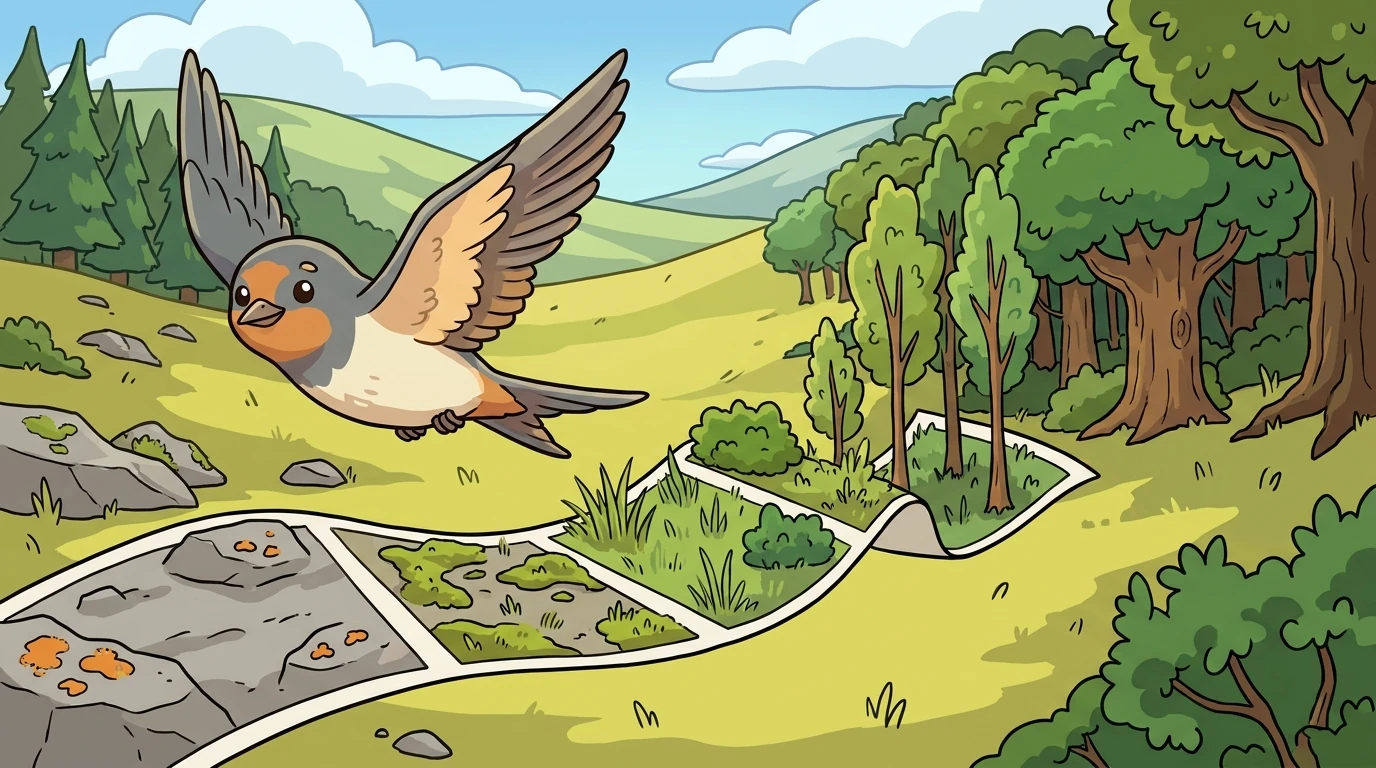
Phase was a young swallow. She was small and quick. Her feathers were grey, cream, and warm orange-brown. She had bright eyes that noticed every little change. In her wing-pocket, she kept a folded paper strip. When she unfolded it, it was several feet long.
The strip showed the exact same valley, but at different times. Each drawing was two hundred years apart.
The first panel showed bare rock. The next showed lichens. Then came moss, then grass, then bushes. After that came young trees, and finally a deep, old forest.
Phase loved to unfold this strip for her students. She did it slowly, one panel at a time.
"Look," she would whisper. "The same place becomes different things."
This was her special skill. Phase taught *succession*. That is the way an ecosystem changes naturally over time. It does not stay still. It is always moving. It moves slowly, over hundreds of years, but it never stops.
Imagine a glacier melts and leaves behind bare rock. First, lichens arrive. Lichens are crusty little plants that can grow on hard stone. They slowly break the rock down into thin soil. Next, moss grows. It makes the soil deeper. Then, grass seeds blow in and take root. Their roots hold the soil in place. Soon, bushes grow and make shade. Young, fast-growing trees sprout in the shade. Finally, slow-growing, strong trees take over.
This whole process is called *succession*. It takes centuries. It does not happen in a day. But it always happens.
Phase always made one thing very clear. Change is not a bad thing.
"Ecosystems change in phases," she told her class. "The forest you see today was once a meadow. The meadow was once bare rock. Change is not loss."
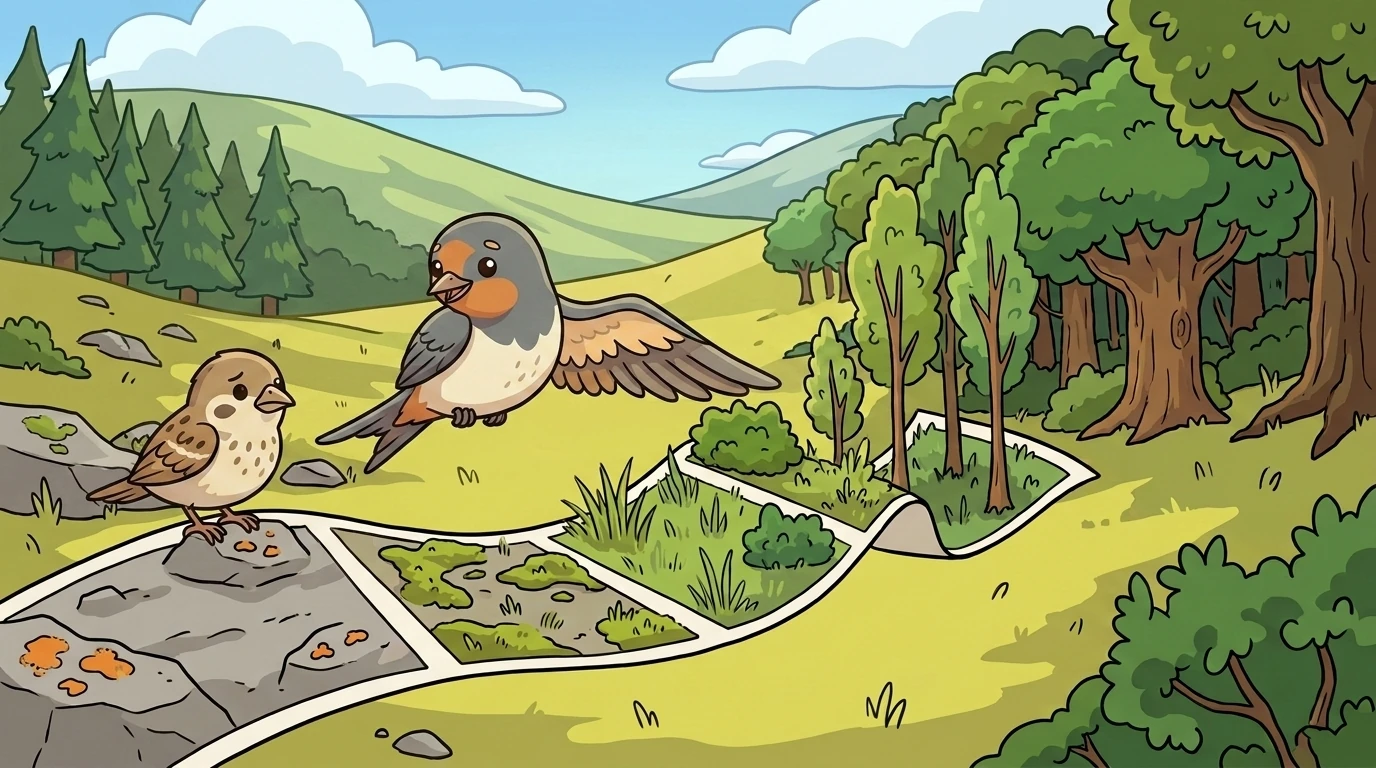
She looked at a student who was frowning.
"Each phase is whole," Phase said gently. "The meadow is not a failed forest. The meadow is just a meadow. The bare rock is not a failed meadow. It is just bare rock. Each step is exactly what it is supposed to be."
This was important. Many kids think an ecosystem must stay the same forever. They feel sad when a meadow turns into a forest. But Phase showed them that change is natural. It is not a sad ending. It is just a new chapter.
She taught natural change. Her friend Brink taught a different kind of change. Brink taught what happens when humans damage a forest, or when a sudden disaster strikes. Brink's changes are fast and messy. Phase's changes are slow, natural, and healthy.
Phase grew up in a tiny village. Her family had been the village swallow-watchers for generations. They kept track of the birds coming and going each year. Some years the swallows arrived early. Some years they arrived late. Some years there were many birds, and some years only a few.
This job required patience. You had to watch the years go by to see the patterns. By the time Phase was six years old, she knew a secret.
"Ecosystems are like rivers, not lakes," she told her mother.
She meant they were always moving. A lake just sits there. A river flows and changes. The changes were part of the place. They were not mistakes.
When Phase was twenty-two, she walked to the EcoSphere Academy. She wanted to teach.
The head of the school, Terra, met her at the gate.
"What is *succession*?" Terra asked.
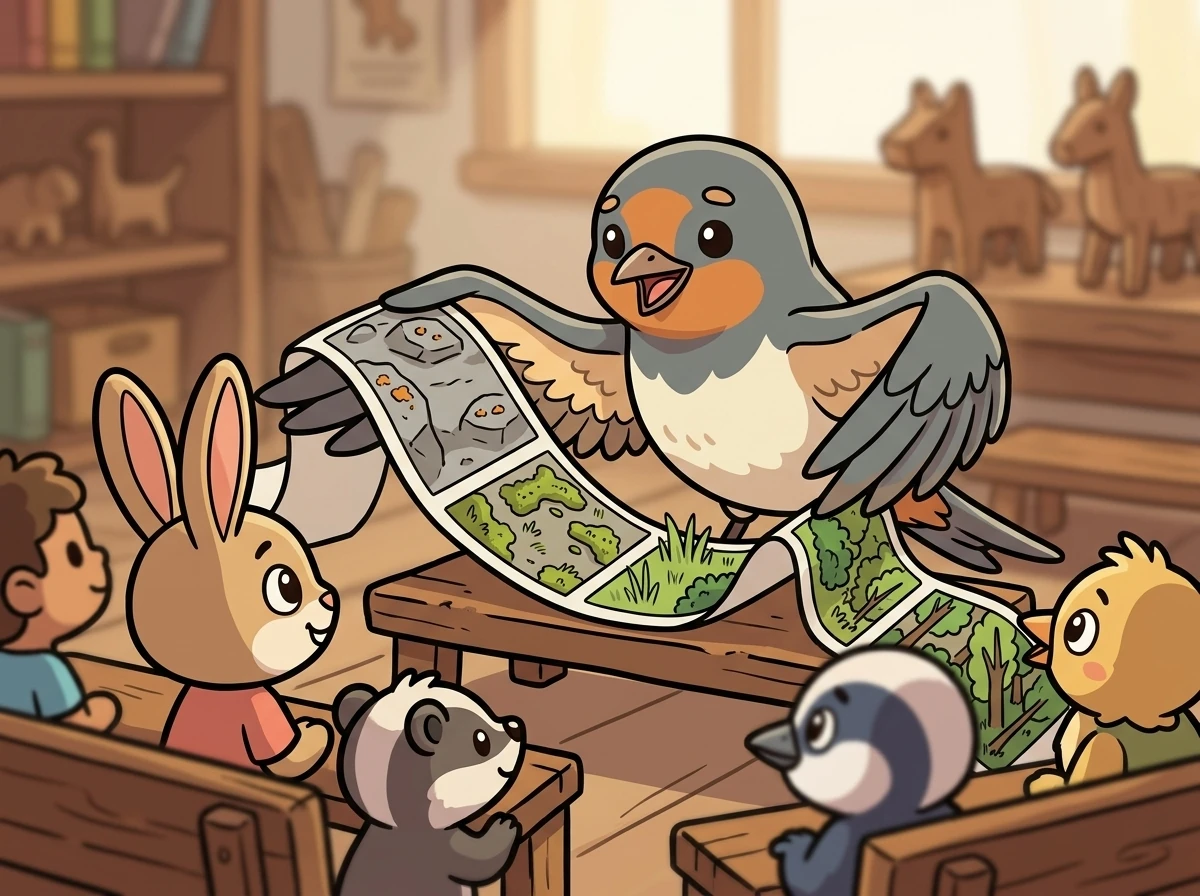
Phase pulled the paper strip from her wing-pocket. She unfolded it on the grass.
"It is how an ecosystem changes over time," Phase said. "The forest was once a meadow. The meadow was once rock. Rock leads to lichen, then moss, then grass, then trees. Change is not loss. Every step is whole."
Terra smiled. "You are hired," she said.
Now, Phase stood in her workshop. A group of young students sat on wooden benches.
Phase reached into her wing-pocket. She pulled out the folded paper strip.
She unfolded the first panel. It showed a grey, empty mountain.
"I am Phase," she said. "We are going to learn about *succession. Our main tool is to trace the phases*. That means we follow the steps of change."
She unfolded the next panel. Green spots appeared on the grey rock.
"Look closely," Phase said. "What do you see?"
"It looks like green crust," a young rabbit student said.
"Those are lichens," Phase said. "They are the pioneers. They make the soil."
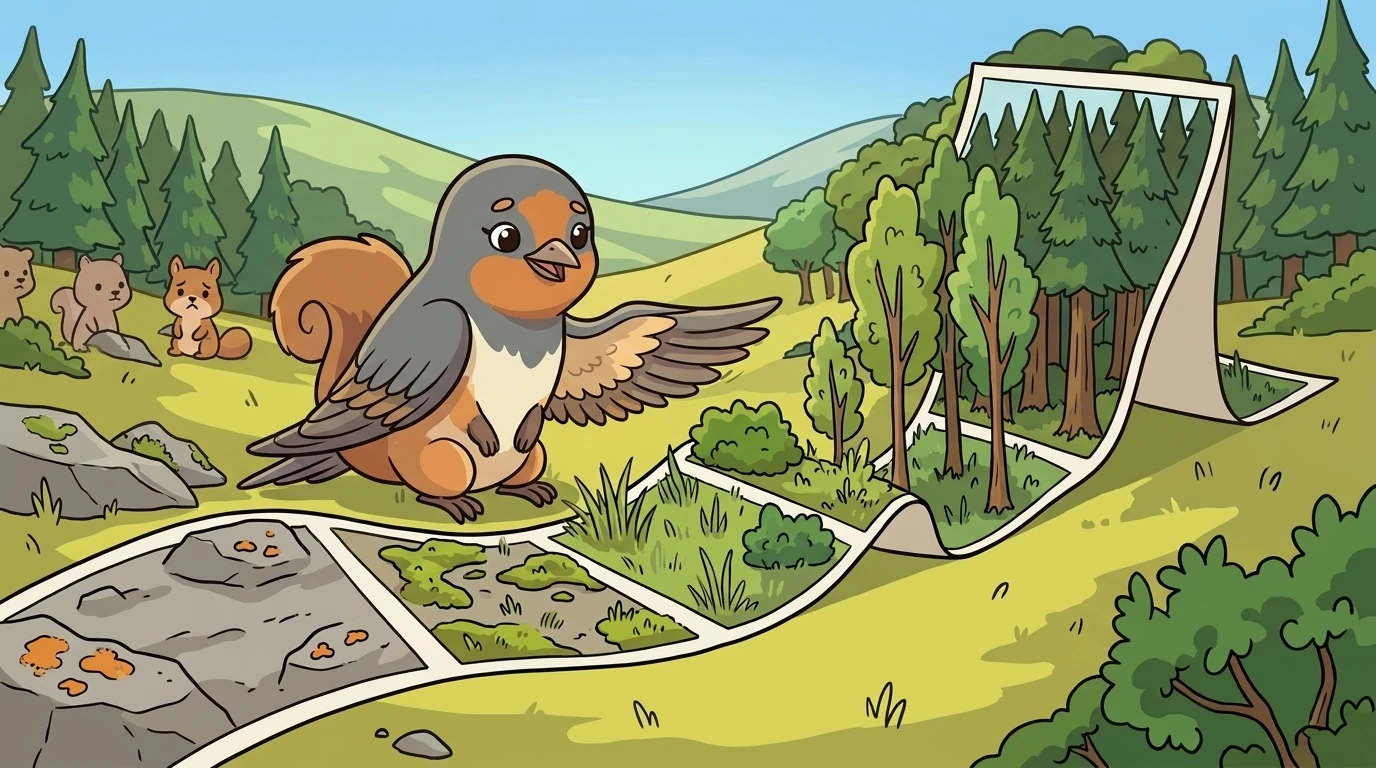
She unfolded the third panel. Soft green moss covered the ground.
"Now the soil is deeper," Phase explained.
She unfolded the fourth panel. Tall grass waved in the wind.
"A meadow!" a student cheered.
But when Phase unfolded the fifth panel, bushes grew. By the seventh panel, tall pine trees blocked the sun.
A young squirrel in the front row looked sad. "But I liked the meadow," he whispered. "The meadow is gone now. Is it lost?"
Phase knelt down so she was eye-to-eye with the squirrel.
"The meadow is not lost," Phase said softly. "The meadow did its job. It helped the trees grow. Now the forest has a new job. Change is not loss. Each phase is beautiful."
The squirrel looked at the tall trees, then at the meadow panel. He nodded slowly.
Phase taught her students how to study any ecosystem. She gave them these steps:
First, *identify the current phase*. Look around you. What stage of change is this place in? Is it bare rock? Is it a young grassland? Or is it an old forest?
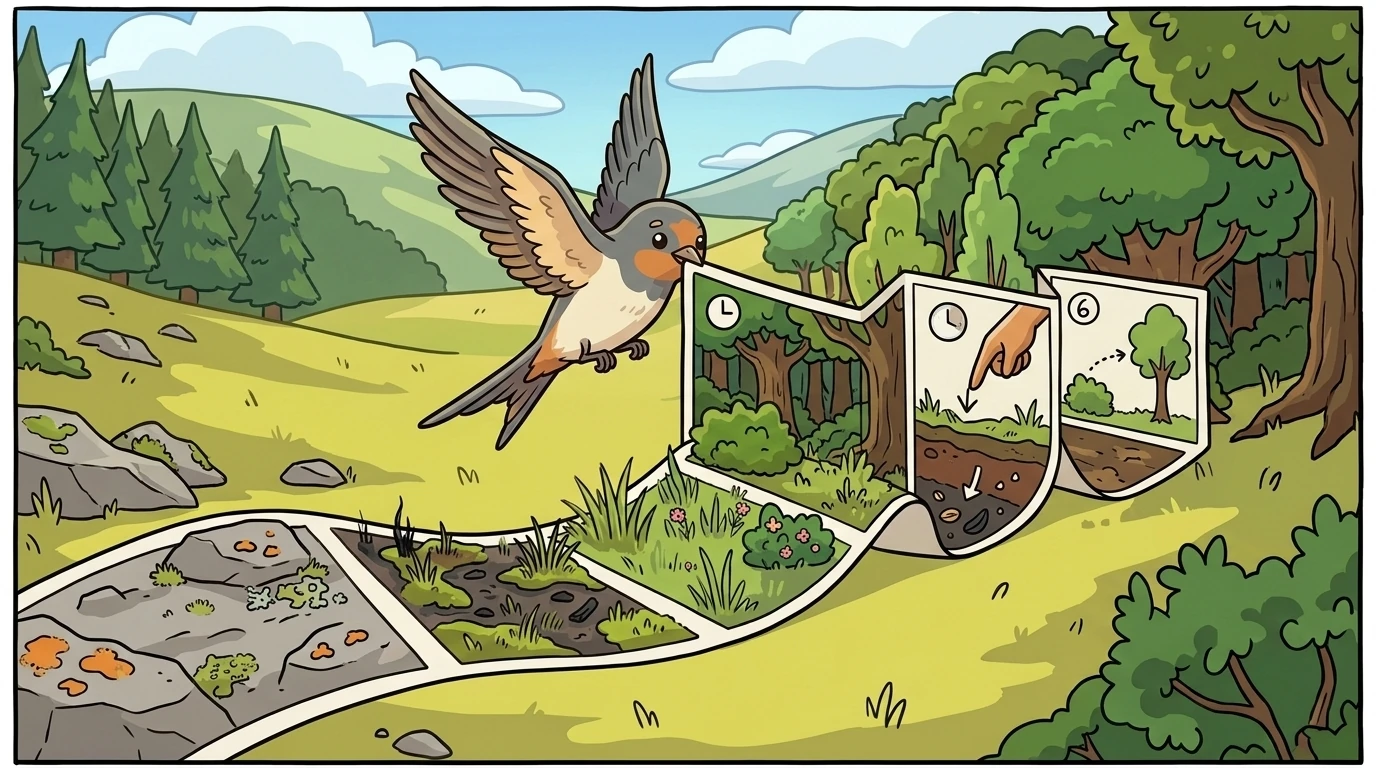
Second, *look backward through time*. What used to be here? You can find clues in the dirt. Deep soil means plants have been here a long time. You might find old seeds or charcoal from an ancient fire.
Third, *look forward through time*. What will this place become next? If nothing disturbs it, what will grow here in fifty years?
Fourth, know the difference between *primary succession and secondary succession. - Primary succession is when life starts from nothing. It begins on bare rock with no soil at all. It is very slow. It needs lichens and moss to grind up the rock and make dirt first. - Secondary succession* is much faster. It happens after a disaster, like a fire or a storm. The plants are gone, but the rich soil is still there. Seeds are already hiding in the dirt, waiting to grow.
Fifth, find the *climax community*. This is the final, stable stage of the ecosystem. It is an old, strong forest or a steady grassland. It can stay this way for a very long time, unless a big storm or fire resets it.
Sixth, remember that *each phase is whole*. Do not treat a young grassland like a broken forest. The grassland is perfect just the way it is.
Seventh, separate *natural succession from external disturbance*. Natural change is slow and comes from inside the ecosystem. External disturbances are fast, sudden events from the outside. A wildfire or a bulldozer is a disturbance. That is Brink's area of study. Phase teaches the quiet, natural steps.
Sometimes a student would still feel a little sad. They did not want the meadow to change.
"Is it hard to watch things change?" they would ask.
Phase always gave them the same gentle answer.
"It is not hard," she said. "We just *trace the phases*. Ecosystems change. Each phase is whole. Change is not loss."
She slowly folded the paper strip back up. She slipped it into her wing-pocket.
The next panel was waiting for tomorrow.
The EcoSphere ensemble
Phase is part of EcoSphere's distributed-narrative cast. Each character embodies a different curricular primitive; together they teach the full subject.