Niche
ECOLOGICAL ROLE — *every species has a job, and the ecosystem holds together by the jobs fitting together.* The ecology primitive of *what-an-organism-does in the system.*
Press play to listen along. The line being read lights up as you go.
Show full transcript
Loading transcript…
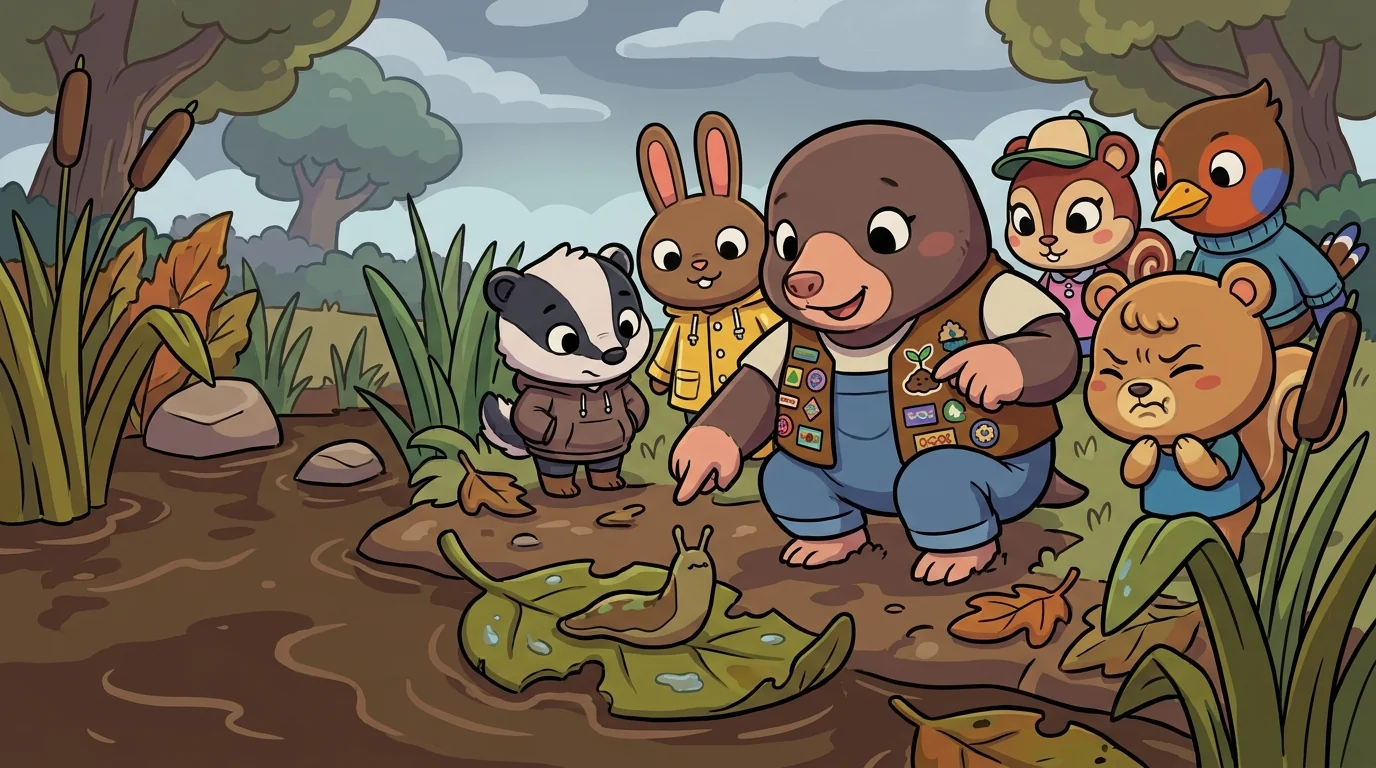
At the edge of a muddy pond, a mole-tween in a crowded little vest crouched down and pointed at a slug.
"That one," said Niche. "Watch what it does."
A cluster of students leaned in, and one of them wrinkled his nose. The slug was doing nothing anyone could see — just sliding across a wet, half-rotted leaf, slow as a minute hand. It was not a heron. It was not an otter. It was a slug on a leaf.
"It's eating the leaf," Niche said. "The old, dead one. It chews it small, then leaves the crumbs behind, and the crumbs sink into the soil and feed the next leaf that grows. That's its work. Nobody hired it. Nobody thanked it. It just does the job."
She tugged her vest straight. It was covered in small embroidered labels, dozens of them, each one naming something a creature could do in a place like this — one said the word for pollinator, another for scavenger, others crowded together too small to read from far. When she found the label that matched, she tapped it, gently, like touching a name on a list.
"Decomposer," she said, tapping. "This slug. And a soil-feeder too." She tapped again. "Two jobs, at least, from something you almost stepped on."
The boy who had wrinkled his nose said, "But it's gross."
"Sure," Niche said, easy about it. "Gross is allowed. Gross has nothing to do with it." She looked back at the slug, warm behind her round little spectacles. "Ask the pond if it wants the slug. The pond doesn't care whether the slug is cute. The pond cares whether somebody is turning the dead leaves back into dirt. Somebody is. It's this one."
The slug reached the far edge of the leaf and kept going, unhurried, doing its quiet job in a world that had never noticed.
Niche had grown up in a village where nobody's work went unnoticed, and for a long time she'd thought that was simply how the whole world was.
Her family kept the job-board — a big wooden wall in the village square where every person's work was written down. The rope-maker. The well-digger. The one who cooked the festival soup. The one who swept the schoolhouse. Each name, each job, chalked up plainly so everyone could see who held which piece of the village together.
The night she understood it, she was six. A storm had knocked out the lamps, and the lamp-tender was sick in bed. Nobody had thought about the lamp-tender before — she was old, she was quiet, she lit the lamps and went home. But that dark, stumbling night, with people tripping in the square and a child crying somewhere she couldn't be found, Niche felt something turn over in her chest. It wasn't fear exactly. It was the sudden, dizzy sense of a hole — a job nobody was doing, and everything sagging into the gap.
"She matters," Niche said to her father, meaning the lamp-tender, and her voice came out fierce and surprised.
"She always did," her father said. "You just couldn't see it until she stopped."
Niche never forgot the feeling — that the smallest, most invisible worker was holding up a corner of everything, and you only felt the corner when it dropped. She started reading the job-board differently after that. Not looking for the important names. Looking for the jobs, all of them, especially the ones too easy to overlook.

She came to the EcoSphere academy when she was grown, still wearing the vest she'd started embroidering as a girl.
Terra, who welcomed the newcomers, asked her a single question at the gate. "What is an ecological niche?"
Niche didn't rush. She thought about the lamp-tender, and the slug she'd watched that morning on the walk over.
"It's what a creature does in its home," she said. "Every one of them has at least one job. Lots of them have more than one. And the whole place holds together because the jobs fit against each other — the bee feeds the flower and the bird and itself, all at once." She held her vest open. "So when I meet a new species, I don't ask if it's grand. I ask what it does. Then I find its label."
Terra looked at the crowded vest for a moment, at all those small stitched jobs. "Stay," she said. "We need you here."
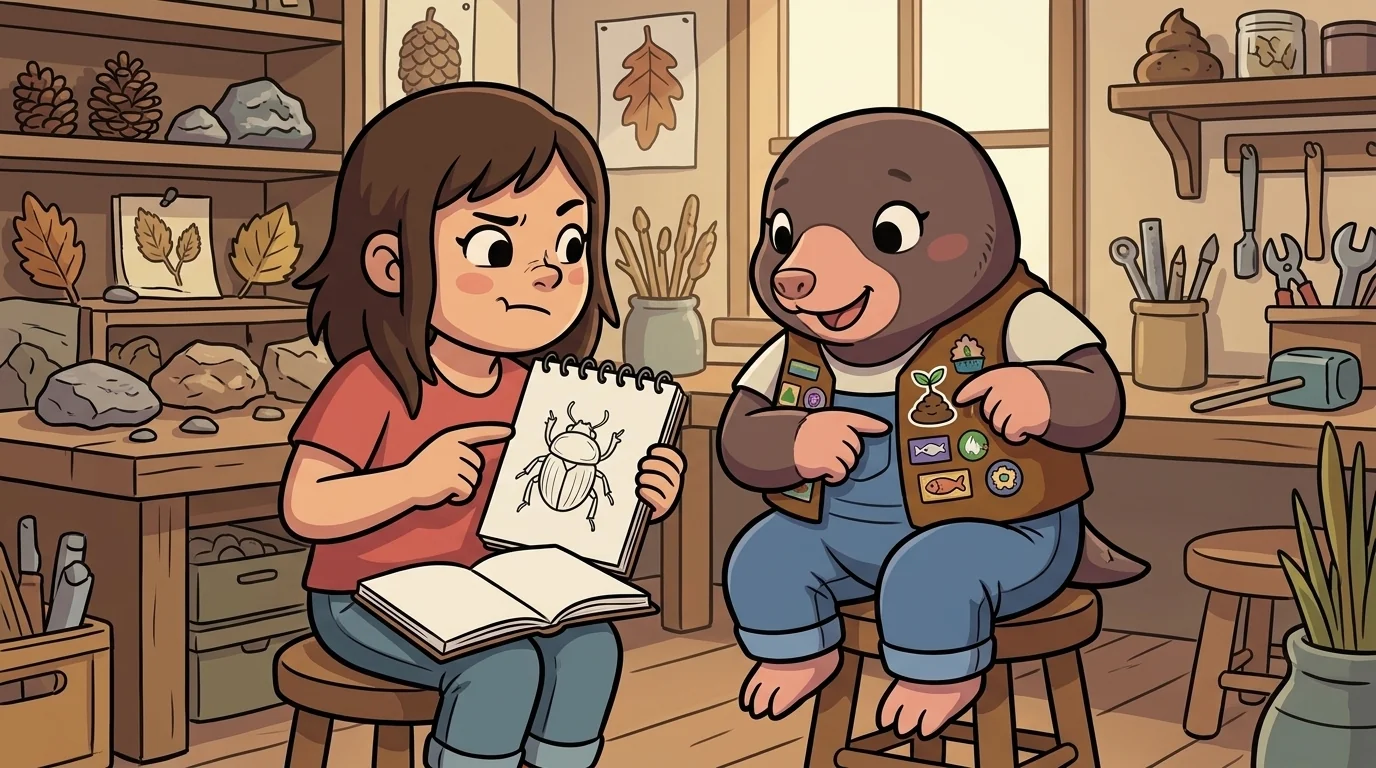
A girl came to Niche's workshop one afternoon convinced she'd been given a boring animal to study. She dropped her notebook on the bench with a sigh. "A dung beetle," she said. "I got a dung beetle. Everyone else got wolves and eagles."
Niche didn't argue. She pulled a stool over and sat beside her. "Tell me the obvious thing it does."
"It rolls dung." The girl made a face. "That's the whole thing."
"That's the first thing," Niche said. "Roll the dung where?"
"Into the ground."
"And what happens to the ground where the dung goes?"
The girl paused. "...It gets — better? The plants like it?"
"The plants love it. So now your beetle is a — " Niche tapped a label on her chest — "fertilizer-spreader. That's two jobs." She leaned in. "And when it buries the dung, what stops living up on the surface where the dung used to sit?"
"...Flies?" the girl said slowly. "The flies don't get to breed in it?"
"Fewer flies. Fewer sick animals." Niche smiled. "So it's a bit of a doctor too, your beetle. Three jobs, and we're only warming up. Take away every dung beetle from a grassland, and the grass chokes under its own waste and the flies swarm and the whole field turns sour." She let that sit. "Now. Say that word 'boring' again for me."
The girl looked down at her notebook, and Niche watched something shift in her face — the exact turn she remembered from a dark village square long ago, the moment a nothing becomes a something.
"It's not boring," the girl said quietly. "I just couldn't see it yet."
"Nobody can, at first," Niche said. "That's the whole skill. You keep looking until the invisible work shows up. It's always there. Somebody's always holding a corner."
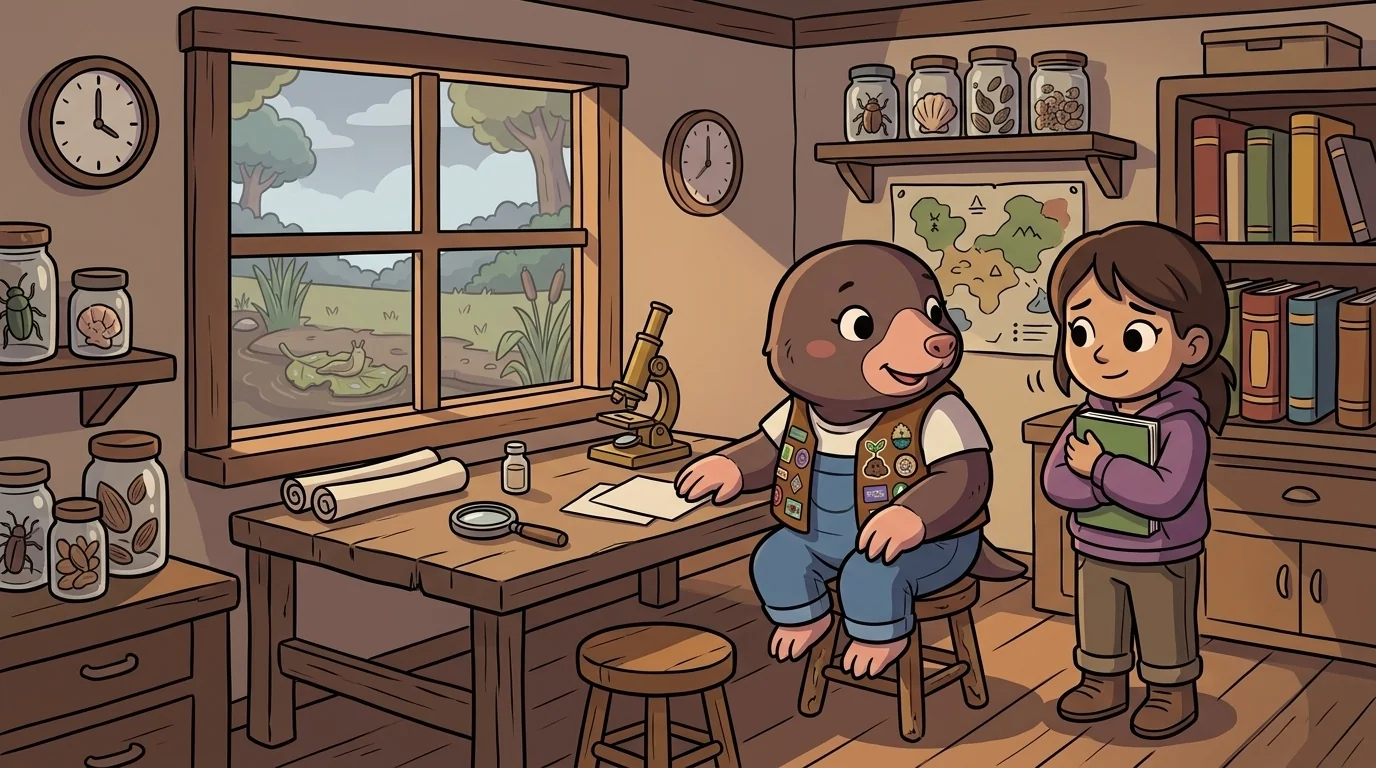
Later, when the workshop had emptied, the girl came back with her notebook hugged to her chest and one more thing to say.
"I keep thinking about it," she said. "How the beetle does all that, and it never knows. It just… does it. And nobody ever thanks it."
Niche pulled her stool back over and sat.
"I know," she said. "I used to think that was sad. The unthanked ones." She was quiet a moment. "But it's not, really. The beetle doesn't need thanking to matter — it matters the second it starts working, whether or not a single soul is watching." She looked toward the window, toward the muddy pond and the slug still out there somewhere. "That's the part I love most, if I'm honest. That a small, overlooked thing can be holding up its whole corner of the world, quietly, all by itself, and never once ask to be seen."
The girl nodded, hugging her notebook tighter.
And Niche felt it settle in her chest again — the old, warm ache she'd carried since she was six: not pride, not quite. Something gentler. The steady comfort of knowing that nothing, and no one, is ever really as small as it looks.
The EcoSphere ensemble
Niche is part of EcoSphere's distributed-narrative cast. Each character embodies a different curricular primitive; together they teach the full subject.