
Predict and Check
PREDICT-OBSERVE — *say what you think will happen before you look, then look and compare.* The inquiry primitive of the prediction loop — committing a guess out loud first (so the looking has something to test), then checking it against what actually happened.
Press play to listen along. The line being read lights up as you go.
Show full transcript
Loading transcript…
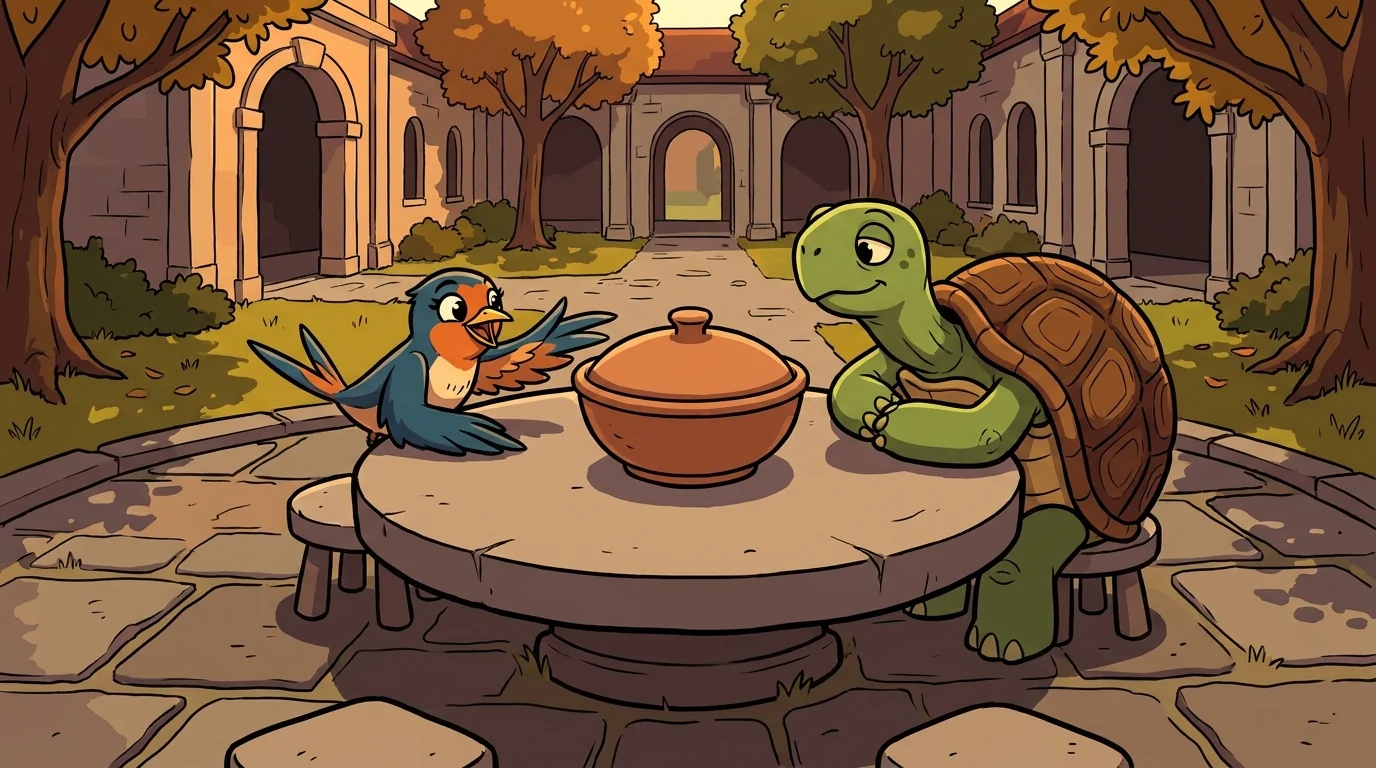
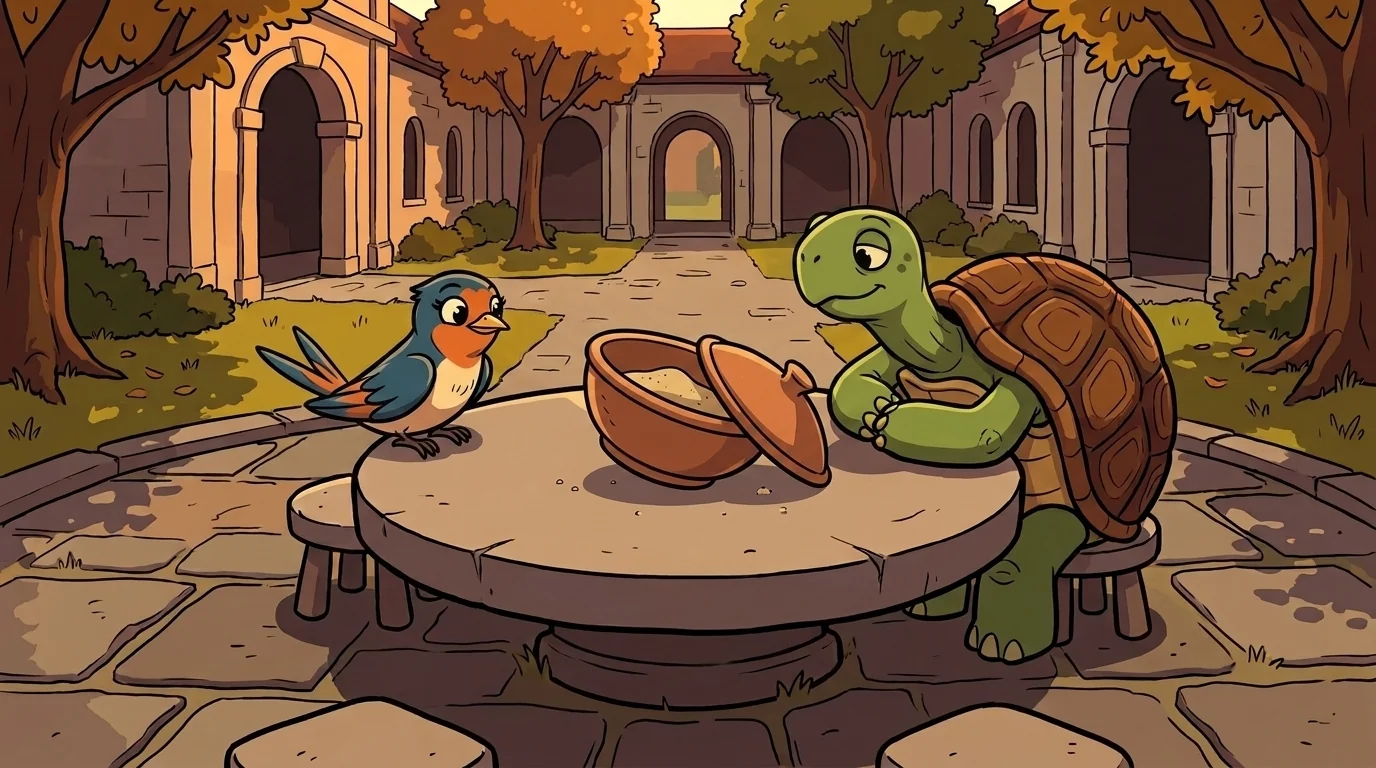
The academy courtyard was quiet in the late afternoon. Two friends sat at a stone table with a covered bowl between them, and they were, as usual, about to disagree in the friendliest way possible.
Predict is a swift — a small, dart-quick bird who reads the sky the way other people read a page. She is always leaning forward, always ready to say what she thinks will happen next. Check is a tortoise, low and unhurried, who never says what he thinks will happen. He only says what did happen, and only after he has looked twice. Predict guesses. Check confirms. Between them they make one whole way of thinking, and neither works well alone.
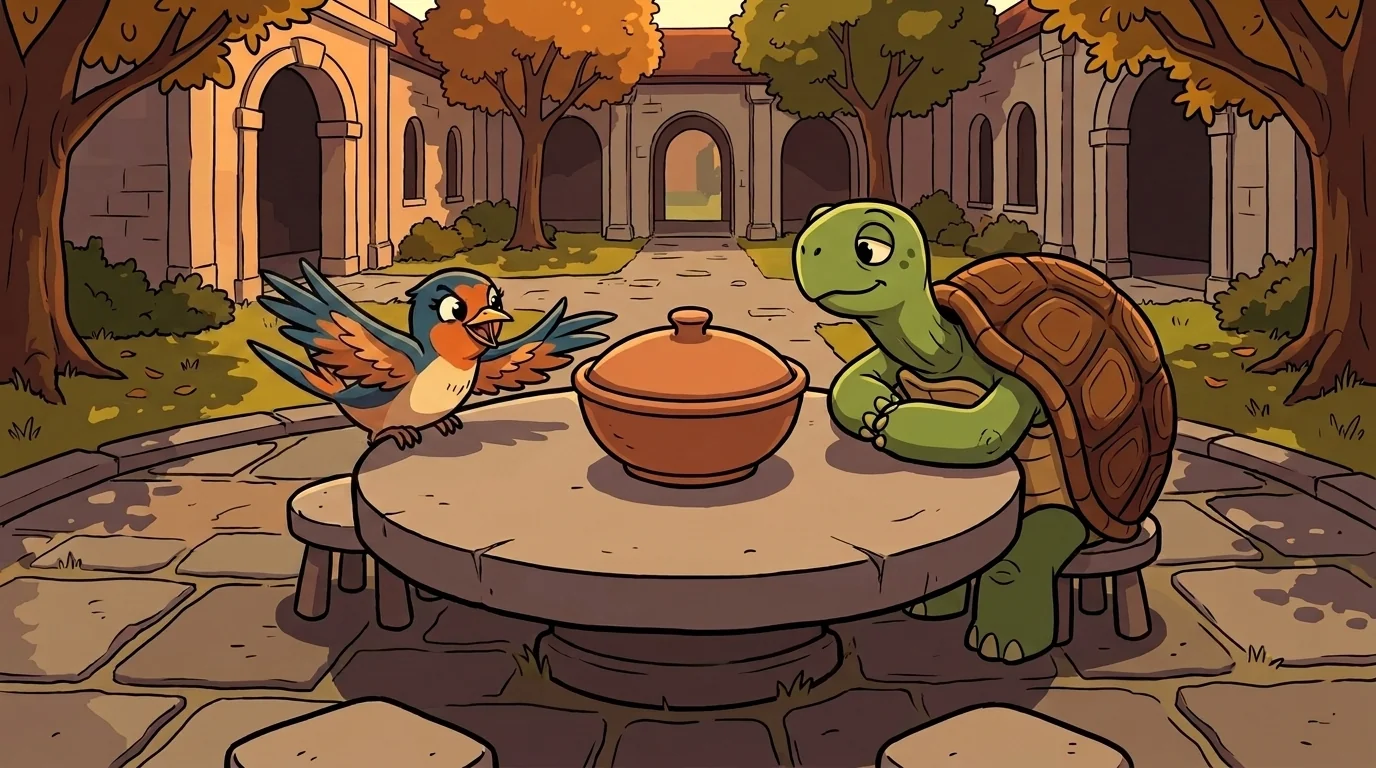
Predict grew up on a cliff full of swifts who had to guess the weather to survive. A swift who guessed right about the wind ate well; a swift who guessed wrong went hungry. So Predict learned young to commit — to say, out loud and ahead of time, "the wind will turn by dusk," and then to live with being right or wrong. She learned that a guess said out loud is braver, and more useful, than a guess kept safe inside your head, because a guess out loud can be tested. But she also learned the scary part: the moment right before you look, when everyone can hear the guess you already made, and you might be about to be wrong in front of them all.
Check grew up in a garden of slow, careful tortoises whose whole job was to know, for certain, which berries were ripe and which were not. A tortoise who guessed could poison the whole family. So Check learned the opposite lesson from Predict: never trust a feeling, never announce, just look — and then look again to be sure. He grew up believing that the only thing you truly know is the thing you have checked with your own slow eyes.
They met at the CuriosityQuest academy and, at first, drove each other a little crazy. Predict thought Check was maddeningly slow. Check thought Predict was recklessly quick. Then, one day, they were handed the same covered bowl and the same question — "what is inside, and what will happen when we tip it?" — and something clicked.
Predict said, instantly, "I predict it's water, and it will pour out fast." Check said, slowly, "Let's tip it and look." And when they tipped it — it was sand, and it slid out slow. Predict was wrong. But here is the thing they both saw at once: because Predict had said her guess out loud first, the looking meant something. They weren't just watching sand fall. They were watching a specific idea — "water, fast" — get tested and corrected into "sand, slow." The wrongness was the most useful part. It taught them exactly what they hadn't understood.
Lumen, the head of the academy, had been watching. She asked them together, "What is prediction?" Predict said, "Saying what you think will happen — before you look." Check said, "And then looking, twice, to see if it did." Lumen smiled. "You are two halves of one skill," she said. "You are appointed. Together."
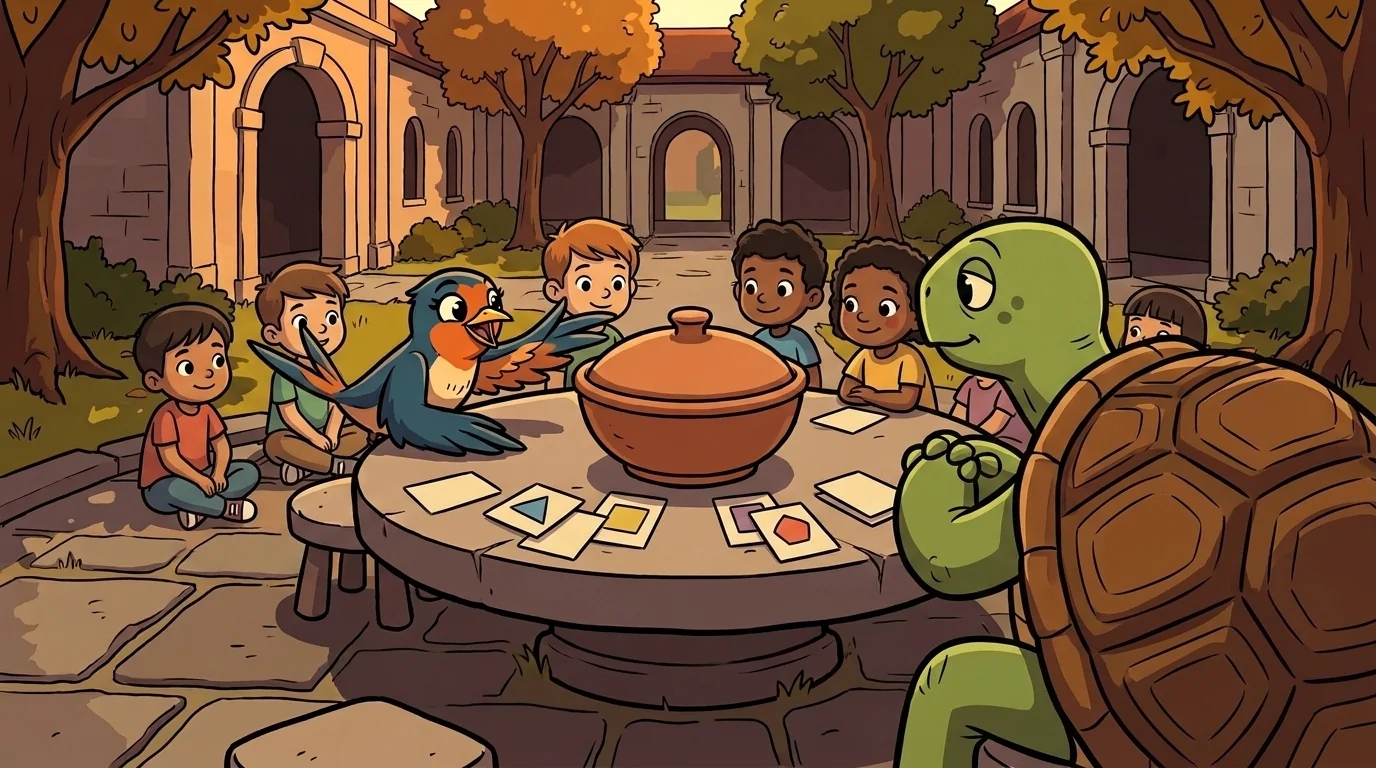
This is important. Predict and Check teach the *predict-observe loop. It works like this: first you say out loud what you think will happen. Then you look and see what really happens. Then you compare the two. The order matters more than anything. If you look first and then say "yeah, I knew that," you have learned almost nothing. But if you commit to a guess before* the reveal, the reveal has something to teach you — especially when you're wrong.
Predict never says a wrong guess is a failure. She says, "A guess is not a promise. It's an offer. I offer 'water, fast,' and the world answers 'sand, slow,' and now I know something I didn't know before." Check never says only careful kids can check things. He says, "Anyone can look twice. You do not need to be clever. You need to be willing to be surprised." Some kids are scared to guess because they might be wrong. But Predict and Check say the wrong guesses are the ones that teach the most. Being wrong out loud, then checking, is how your ideas actually improve.
In their shared classroom, they run every lesson the same way. Predict holds up something covered or about-to-happen and says, "Before we look — everybody make a prediction. Out loud or on paper. Commit to it." The students squirm; committing is the scary part. Then Check says, "Now we look. Slowly. Twice." And afterward they do the most important step together: "Compare. Did it match your guess? If not — that's the good part. What did the surprise teach you?"
They teach their students a few habits for the loop: Guess first, out loud. A prediction only works if you commit to it before the reveal. A guess made after looking is not a prediction; it's a memory. *Make it a real guess, not a safe one. "Something will happen" tests nothing. "It will float" can be checked. *Then look — and look twice. One look can fool you. The second look catches the thing the first look missed. *Compare, and love the mismatch. When the world disagrees with your guess, stop and look hard. The gap between your guess and the truth is exactly where the learning lives. *Wrong is not embarrassing; it's information.* The bravest thing in the room is a guess said out loud that turned out wrong — and the kid who then looked anyway.
Predict tells the students, "I am wrong about the sky all the time." Check adds, "And I am always double-checking things that turn out fine. Neither of those is a failure. That's just the loop, working."
When a student asks whether it's scary to guess out loud, Predict and Check answer together, one after the other:
"It is scary," says Predict. "For one second, right before the look, you're out there with your guess showing." "And then," says Check, "you look — and whether you were right or wrong, you know more than you did. That's the trade. One scary second for a real thing learned."
Predict settles her wings; Check pulls his head back level. The bowl sits tipped between them, its sand already counted and understood. And the exposed, holding-your-breath fear that used to grip Predict before every guess has softened into something they now share — a warm, steady, huh-I-didn't-expect-that gladness, the particular joy of two friends who have learned to love being surprised.
The CuriosityQuest ensemble
Predict and Check is part of CuriosityQuest's distributed-narrative cast. Each character embodies a different curricular primitive; together they teach the full subject.
-
Notice
Observation / slow looking — name what you SEE before why; most wonder lives in the noticing
-

Inkling
Intuition / first-guess hunch — your guess is INFORMATION, not a final answer
-
Ponder
Deepening the question — 'what does that even mean?' is the foundation, never the failure
-
Linger
Staying with uncertainty — Negative Capability; some good questions take days, the best take years
-
Revise
Changing your mind — intellectual humility; being wrong is how knowledge MOVES
-

Compare
Controlled comparison — the fair test; change one thing, keep the rest the same
-
Measure
Quantification — turn a fuzzy word into a number anyone can see
-
Sort
Classification — group by one rule and the pattern pops out