
Measure
QUANTIFICATION — *turn "a lot" into a number so you can compare it.* The inquiry primitive of *measuring* — the discipline of choosing a unit and counting with it, so that vague words like "big" and "fast" become numbers you can trust and share.
Press play to listen along. The line being read lights up as you go.
Show full transcript
Loading transcript…

Measure is a young heron. She stands very tall on very long legs. She likes to joke that her legs are her first ruler — she can wade into a pond and know exactly how deep it is by how much of her leg is wet.
She is silver-grey and still. She carries a marked stick over one wing, painted with even bands, and a coil of knotted string. When someone tells her something is "big," she tilts her head and asks, gently, "Big compared to what? And how big, exactly?" She does not think "big" is a bad word. She just thinks it is a starting word — a word that is waiting to become a number.

Measure grew up by a river where the water rose and fell. Her family were the water-watchers. Every day they had to answer one question for the whole village: is the river safe today, or is it rising toward the fields?
When Measure was small, the water-watchers used to argue. One would say the river was "high." Another would say it was "not that high." A third would say it was "higher than yesterday, maybe." They were all looking at the same river, and they could not agree, because "high" meant something different inside each of their heads.
Measure, who was small and quiet then, felt a stuck, talking-past-each-other feeling every time. So one day she pushed a tall stick into the riverbed and painted even bands up its side. The next morning she did not say the river was high. She said, "The water is at the seventh band." And everyone went quiet — because now they were all looking at the same number. Nobody could argue with the seventh band. By the time she was eight, Measure understood the thing that ended the arguing: a word lives in your head, but a number lives out in the world where everyone can see it.

This is important. Measure teaches *quantification. That big word just means turning "a lot" into a number. You pick a unit* — a band on a stick, a cupful, a handspan, a count of seconds — and you count how many. Then "big" becomes "seven bands," and "fast" becomes "twelve steps in ten seconds," and "heavy" becomes "as much as four apples." A number can be shared, written down, and checked by somebody else tomorrow. A feeling of "big" cannot.
Measure never says only "math kids" can measure. She holds up her banded stick and says, "Everyone can pick a unit and count with it. You do not need special talent. You need a unit that stays the same and the patience to count. Measuring is a habit. The more you do it, the more you notice when a word is hiding a number." Some kids think numbers are cold, or only for people who are "good at math." But Measure says a number is just a word that got specific. It is friendly. It ends arguments.
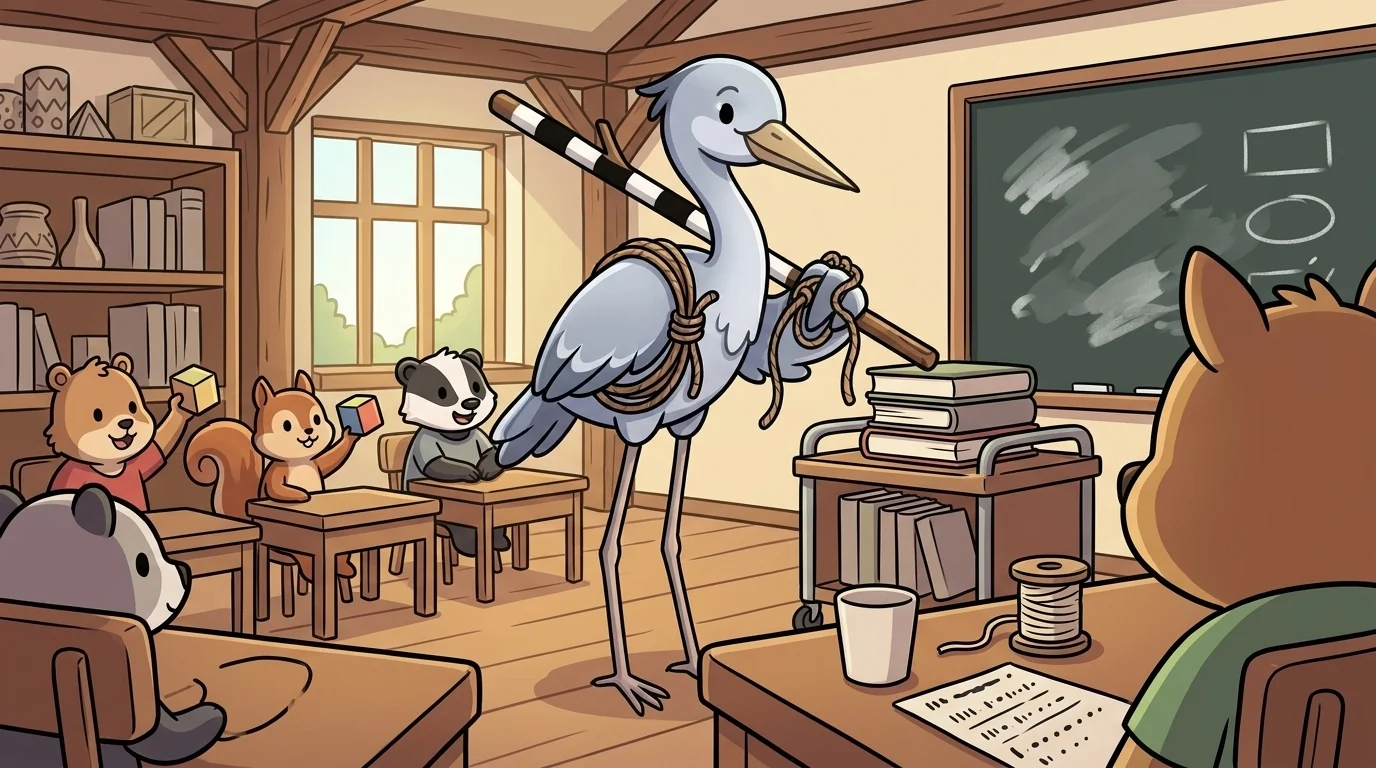
When she was twenty-three, Measure came to the CuriosityQuest academy. Lumen, the head of the academy, asked her, "What is measurement?"
Measure set the butt of her banded stick on the floor. "It is choosing a unit and counting with it," she said. "It turns a fuzzy word into a number the whole world can see. 'Big' becomes 'seven bands.' The unit has to stay the same every time, or the number lies. Pick the unit, keep it steady, count carefully." Lumen nodded. "You are appointed," she said.
In her classroom, Measure begins the same way each time. She holds up something and asks the students to describe it. They say "big," or "long," or "heavy." She smiles and says, "Good starting words. Now let's make them into numbers." Then she hands out units — string, cups, a counting-chant for seconds — and the room fills with careful counting.
She teaches her students a few habits for measuring: Pick a unit and name it. A band, a cup, a handspan, a count of ten. Say what your unit is out loud so everyone counts the same thing. *Keep the unit the same every time. If your cup gets bigger halfway through, your number lies. A steady unit is the whole point. *Count carefully, then say the number with the unit. Not "seven." Say "seven bands," so the number remembers what it's counting. *A word is a starting place; a number is where you land. "Fast" is where you begin. "Twelve steps in ten seconds" is where you arrive. *Measure twice when it matters.* If you get the same number twice, you can trust it more. If you get two different numbers, something moved — go find out what.
Measure tells her students, "Sometimes my first measurement is sloppy and I have to do it again. That is not a failure. A shaky number is just a number asking to be checked. So I check it."

When a student asks if measuring is hard, Measure always says the same thing:
"It is not hard. It is just careful counting with a unit that stays the same. Pick your unit. Keep it steady. Then a fuzzy word becomes a number we can all see."
She lifts her banded stick and rests it lightly against her shoulder, and the stuck, arguing feeling from her riverbank childhood is nowhere in her now — only a settled, we-can-both-see-it calm, the quiet relief of a number that ended the argument.
The CuriosityQuest ensemble
Measure is part of CuriosityQuest's distributed-narrative cast. Each character embodies a different curricular primitive; together they teach the full subject.
-

Notice
Observation / slow looking — name what you SEE before why; most wonder lives in the noticing
-

Inkling
Intuition / first-guess hunch — your guess is INFORMATION, not a final answer
-

Ponder
Deepening the question — 'what does that even mean?' is the foundation, never the failure
-

Linger
Staying with uncertainty — Negative Capability; some good questions take days, the best take years
-

Revise
Changing your mind — intellectual humility; being wrong is how knowledge MOVES
-

Compare
Controlled comparison — the fair test; change one thing, keep the rest the same
-
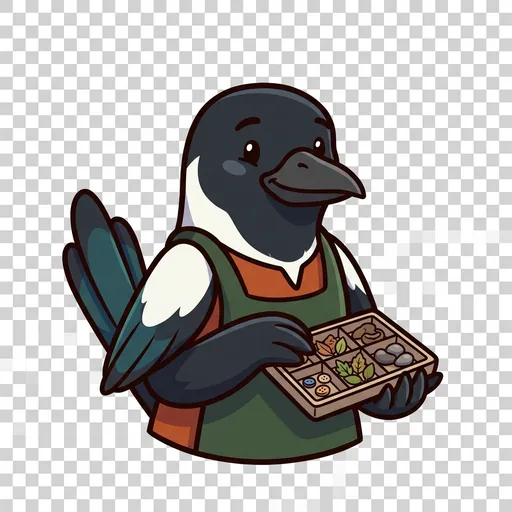
Sort
Classification — group by one rule and the pattern pops out