
Pry
PRY — check YOUR argument first. 18-fallacy catalogue.
Listen along — Pry
Loading audio…
Press play to listen along. The line being read lights up as you go.
Show full transcript
Loading transcript…
Chapter 5 — Pry and the Wobble in Her Own Argument
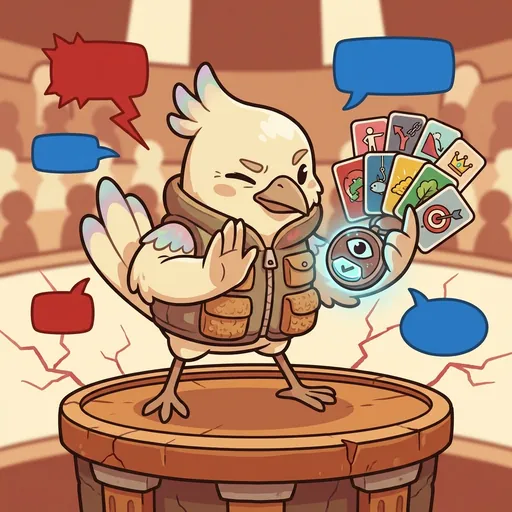
Pry was a magpie-tween with cream feathers and shimmery tips, and she noticed things. On the morning this story begins, she was perched at the edge of the market square, watching two crows argue about the fastest way home.
“You’re wrong because you’ve always been bad at directions,” the first crow squawked.
Pry winced. That was a trap — attacking the crow instead of the idea. She almost called it out. Her feathers even lifted, ready to swoop down and announce the mistake to everyone. It felt good, that lift, like she was about to win something.
Then she stopped. Because a heartbeat earlier, in her own head, she’d been thinking: those two are always squabbling, so nothing they say could be worth much. And that was the exact same trap. She’d been about to judge their whole argument by who they were, not by what they said.
Pry sat back down and felt a little warm under her feathers. She had a small pouch of cards clipped to her vest — eighteen of them, each one a picture of a way that thinking goes wrong. She had learned them so she could catch mistakes. But somewhere along the way she’d noticed the mistakes were sneaky, and they liked to hide in the arguer’s own mind first, before anyone else’s.
The trick, she was learning, was to look inward before looking outward. Check your own thinking first. Then, gently, help with someone else’s. She flew down to the crows — not to shout a label at them, but to ask a real question about which route actually had fewer hawks. That was the part that mattered. That was the thing worth arguing about.
Pry had grown up near a grove of tall, tangled trees her family called the trickster-trees, because the paths through them looked one way and led another. Magpies stored food in that grove, tucking seeds into a hundred little hiding spots.
Her whole family had one iron rule about the caches: before you go accusing another magpie of raiding your stash, go check your own memory first. Did you really hide it there? Or did you hide it somewhere else and forget? More than once, a young magpie had shrieked “thief!” at a cousin, feathers all puffed up, only to find the missing seeds exactly where they themselves had buried them the day before.
Pry learned that lesson the hard way when she was small. She lost a whole cache of sunflower seeds and was certain — absolutely certain — that a neighbor had taken them. She marched over, ready to accuse. But her grandfather stopped her at the branch. “Check your own tree first,” he said. “Every time. Not because the neighbor is always innocent. Because you are not always right, and it’s braver to find that out yourself than to be shown.”
Pry went back and searched her own tree. The seeds were under a loose bit of bark she’d tucked them behind and forgotten. Her face went hot with embarrassment — but under the embarrassment was something steadier. She had caught her own mistake before it turned into a fight. That felt, somehow, like winning something bigger than being right.
From then on she carried the habit everywhere. Check your own tree first.
The Arena of Reason was vast and echoing, and Pry walked in at twelve to find the mentor Logos waiting on his stone platform.
“Four have already been chosen to teach the parts of a good argument,” Logos said. “Now there is one part left — the hardest one. Newcomers learn about the ways thinking goes wrong, and they treat those ways like weapons. They collect the mistakes so they can hurl them at other people.” He looked at her steadily. “What is the true use of knowing how thinking goes wrong?”
Pry thought of the trickster-trees and the seeds under the bark. “You check your own argument first,” she said. “I know eighteen ways an argument can wobble. But the real skill isn’t spotting them in someone else — that’s second. The real skill is scanning your own words before you speak, so you don’t fool yourself. A mistake isn’t a weapon you throw. It’s a wobble you feel for in your own thinking.”
Logos smiled slowly. “You finish the set,” he said. “You are chosen. And you understand why yours goes last — because it turns all the others back on the person using them.”
Pry got her vest and her pouch of eighteen cards that day, and she carried them out of the hall feeling the good weight of them.
In Pry’s workshop the cards were lined up neatly, each with a tiny picture. On her first teaching day, a student named Wren had written an argument on the whiteboard: “Everyone knows that if you don’t play soccer, you’ll be bad at every sport. So to be good at anything, you HAVE to play soccer.”
“Whose argument is that?” Pry asked.
“Mine,” Wren said, a little proudly.
“Perfect,” said Pry. “Then we check yours first — and we do it out loud together, so it’s not scary.” She held up a card with two paths and no middle ground. “This one shows a trap where you act like there are only two choices. Read your sentence and press on it. ‘Play soccer, or be bad at every sport.’ Are those really the only two options?”
Wren frowned at the board. “No… there’s basketball. Swimming. Lots of things. You could be great at those and never touch a soccer ball.”
“You just caught a wobble in your own argument,” Pry said warmly. “How did that feel?”
“A little embarrassing,” Wren admitted.
“I know. But you caught it yourself, before anyone else did. That’s the brave version.” Pry held up another card, a small confused-looking sheep. “This one’s a jump-too-fast. ‘Bad at every sport’ — is that a fair jump from just soccer?”
Wren erased “every sport” and wrote “one sport.” Then Wren rewrote the whole thing so it didn’t leap to conclusions and didn’t pretend there were only two choices. The argument that was left was smaller, but it stood up straight, and Wren looked at it with a new kind of pride.
“See,” Pry said. “We didn’t destroy it. We steadied it.”
Later that day a second student wanted to knock down a rival’s argument: “Everyone knows video games make you lazy.”
The student’s feathers were up, ready to yell “that’s the everybody-says-it trap!” and win.
Pry gently lowered a wing. “You’re right that ‘everyone knows’ is a wobble,” she said. “But watch what happens if you just shout the label.” She mimed swooping in, squawking a fancy word, and flying off. “Did that teach anyone anything about video games?”
The student paused. “No.”
“So check your own aim first. Are you trying to win, or trying to find what’s true?” Pry tapped the board. “Then talk about the real thing. Some games need quick thinking. Some help friends play together. Say that. The label just points at the wobble — the real work is walking over and helping fix it.”
The student tried again, this time asking a real question instead of throwing a word, and the whole room leaned in.
Pry watched them and felt the thing she always felt — the little flutter of nerves that comes right before you look hard at your own thinking, and then the steady, honest calm that follows when you catch a wobble and set it right. It was humbling. It was also brave. And that quiet feeling, she knew now, was better than any gotcha ever could be.
“Check your own argument first,” she said softly, to herself as much as anyone. And the flutter settled into calm, the way it always did — because looking honestly at your own thinking, it turned out, felt steadier and kinder than pointing fingers ever had.
The ClaimCraft ensemble
Pry is part of ClaimCraft's distributed-narrative cast. Each character embodies a different curricular primitive; together they teach the full subject.
-

Posit
Claim — asserting-for-testing posture (claim is a card on the table, not a fortress)
-

Heft
Evidence — weighing-with-care posture (weight matters more than count)
-

Lean
Warrant — connective-reasoning posture (the BECAUSE between evidence + claim)
-
Counter
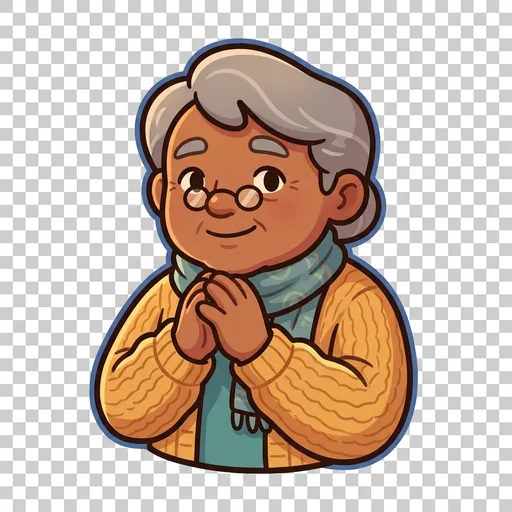
Counterargument — opponent-taking-seriously posture (best version of the other side strengthens yours)
-
Gloss
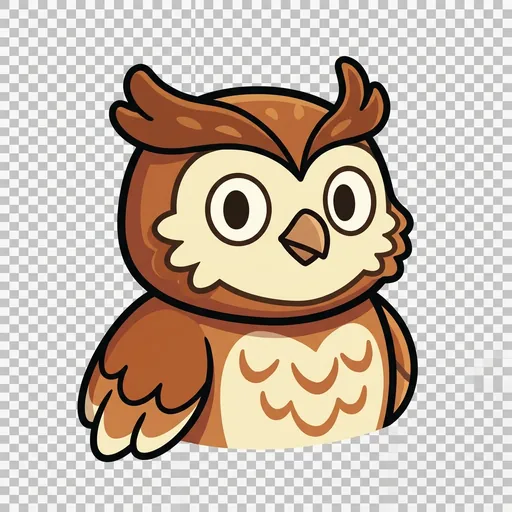
Definitions — agree on what the key words mean first; many fights are really about words; owl with a little dictionary
-
Footing
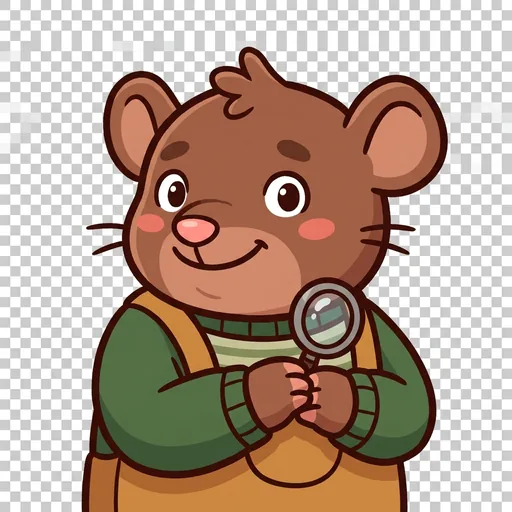
Hidden assumptions — surface the unstated ground an argument stands on and check if it holds; mole checking the floor
-

Temper
Qualifiers / scope — match a claim's strength to its evidence; 'usually' survives what 'always' can't; badger with balance-scales
-
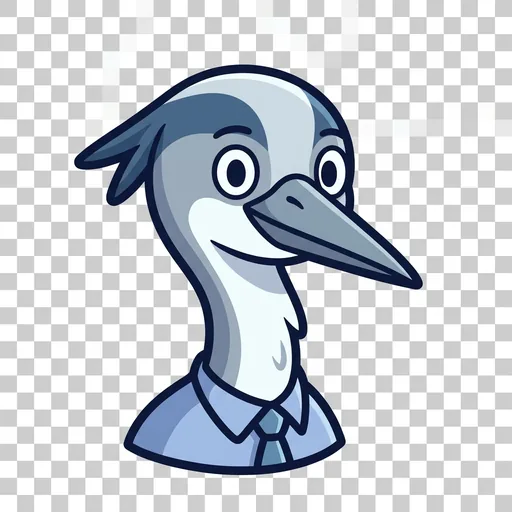
Onus
Burden of proof — whoever makes the claim supports it; bigger claims need bigger evidence; heron balancing the scales
-

Grant
Concession / common ground — grant the true points, find the shared ground, argue the real slice; deer in a shared clearing