
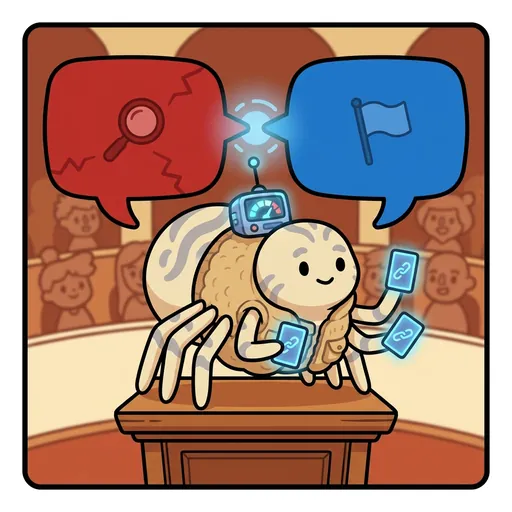
Lean
LEAN — the BECAUSE between evidence and claim. connective reasoning.
Listen along — Lean
Loading audio…
Press play to listen along. The line being read lights up as you go.
Show full transcript
Loading transcript…
Chapter 3 — Lean and the Hidden Word That Connects Everything
The wind came up over the canopy just before dawn, and every bridge in the treetops began to sway. Ropes of silk stretched between the tall trunks, and on the longest one stood Lean, a small spider-tween still growing into her eight legs, checking her morning route the way she always did.
She did not check the two big anchor-knots at the ends. Everyone checked those. She checked the strand in the middle — the thin line that actually carried the walker across the gap. She pressed one leg against it, felt it hum, and nodded.
A young beetle scuttled up beside her, out of breath. “The green bridge is safe,” he announced. “I know because it’s the newest one.”
Lean tilted her head. On her orange vest, a tiny clipped-on device gave a soft, worried blink. “That’s a claim and a fact stuck together,” she said gently, “but you skipped the middle part. Why does being newest make it safe?”
The beetle blinked. “Because… newer things are stronger?”
“Maybe. Or maybe the newest strand hasn’t been walked on yet, so nobody’s found the weak spot.” Lean stepped onto the green bridge and pressed the center strand. It gave a little more than she liked. “See? The reason in the middle is where the whole thing holds — or doesn’t.”
She walked the beetle across slowly, one careful step at a time, testing the strand ahead before she trusted it. When they reached the far trunk, the beetle let out a long breath. Lean smiled. The word for the thing she’d just checked — the reason in the middle, the strand that carries the weight — was the word she loved most. She just hadn’t said it out loud yet.
Lean had grown up on these bridges. Her whole family were bridge-spiders, and the first thing any of them learned was a rhyme her grandmother repeated every evening: “The strand between two points carries the weight. Check the strand, not just the anchors.”
When Lean was very small, she thought that was a boring rule about silk. Then one rainy season a bridge collapsed. Not because either anchor-knot failed — both knots were perfect — but because the strand between them had frayed where nobody looked. A family of ants had been halfway across.
They were fine. A soft leaf caught them. But Lean never forgot the sound the strand made when it let go, and she never forgot that the two ends had looked completely trustworthy right up until the middle gave way.
After that she spent hours testing tiny threads. She would hang a single dewdrop from a strand and wait to see if it held. She would set a sleepy gnat on a line and watch. Her cousins teased her — the anchors are what matter, they’d say, tie those tight and stop worrying. But Lean had heard the strand snap. She knew the truth lived in the connection, in the part between, in the quiet reason that decided whether two solid ends actually reached each other.
She started carrying a little stack of cards, one for each bridge, where she wrote down not just “safe” or “unsafe” but the reason: this strand holds because it’s woven triple; that one is weak because the damp got in. Writing the reason down, out where she could look at it, made the frightened feeling smaller.
The Arena of Reason was a hall so tall the ceiling disappeared into shadow, and voices there echoed for a long time before they faded. Lean was twelve when she walked in. An old mentor named Logos waited on a stone platform, and he did not waste words.
“There are five who teach the parts of a good argument,” he said. “One teaches the claim. One teaches the evidence. And one must teach the thing between them — the reason the evidence supports the claim at all.” His eyes found her. “What is that reason called?”
Lean’s legs were shaking, but she thought of the strand and the dewdrop and the sound of silk letting go. “It’s the warrant,” she said, her voice small but steady. “When someone says ‘this is true because of that,’ there’s a hidden step in the middle. Why does that actually support this? The warrant is the strand between the two ends. If you don’t check it, you’re only trusting the anchors.”
For a moment the hall was silent. Then Logos smiled. “You understand the part most people walk right past,” he said. “You will teach the warrant.”
Lean got her orange argument-vest that very day, with its little pockets for cards and the soft blinking tracker that noticed whenever an argument skipped its middle. Walking out of that echoing hall, she felt the frightened flutter finally settle into something warm.
Lean’s workshop was strung with bridges, of course, and on her first teaching day a nervous student named Fuzzy raised a paw.
“I have an argument,” Fuzzy said. “My cat Mittens is the best cat. Because she purrs really loudly.”
Lean laid two cards on the strand between them — CLAIM on one side, EVIDENCE on the other — and left a wide gap in the middle. “Good. Now show me the strand,” she said. “Why does purring loudly make her the best?”
Fuzzy thought hard. “Because… purring loudly means she’s happy? And happy cats are the best cats!”
Lean’s tracker blinked yellow, not green. “That’s one strand you could put in the middle,” she said kindly. “Let’s press on it. What if Mittens purrs loudly because her little motor is just built loud, and she isn’t especially happy at all?”
Fuzzy’s fur flattened. “Oh. Then loud purring wouldn’t prove she’s the best.”
“You just found a weak strand,” Lean said, and it wasn’t a scolding — it was almost a cheer. “That’s the whole job. The middle looked fine until we walked on it.”
A quick beetle named Buzz spoke up. “Try this strand: Mittens purrs loudly because she’s showing she trusts you. And a cat that shows trust is a wonderful cat.”
Lean’s tracker glowed green. “Now press on that one,” she said. “Does it hold?” The class pushed and poked at it and couldn’t make it snap. “Feel the difference?” Lean asked. “Same claim, same evidence — but a different strand in the middle. One frayed the second we tested it. One held. That’s why you say the reason out loud, so everyone can walk across it and check.”
At the end of the day Fuzzy stayed behind, looking a little unsure. “It felt scary,” Fuzzy admitted, “saying my hidden reason out loud. Like everyone could see the weak part.”
“I know that feeling,” Lean said softly. “I feel a flutter every time too.” She rested a leg on the center strand of the nearest bridge. “But here’s the secret. When the reason stays hidden inside you, it can be quietly weak and you’d never know. When you say it out loud and it holds — you feel the two ideas pull tight together, like a cable going taut. And the worry lets go.”
Fuzzy tried it once more, out loud this time, and Lean watched the moment the reason clicked into place. Fuzzy’s shoulders dropped. Something in the small face went calm.
“That’s it,” Lean whispered. “The BECAUSE between evidence and claim. Connective reasoning.” She said it the way you say something you love, and it left her feeling the steady kind of glad — the warm, settled feeling of a bridge that holds, worry loosening its grip, two ideas finally reaching each other across the gap.
The ClaimCraft ensemble
Lean is part of ClaimCraft's distributed-narrative cast. Each character embodies a different curricular primitive; together they teach the full subject.
-

Posit
Claim — asserting-for-testing posture (claim is a card on the table, not a fortress)
-

Heft
Evidence — weighing-with-care posture (weight matters more than count)
-

Counter
Counterargument — opponent-taking-seriously posture (best version of the other side strengthens yours)
-

Pry
Fallacy — trap-spotting posture (check YOUR argument first; 18-fallacy catalogue)
-
Gloss
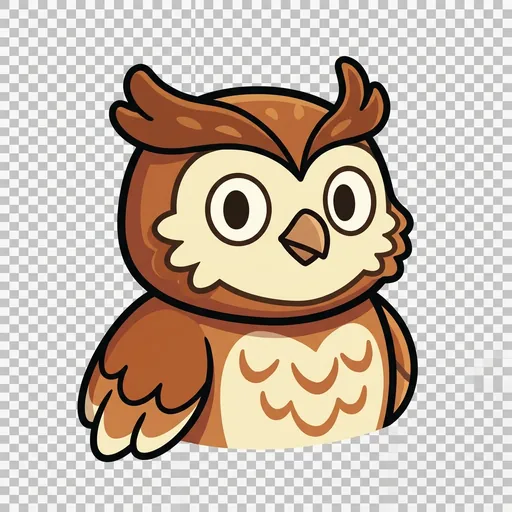
Definitions — agree on what the key words mean first; many fights are really about words; owl with a little dictionary
-

Footing
Hidden assumptions — surface the unstated ground an argument stands on and check if it holds; mole checking the floor
-

Temper
Qualifiers / scope — match a claim's strength to its evidence; 'usually' survives what 'always' can't; badger with balance-scales
-

Onus
Burden of proof — whoever makes the claim supports it; bigger claims need bigger evidence; heron balancing the scales
-

Grant
Concession / common ground — grant the true points, find the shared ground, argue the real slice; deer in a shared clearing