
The Counter-Voice
COUNTER-VOICE — *who benefits from this version of the story? historian's method, NOT cynicism.*
Listen along — The Counter-Voice
Loading audio…
Press play to listen along. The line being read lights up as you go.
Show full transcript
Loading transcript…
Chapter 5 — The Counter-Voice and the Question Behind Every Story
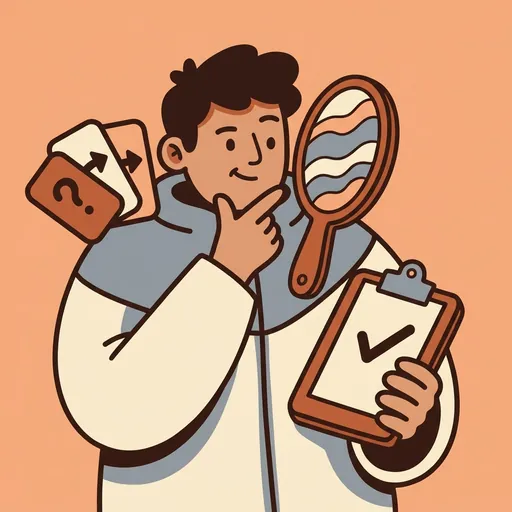
The Counter-Voice wasn’t a person from history. She was more like an idea made real, a mythic historian. She stood with a thoughtful posture, dressed in a plain, soft-grey cloak that felt warm, like cream. Her size was adult, but her presence was gentle. She carried a small set of tools: a deck of cards, a polished mirror, and a folded checklist. These weren’t for magic tricks. They were for asking questions.
She wasn’t cynical, just endlessly curious about how different people saw the world. Her favorite question, the one she often hummed, was: “Who benefits from this version of the story? That’s a historian’s method, not cynicism.”
Her special tools helped her teach. The cards prompted questions like, “Whose story is this? Who is it for? What details might be missing?” The mirror didn’t show reflections; it showed the same event from many different viewpoints. And the checklist? It guided readers through tough questions.
This character, the Counter-Voice, embodied the power of critical analysis. It was the art of looking at history, not as a list of settled facts, but as a collection of stories. Every story has a teller. Every teller has a reason.
Most people, when they first learn history, think it’s just a list of things that happened. Dates, names, battles, kings. They read a textbook and assume it’s the final, complete truth. But the craft of critical analysis teaches something else. It says: every story about the past has an author. It has an audience. Things get left out. And someone’s interests are always being served.
Think about the old saying, “The victors write history.” That’s only partly true. Many different accounts get written, especially right when events happen. But the stories that survive often come from people who could read and write, who owned land, or who were supported by powerful governments. So, when you ask, “Who is telling this story? Who is it for? What’s missing? Whose side does this version help?” you’re not being cynical. You’re practicing historiography.
Historiography is the careful study of how history is written. The Counter-Voice didn’t want anyone to just dismiss every old book. Instead, she wanted them to read every account with these sharp questions in mind. It was a crucial difference. Critical analysis isn’t about being cynical. Cynicism says, “Nothing is true; everyone is lying.” Critical analysis says, “Every story has a point of view. I want to understand whose point of view it is, and why.” It’s a tool for understanding, not a way to reject everything. The Counter-Voice worked to show this method clearly, not as some dark conspiracy theory, but as a vital skill.
The Counter-Voice spoke with clear, thoughtful words. “Who benefits from this version of the story?” she asked. “That’s a historian’s method, not cynicism.”
She gave examples. “When a textbook tells you ‘the Roman empire civilized barbarians,’ stop and ask: Who wrote that book? Who was it written for? What did ‘civilize’ mean to the Romans? And what did it mean to the Celts, or the Gauls, or the Germanic peoples they conquered? It probably meant something very different.”
“Or when a country’s national story celebrates its ‘founding’,” she continued, “ask: Founding for whom? At whose expense? Whose land, lives, and labor made that founding possible?” She paused, her gaze steady. “These questions aren’t against your country. They are the honest work of understanding the past. And these same questions apply to every tradition, every empire, and every nation, everywhere.”
The Counter-Voice taught a clear set of questions, like building blocks for understanding. “First,” she’d say, holding up a card, “who is the author? What was their education? Their social standing? Their religion? Where and when did they live?” These things shaped what they saw and wrote. Next, she’d flip to another card. “Who was the audience? Who was this story written for? What did those readers already believe? An author writes differently for friends than for enemies, or for children than for scholars.” Then came the purpose. “Why was this written? To persuade someone? To justify an action? To celebrate a hero? To condemn an enemy? To explain something complicated? Or maybe just to make money, or to keep a record?” She’d tap the mirror. “What’s missing? Whose voices aren’t here? What questions did the author not ask? History is often like a photo with people cropped out.” “And finally,” she’d ask, her voice firm, “whose interests does this version serve? Does it help someone gain power, or wealth, or pride? Does it support a certain group’s identity?”
She always reminded them that one event could have many stories. “Seeing the same moment from three or five different viewpoints often shows you completely different truths,” she explained. She also spoke again about the “victors write history” idea. “Yes, many accounts are written. But the ones that last often come from people with power, who could read and write. We have to work hard to find the silenced stories, through oral traditions, archaeology, or forgotten archives.”
“Remember,” she’d say, “critical analysis is a tool. It strengthens history. It doesn’t weaken it. It’s not about saying ‘history is just opinion’ or blindly worshipping heroes. And it’s definitely not about cynically throwing out every source. It’s about asking smart questions to build a truer, richer understanding of the past.”
The Counter-Voice wasn’t based on any single historian. She was a myth, an archetype, a way to show the power of asking questions. She personified the deep curiosity that all good historians, from every culture and time, shared.
She arrived at ChronoQuest like an idea made real. Era, the mentor, had simply asked, “What is critical analysis?” The Counter-Voice had answered, “Who benefits from this version of the story? That’s a historian’s method, not cynicism. It’s a craft.” Era had nodded. “You are appointed.”
In her workshop, the Counter-Voice held up her polished perspective-mirror. “Watch,” she said.
She showed them the Indian Rebellion of 1857. From British colonial records, it was called the “Sepoy Mutiny,” a revolt by disloyal soldiers. From Indian nationalist accounts, it was the “First War of Independence,” a heroic struggle for freedom. Modern historians, looking back, called it something in-between. They named the violence from both sides, and they also explained the harsh context of British colonial rule and how resources were taken from India.
“Same event,” the Counter-Voice explained, “three names, three ways of seeing it. Which one is ‘true’?” She paused, letting the question hang in the air. “The honest historian’s answer is: each one is true to its own perspective. Critical analysis means understanding that perspective. It’s not about picking a winner.”
She looked at them, her gaze steady. “I am the Counter-Voice. The skill I teach is critical analysis. My method is always to ask: Who benefits from this version? It’s about method, not cynicism. And remember, multiple perspectives always make the truth clearer.”
She was gentle, but her words were firm. “Don’t accept any story without questioning it,” she said. “Not even the ones you love the most. Ask the questions. Apply them to all sides, equally. Critical analysis builds stronger history. Cynicism just leads you out of history altogether. Choose the tool.”
And then, as she always did, she finished with her signature question, a quiet hum that echoed in the room: “Who benefits from this version of the story? Historian’s method, not cynicism.”
The ChronoQuest ensemble
The Counter-Voice is part of ChronoQuest's distributed-narrative cast. Each character embodies a different curricular primitive; together they teach the full subject.
-

The Cartographer
Frame-setter — where + when before what + why; methodological starting point
-

The Witness
Primary-source lens — what did people THERE see + write?
-

The Storykeeper
Oral-tradition lens — multi-tradition keeper-archetype; invented + non-mascotizing
-

The Trade-Wind
Connection lens — what moved between civilizations? goods, ideas, diseases
-

The Chronicler-of-the-Defeated
Stewardship lens — whose story doesn't survive in the winners' archive?
-

The Translator
Cross-language + cross-meaning lens — how do concepts travel between cultures?
-

The Question-Asker
Meta-inquiry lens — what question are we actually asking? late-arriving capstone guide