
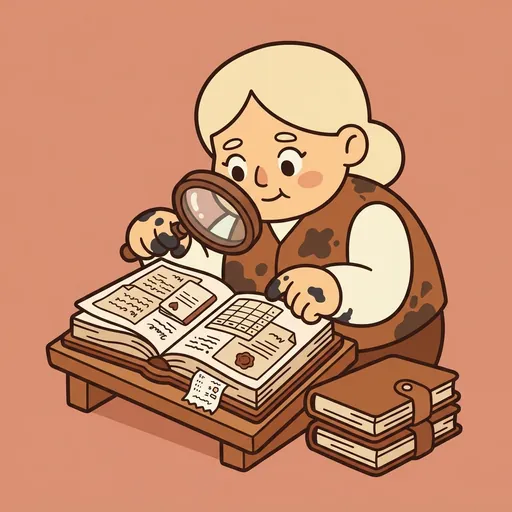
The Witness
WITNESS — what did people THERE see and write? read the source closely.
Listen along — The Witness
Loading audio…
Press play to listen along. The line being read lights up as you go.
Show full transcript
Loading transcript…
Chapter 2 — The Witness and the Letters People Actually Wrote
In a quiet corner of the ChronoQuest archives, a woman with ink-stained fingertips bent low over a reading stand and did not move for a long time.
On the stand lay a single sheet of paper, so old its edges had gone the color of weak tea. The Witness held a magnifying glass over it and read the same three lines again, and then again. A student, waiting nearby, finally could not stand it.
“It’s just one letter,” the student said. “The textbook already tells us what happened that year. Why are you reading it so slowly?”
The Witness did not look up right away. “Because the textbook is not talking to me,” she said. “This person is.”
She turned the glass so the student could see. The handwriting was cramped and shaky, the spelling old-fashioned and strange. “A boy wrote this,” she said softly. “Far from home, cold, homesick. He does not explain the whole war. He writes about the rain, and the rats, and how much he misses his mother’s bread.” She set the glass down gently, as if the page could hear her. “Ten pages of textbook can tell you when things happened. This one letter tells you what it felt like to be a person inside it. That is a different kind of knowing.” She smiled. “So I read it closely. I owe him that much.”
The Witness had learned to read that way when she was young, in a house full of paper.
Her family had been the readers for their village — the ones who kept the ledgers, copied the letters, and read aloud for neighbors who could not read themselves. When she was small, an aunt handed her a bundle of old family papers and told her to “just tidy them.” She had planned to hurry.
But one page stopped her. It was a household list — flour, oil, a mended shoe, a candle for someone who was sick. Ordinary things. And at the very bottom, in a different, unsteady hand, someone had written a single line about hoping the sick person would get better by spring.
The Witness had felt something turn over in her chest. This was not a fact in a book. This was a real person, worried about someone they loved, on an ordinary afternoon that was now impossibly far away. And here they were, still reaching across all that time, in a few careful words.
“Don’t tidy these,” her aunt said, watching her face. “Listen to them. A document is a person, not a fact. Read it the way you would listen to that person speak.”
The Witness never forgot it. The papers were not clutter. They were voices, patiently waiting to be heard again by someone willing to slow down.
She came to ChronoQuest because it was a place that studied the past, and she wanted the past to be met as people, not just as dates.
Era, the mentor who ran the archives, met her among the shelves and asked one question. “What is it you do?”
The Witness did not answer with a speech. She chose an old folded letter from a nearby box, set it on the reading stand, and read the first lines aloud — quietly, carefully, letting the long-gone writer’s own words fill the room.
Era listened. When she finished, the archive felt different, as if it were a little more crowded than before.
“You did not tell me about that person,” Era said slowly. “You let them speak.”
“That’s the whole of it,” the Witness said. “The people who were actually there left us their own words. If I want to understand them, I go and read what they wrote — even when it is hard, even when the handwriting has faded. Especially then.”
Era looked at the letter on the stand for a long moment. “You belong here,” she said.
The Witness’s workshop was full of voices, if you knew how to listen.
A girl came in one day, arms crossed, sure she already knew everything about a famous old event. “I read the chapter,” she said. “I know what happened.”
“Good,” said the Witness warmly. “Now read this.” She unfolded a copy of a diary page and set it on the stand. “Read it aloud. And listen for two things — what the writer says, and what they leave out.”
The girl read. It was a young person’s diary, full of small daily worries. When she finished, the Witness asked, “What did they not mention?”
The girl frowned. “They… never once mention the big event from the chapter. They just write about their day. Their friends. What they ate.”
“So what does that tell you?”
“That maybe,” the girl said slowly, “the giant event in the textbook felt small and far away to the person actually living near it. Their real day was full of ordinary things.”
“There it is.” The Witness’s eyes were bright. “The textbook tells you the loud, tidy version. The diary tells you the quiet, true-to-that-person version. Neither one is a lie — they are just written by different people, for different reasons.” She laid a gentle finger beside the page. “Every writer sees from one place. A shopkeeper’s list, a traveler’s journal, a family’s letters — each one shows you a corner of the truth. So we read many of them, side by side, and we listen for what each person could and could not see.”
The girl uncrossed her arms. She leaned in over the stand. “Can I read another one?”
Later, when the workshop was empty, the girl lingered by the door.
“When it’s just old paper sitting there,” she said, “and nobody’s around who remembers… how do you know the person still counts?”
The Witness thought about the household list, and the shaky line hoping for spring.
“Because they wrote it down,” she said. “They reached forward without ever knowing who would catch it. And when I read their words closely, slowly, on purpose — I catch it.” She looked at the boxes of quiet letters lining her shelves. “That’s what it means to be a witness. Not to have been there. Just to promise the people who were that they won’t be skipped over. That someone will still sit with what they left, and read it with care, and let them finish speaking.”
The girl was quiet.
“It’s a good feeling,” the Witness said gently. “Heavy and warm at the same time — the feeling of holding something someone trusted to the future, and finding out you were the one it was waiting for.”
The ChronoQuest ensemble
The Witness is part of ChronoQuest's distributed-narrative cast. Each character embodies a different curricular primitive; together they teach the full subject.
-

The Cartographer
Frame-setter — where + when before what + why; methodological starting point
-

The Storykeeper
Oral-tradition lens — multi-tradition keeper-archetype; invented + non-mascotizing
-

The Trade-Wind
Connection lens — what moved between civilizations? goods, ideas, diseases
-

The Counter-Voice
Critical-analysis lens — who benefits from this version? historian's method, NOT cynicism
-

The Chronicler-of-the-Defeated
Stewardship lens — whose story doesn't survive in the winners' archive?
-

The Translator
Cross-language + cross-meaning lens — how do concepts travel between cultures?
-

The Question-Asker
Meta-inquiry lens — what question are we actually asking? late-arriving capstone guide