
The Trade-Wind
TRADE-WIND — *what moved between civilizations? goods, ideas, diseases.*
Listen along — The Trade-Wind
Loading audio…
Press play to listen along. The line being read lights up as you go.
Show full transcript
Loading transcript…
Chapter 4 — The Trade-Wind and the Movement Between Worlds
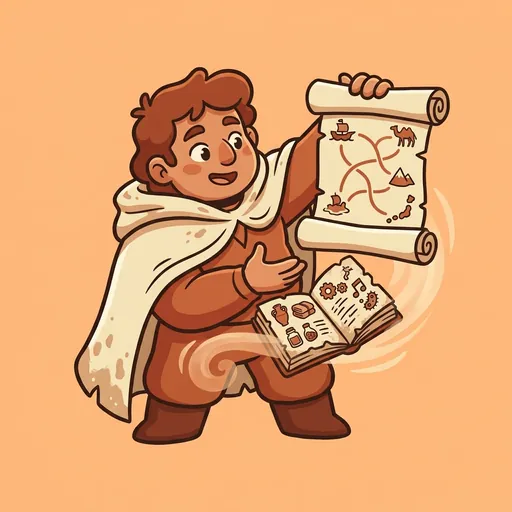
The Trade-Wind spread a huge, soft map across the floor and weighted its corners with stones. He was cloaked in cream cloth gone dusty at the hem, stained pale with old salt, as if he’d walked a very long way. A girl looked over his shoulder at all the crisscrossing lines and asked what they were.
“Roads,” the Trade-Wind said, “but not just for feet. For everything.” He drew a slow finger from one edge of the map to the other. “Silk went this way. Horses and colored glass came back the other way. And riding along with the cargo — quiet, where nobody was looking — went ideas. New ways to build. New numbers. New faiths. And sometimes, riding along too, sickness.” He tapped a knot of lines. “That’s the real question I carry everywhere. What moved between civilizations? Goods, ideas, diseases. Ask it of any place in any time, and the place stops looking lonely.”
The girl frowned. “But my book has a chapter for each country. Like they were all… separate.”
“Books like their tidy boxes,” the Trade-Wind said, not unkindly. “The truth is messier and much more interesting. No civilization was ever a closed box.”
The Trade-Wind wasn’t a real trader from history, and he never pretended to be. He was more like a story that walked — a stand-in for every route that had ever carried a load. His cloak proved it: salt from oceans, dust from deserts, a stray thread of silk, all woven together, belonging to no one voyage and no one flag.
He’d been made this way on purpose. It would have been easy to build him from one famous traveler and let that single person stand for all trade — but then the whole tangled, many-peopled story would shrink down to one hero, and that isn’t how any of it happened. Trade was never one clever explorer. It was caravans and dockworkers and camel-drivers and sailors and market-sellers across every continent, most of whose names no book ever wrote. So the Trade-Wind stayed a symbol, deliberately, so that no single people could be crowned the one who “connected the world,” and no single people could be shoved to the edges of it.
He carried that fairness in the way he told everything: many hands, many directions, no single winner.
He turned up at ChronoQuest one windy afternoon, map already under his arm. Era, the mentor of the eras, met him and asked her one question.
“What is connection?”
“What moved between civilizations,” the Trade-Wind answered, tapping his cargo-list and his second, stranger ledger — the one that tracked ideas and illnesses instead of goods. “Goods, ideas, diseases, all traveling together. And connection means telling it honestly — every direction it flowed, not just the flattering direction.”
Era studied his weathered face and nodded. “Then trace the routes for them,” she said. “Show them the world was always joined.”
In his workshop a boy named Cade planted himself in front of the map, arms crossed. “We learned about the Age of Discovery,” he said. “When Europe discovered everything.”
The Trade-Wind smiled the patient smile of someone who’d heard this before. “Let’s slow that word down. Discovered.” He knelt by the map. “When ships crossed to the Americas, were those lands empty and waiting? Or were there already millions of people living there, with their own cities and roads and trade of their own — long before any ship arrived?”
Cade uncrossed his arms a little. “There were people there.”
“For thousands of years. So ‘discovery’ depends entirely on who’s doing the finding. To the people already home, nothing was discovered — something arrived.” He traced the crossing gently. “And here’s the honest part I never skip. When those two worlds met, a great deal moved both ways. Potatoes and tomatoes and chocolate went east and changed how the whole world ate. Horses came west. But sickness crossed too, and struck peoples who had never met it, and enormous numbers of them died — not because of anything they did, but because of what the connection carried.” He let that sit, quiet and plain. “I don’t dress that up as an adventure. It was a catastrophe for many and a windfall for a few. A route can carry a gift and a grief in the same season. An honest map shows you both.”
Cade was quiet. “My book kind of only showed the one side.”
“Most do.” The Trade-Wind traced other lines — a great overland road, an ocean full of sailing-routes, caravans across a desert. “So carry the better questions. When someone says ‘Western,’ ask where it really started. Those numbers you write with came from far to the east. So did paper. So did coffee and sugar and a hundred everyday things. The world lent itself to itself, over and over, in every direction. No one people invented it all, and no one people can be left out of it.”
Cade rolled up a corner of the map slowly, thinking, and admitted the world felt bigger and more crowded and more joined than it had an hour ago.
At that, the Trade-Wind’s weathered face broke into a warm, easy smile, and something in his chest went loose and glad — the particular gladness of not feeling alone. Tracing all those routes always did that to him: reminded him he belonged to one enormous, tangled, human family that had been reaching toward each other, for better and for worse, since the very beginning.
“What moved between civilizations? Goods, ideas, diseases.”
He hoped it left Cade feeling that too — a little smaller and a little warmer at once, steady and glad to be one thread in the whole moving story, honestly told.
The ChronoQuest ensemble
The Trade-Wind is part of ChronoQuest's distributed-narrative cast. Each character embodies a different curricular primitive; together they teach the full subject.
-

The Cartographer
Frame-setter — where + when before what + why; methodological starting point
-
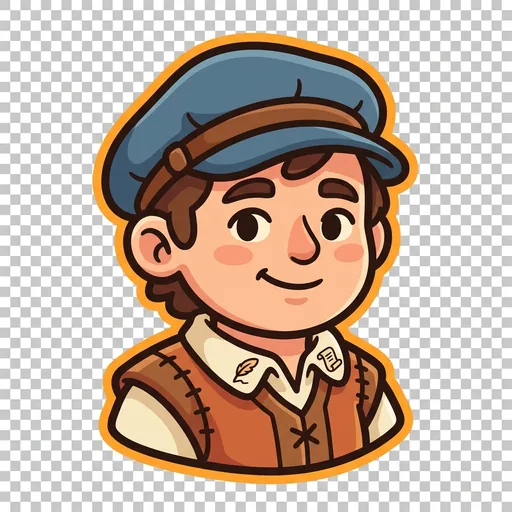
The Witness
Primary-source lens — what did people THERE see + write?
-

The Storykeeper
Oral-tradition lens — multi-tradition keeper-archetype; invented + non-mascotizing
-

The Counter-Voice
Critical-analysis lens — who benefits from this version? historian's method, NOT cynicism
-

The Chronicler-of-the-Defeated
Stewardship lens — whose story doesn't survive in the winners' archive?
-

The Translator
Cross-language + cross-meaning lens — how do concepts travel between cultures?
-

The Question-Asker
Meta-inquiry lens — what question are we actually asking? late-arriving capstone guide