Edge
MODEL LIMITATIONS — *what a model can't do; modeling 'I don't know' as a good answer.* The AI-literacy primitive of *recognizing that every model has edges — places where it cannot reliably answer.*
Press play to listen along. The line being read lights up as you go.
Show full transcript
Loading transcript…
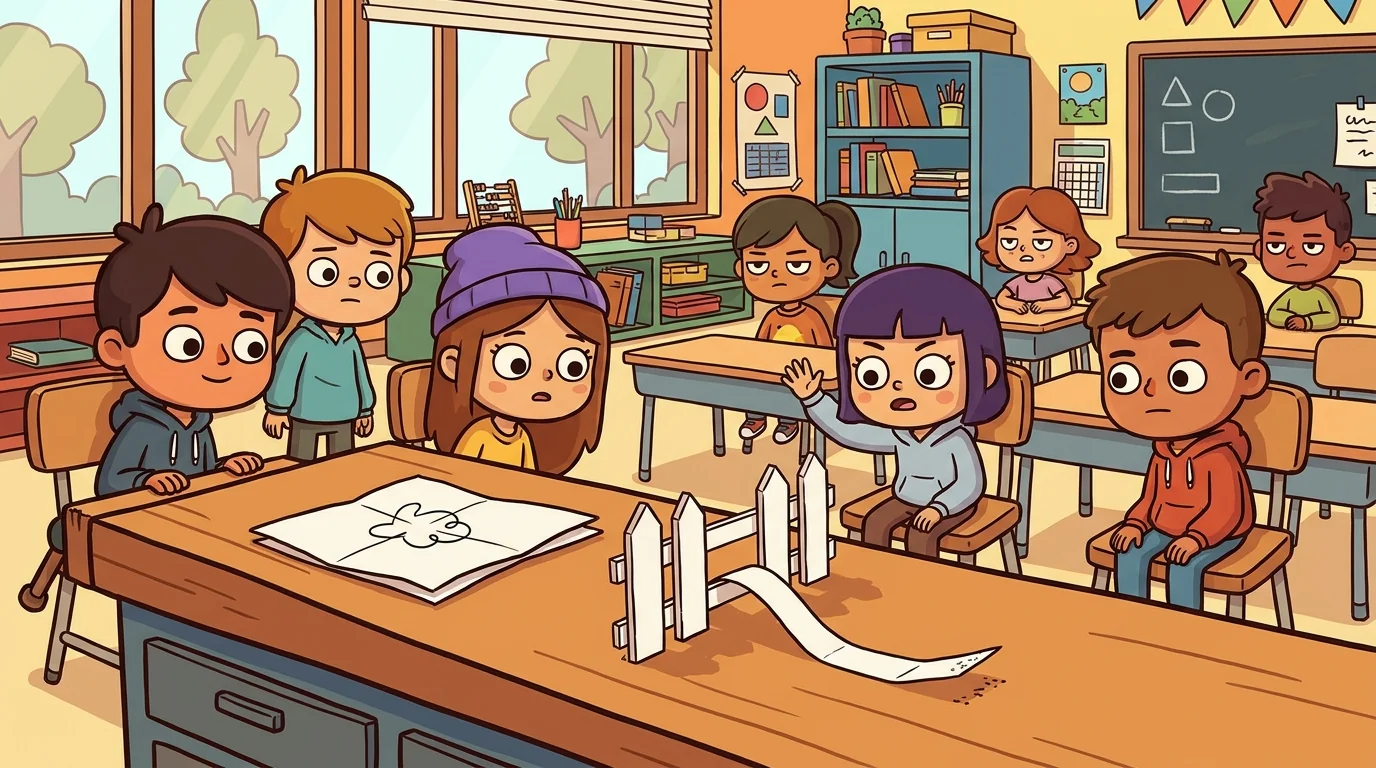
Edge arrived flat.
She looked like a forgotten piece of homework. Just a single sheet of paper lying on the workbench. The students in the classroom peered at it, unimpressed. “Is that… the teacher?” one of them whispered. “Looks like a doodle someone left behind,” another kid grumbled.
Then, the paper twitched. Thwip. A stiff, white post popped straight up from the workbench. Thwip. Thwip. Two more posts shot up beside it. Two long paper rails unfolded to connect them. In seconds, the paper had become a short fence. It was only three posts wide. It had a clear beginning and a definite end. It marked off a small space on one side. The rest of the whole wide world was on the other.

“I am Edge,” a crisp voice announced. The voice seemed to come from the fence itself. The students leaned forward in their chairs. “I am here to teach you the most important secret about AI,” Edge said. “I teach *model limitations*.” A student in the front row raised her hand. “What are model… lim-i-ta-tions?” “It means everything has an edge,” said Edge. “A place where the knowing stops. Your job is to find it.”
To show them, Edge produced a small paper robot. It was a boxy little thing, all sharp corners and folded cubes. She also had a thick stack of photo cards. She carefully placed the little robot inside the space made by her paper fence. “This is Gizmo,” she said. “Gizmo learned all about dogs. He spent weeks looking at pictures of dogs. Big dogs. Small dogs. Fluffy dogs. All of them were right here, inside this fence.” She picked up the top card. It was a photo of a happy golden retriever. She held it up for Gizmo. “What is this?” Edge asked. Gizmo’s paper head whirred. “Dog,” it buzzed. “Correct.” Edge showed him another card. This one was a fluffy poodle. “Dog,” Gizmo buzzed again. “Correct.” She showed him a third card. It was a tiny chihuahua that could fit in a teacup. “Dog,” Gizmo buzzed, perfectly sure of himself.
“Easy, right?” Edge said to the class. “Gizmo is an expert on dogs. The dogs are inside his fence. This is his training data.” The students nodded. This seemed pretty simple. Then Edge did something unexpected. She picked up Gizmo. She moved him to the outside of her fence. She picked up a new card. It was a picture of a fluffy ginger cat, mid-yawn. She held it up. “What is this, Gizmo?” Gizmo’s head whirred for a long, long time. The buzzing sound was different now. It sounded strained and confused. Finally, it said, “Wrinkly… dog?” The class erupted in giggles. “Is it a wrinkly dog?” Edge asked them. “No! It’s a cat!” someone shouted from the back.
Edge gently patted one of her paper posts. “Gizmo has never seen a cat. Cats are outside his fence. He never learned about them. So he has no good reason to know the answer.” She turned to the class. “But he still guessed. And he was wrong. He was confidently wrong.” She paused, letting that sink in. “And being sure of yourself when you’re totally wrong? That can cause big problems.”

“A smarter model knows its own limits,” Edge continued. “An honest model would say something different. It would say, ‘I don’t know.’” She tapped Gizmo’s head. “Saying ‘I don’t know’ is a fantastic answer. It’s an honest answer. You can trust a model that tells you when it’s not sure.” A model you can’t trust just makes things up. It sounds very sure of itself, even when it’s making a wild guess.
“People think AI knows everything,” Edge said. Her paper voice was serious. “They get an answer and they just believe it. That’s a huge mistake. You have to know when not to trust the answer. You have to learn to see the fence.”
Edge grew up in a busy workshop filled with paper crafts. Her friends Sort, Feed, and Skew lived there too. Edge was Sort’s partner. Sort was a classifier, which is a fancy word for a sorter who puts things into groups. Edge’s job was to stand right beside her. She showed everyone where Sort’s amazing sorting skills ended. That was the place where Sort would honestly say, "I don't know." Edge learned that the edge was the most honest part of any system.
When she first came to AIForge, the academy leader, Bit, had watched her. Edge had just rolled in on a small wheeled platform. She was twenty-two folding-years old. Bit had watched her give this exact same lesson. At the end, Bit didn’t say a word. Bit just gave a slow, thoughtful nod. For Bit, that was like a standing ovation.

Back in the classroom, Edge looked at the students. “So, how do you find the fence?” she asked. Hands shot into the air. Edge pointed to a student in the front. “You have to ask what it learned from!” the student said. “Like, Gizmo only learned from dog pictures.” “Exactly!” Edge said. “What did the model train on? Was it just English words? Then it won't know other languages. Was it just grown-up voices? It might not understand you. Was it old photos? It won't know about your new phone.”
“What else?” Edge asked. Another student spoke up. “Don’t some models tell you how sure they are?” “Yes! A confidence score,” Edge said, tapping one of her rails. “It’s a number. If that number is low, the model is telling you it’s near its edge. It’s waving a flag that says, ‘Hey, I’m just guessing here!’ You have to listen.”
Edge folded one of her end-posts inward. “When you build an AI, you should build ‘I don’t know’ right into it. Make it so the AI only answers if it’s really, really sure.”
She pointed to the pictures of the poodle and the chihuahua. “Gizmo might mix these two up sometimes. That’s a mistake inside the fence. We can fix that with more training. We can give him more dog pictures.” She then pointed to the cat picture, far outside her fence. “But this is not a mistake. This is a limit. Gizmo just can’t know about cats. It’s not what he was built for.”

“So don’t believe anyone who says an AI can do anything,” Edge finished. Her voice was firm. “That’s just an advertisement. It’s not real. Every single model has a fence. Every single one has edges.”
She looked out at the new students. Their faces were thoughtful. They were starting to understand. “Your job here is not just to build things,” she told them. “Your job is to find the fence. And to respect it.” A student asked, “Is that hard to do?”
Edge’s paper form seemed to smile. “Not hard,” she said. “The honest model says, ‘I don’t know.’ The dishonest one pretends it knows everything.”
With a final, soft thwip, she folded herself completely flat again. She was just a piece of paper on the workbench. But now, the students saw the fence. And a warm, quiet feeling settled over the room — the good, steady calm of knowing it was okay not to know everything. A few of them let out a breath they hadn't noticed they were holding. It felt lighter, somehow, to stop pretending.
The AiForge ensemble
Edge is part of AiForge's distributed-narrative cast. Each character embodies a different curricular primitive; together they teach the full subject.
-

Sort
Classifier — the simplest ML; putting things in categories
-

Feed
Training data — the examples a model learns from; garbage-in-garbage-out
-
Skew
Bias — where AI systems go wrong when training examples lean
-

Stake
Ethics — what's at stake in deploying AI; people choosing, not rules-from-the-sky
-

Split
Train/test split — keep some examples hidden to tell learning from memorizing
-

Cue
Features — a model decides from the clues you give it; choose good clues
-

Sure
Confidence — a model reports how sure it is; low confidence means check, not trust