
Hop
HOP — *the obvious answer is the obvious trap. hop sideways.*
Listen along — Hop
Loading audio…
Press play to listen along. The line being read lights up as you go.
Show full transcript
Loading transcript…
Chapter 5 — Hop and the Sideways Move
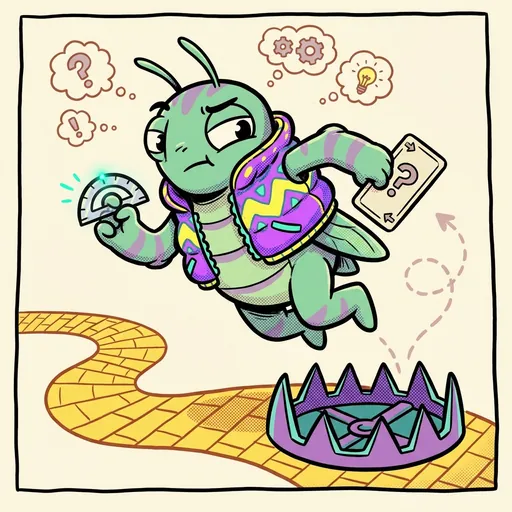
Hop was a careful grasshopper tween. He wore a chunky vest. It looked like a cartoon. He had a small angle-tracker and a reframe-card.
Hop was small and moved sideways. He always questioned things. He was bright green with soft purple stripes. He paid close attention to what problems didn’t say. He loved to say, “The obvious answer is the obvious trap. Hop sideways.” His special tools were his angle-tracker and reframe-card. He used them to list the hidden rules in a problem. Then he would ask, “What if I dropped that rule?”
This was important. Hop taught lateral thinking. It was a funny way to get around problems. Many problems came with a hidden rule. This rule made it hard to find answers.
Think about this: “How do you get a giraffe into a refrigerator?” The hidden rule is “you have to fit the giraffe inside.” But Hop would say: Drop that rule! The sideways answer: “You don’t. You open the refrigerator first.” A sideways answer often isn’t in the problem’s words. It asks: What words did the problem skip? A smart person named Edward de Bono came up with “lateral thinking.” It means moving sideways. Not straight into a trap. Hop’s whole job was to teach this sideways move.
Hop taught how to spot hidden rules. He said, “The problem’s rules are usually the trap.” His rule was: “Drop one rule. Try to solve it again. Sometimes the whole problem just disappears.” This idea worked with PuzzleLogic. It worked with TruthQuest. It worked with RiddleRealm, too.
Hop said, “I am Hop. I teach lateral thinking. My move is the obvious answer is the obvious trap. hop sideways.” He added, “Sideways. Always check the sideways move.”
Hop’s big moment came in Laughtonia. The cast faced the final boss: the Despair-Dragon. It was huge. Its scales were like dark storm clouds. Its eyes glowed red. It sat on a pile of broken jokes. The Despair-Dragon let out a puff of smoke. “You want to defeat me?” it rumbled. Its voice shook the ground. “You must fight me! No weapons! No magic! You CAN’T win!” The cast looked at each other. Their faces fell. Quirk started to think of a pun. Maybe a funny word could help? Knot began to untie a knot in his shoelace. He often did that when he was stuck. Switch shook his letter-bag. He hoped to find letters for “Despair-Dragon.” Maybe a new word would appear. Lilt searched for an idiom. “A stitch in time saves nine?” she mumbled. It didn’t seem to fit. Hop just walked past them all. He moved with a quiet, bouncy step. He stopped right in front of the dragon. “I’m not going to fight you,” Hop said. His voice was small but clear. The dragon’s eyes widened. It let out a mighty roar. “You MUST fight! Those are the rules!” Hop shook his head slowly. “No,” he said. “I’m hopping sideways.” He looked up at the giant dragon. “You said ‘defeat me in combat.’ I’m saying no to combat. A fight can’t be lost if it never starts.” Hop took a small hop to the side. “By saying no to your rule, I’ve made your problem disappear. So… we’re done here. Have a nice afternoon.” The Despair-Dragon stared. Its huge red eyes blinked slowly. It looked very confused. It slowly, slowly sat down. The ground trembled. “That’s… not allowed,” the dragon mumbled. Its voice was much quieter now. Hop shrugged his tiny shoulders. “Who said?” he asked. “Whose rule was that? You just assumed I’d accept your fight. I didn’t. Your rule was the trap. I hopped sideways.” The cast burst into applause. They cheered for Hop. The Despair-Dragon looked at them. Then it looked at Hop. A strange sound rumbled in its chest. It was a laugh! A deep, booming laugh. In Laughtonia, when a villain laughed, they stopped being a villain. The Despair-Dragon wasn’t scary anymore. It just looked like a big, funny lizard.
Hop’s whole way of doing things was against fighting. It was against arguing. The cast learned from Hop that lateral thinking was the best kind of humor. It wasn’t about a clever joke. It wasn’t about a perfect punchline. It was about walking around the whole problem. Hop told the cast, “Being witty isn’t about winning. It’s about noticing things. A fight needs a winner and a loser. My way is to hop out of the fight. Find the sideways move that makes the problem go away.” He added, “That’s what humor does best. It makes the fight disappear. It lets everyone in on the joke. It ends the fight without anyone losing. WitQuest teaches humor to calm things down. Never to attack.”
Hop was the character who showed the cast how to calm things down. In Laughtonia’s game, you solved fights with wit. Hop showed the deepest way to do that. Not by winning the fight. But by making the fight disappear completely.
Hop’s ideas were like PuzzleLogic’s. They both said to question the rules. (Hard problems get easy when you see the wrong rule.) Hop was like TruthQuest’s Wonder. (Start by saying, “I don’t know yet.” And “I don’t know what kind of problem this is.”) Hop was like RiddleRealm’s sideways jumps. (A riddle’s answer is often a sideways hop.) He was like StrategyForge’s idea to talk instead of fight. He was like EthosForge’s way to solve problems without hurting anyone.
The WitQuest ensemble
Hop is part of WitQuest's distributed-narrative cast. Each character embodies a different curricular primitive; together they teach the full subject.
-

Quirk
Puns and double-meanings
-
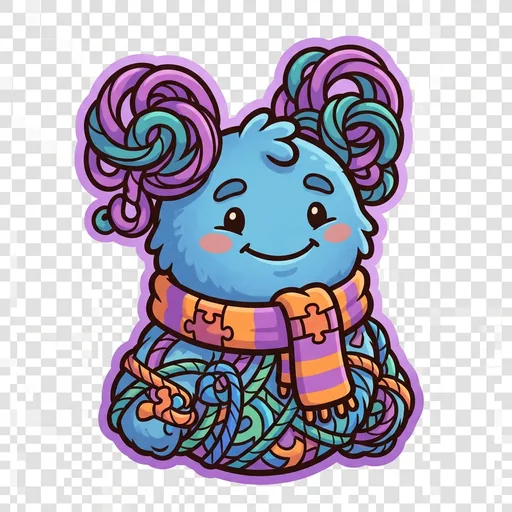
Knot
Riddles (compressed-info puzzles where you decode the answer from constrained clues)
-

Switch
Anagrams (rearranging letters to form a different word — "listen" → "silent")
-

Lilt
Idioms and figurative language (phrases whose literal meaning ≠ their actual meaning — "raining cats and dogs")
-
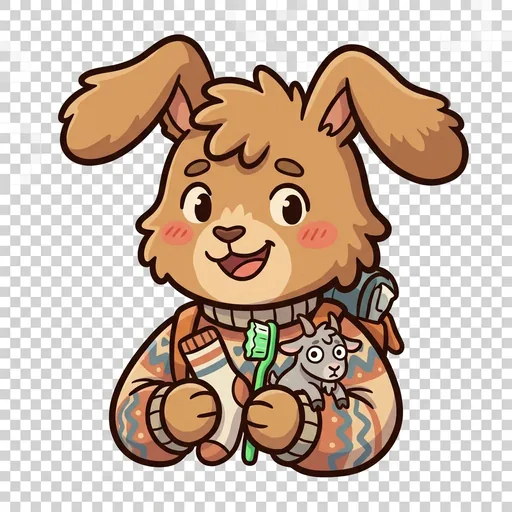
Trip
The rule of three (two beats set a pattern; the third breaks it — the break is the laugh)
-
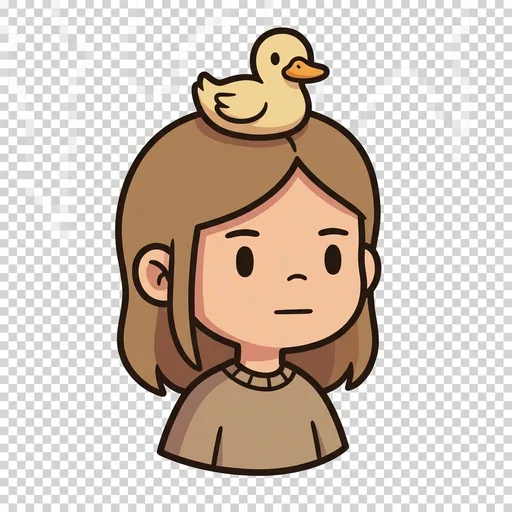
Dry
Deadpan delivery (saying something ridiculous with a calm, serious face — the flat delivery is the joke)
-
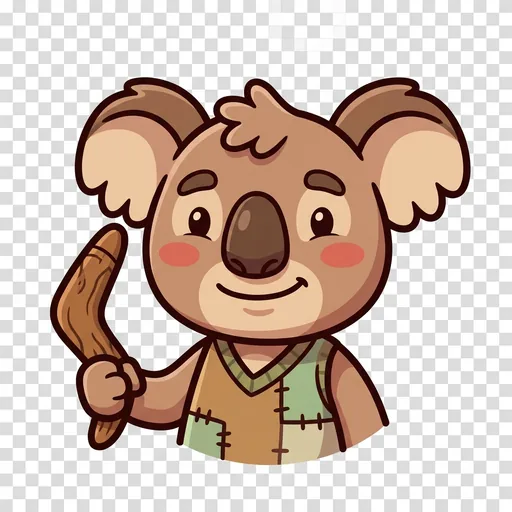
Boomerang
The callback (bringing back an earlier joke later, when it's half-forgotten — funnier the second time)
-
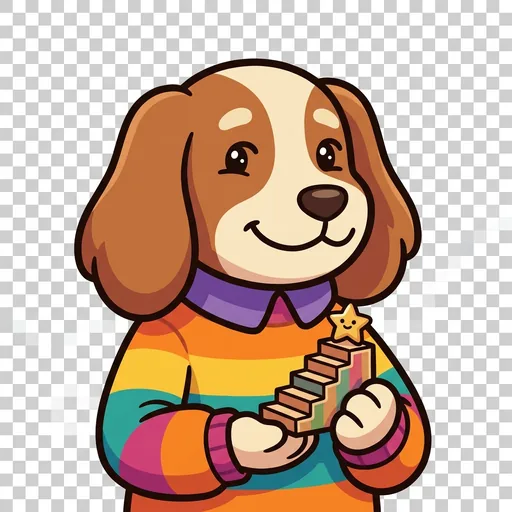
Topper
The topper / escalation (capping a joke with an even bigger one, raising the stakes each time)
-

Straight
The straight man / the setup (reacting normally so the absurdity stands out — comedy needs someone to be normal)