
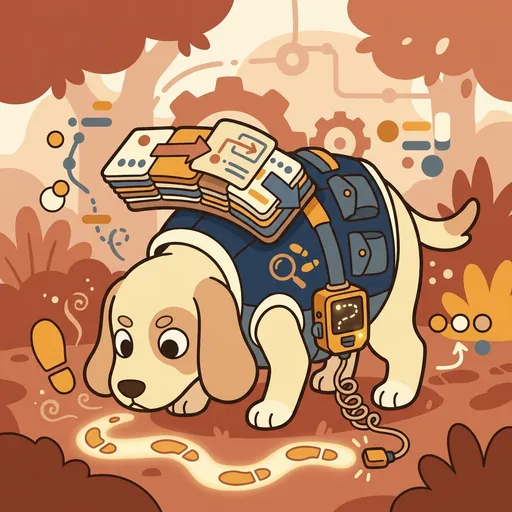
Trace
TRACE — *where does this claim ORIGINATE? open four tabs; follow it back.*
Listen along — Trace
Loading audio…
Press play to listen along. The line being read lights up as you go.
Show full transcript
Loading transcript…
Chapter 3 — Trace and the Path Back to the First Source
Trace hunched over the old oak table, her nose almost touching the laminated screen of her tablet. Sunlight, filtered through the high windows of the Truth Tribune, caught the dust motes dancing around her. She wore a vest with many pockets, each one bulging slightly. It was a practical garment, made for carrying things. Her soft tan ears, usually hidden by her cream-colored hair, drooped a little with concentration. Trace was a bloodhound, not literally, but in the way she tracked things. Her focus was absolute.
“Okay,” she murmured, tapping a stylus against the screen. “Let’s follow this one.”
Her fingers moved quickly across the screen. She was small for her age, but her movements were precise. Trace’s signature tools lay beside her: a stack of small, laminated provenance-chain-cards and a digital breadcrumb-tracker. The cards were simple. Each one asked a question: Where did I hear this? Where did they hear it? Ultimately, where did this start? The tracker, a simple app, mapped the path back.
Today’s claim was a doozy. It had popped up on the school’s unofficial gossip forum, then spread to every social media feed. “The school principal,” Trace read aloud, her voice quiet, “is secretly replacing all the art supplies with recycled trash. A new policy starts next week.”
“Sounds bad, right?” a voice chirped from behind her. It was Leo, a classmate who often wandered into Trace’s workshop. He was always looking for the next big scoop, but sometimes he jumped too fast.
Trace nodded slowly. “It sounds bad. But where does this claim originate?” She held up a finger. “That’s the first question. Always.”
Leo shrugged. “Everyone’s saying it. My cousin heard it from a friend whose mom works at the school.”
“Mid-chain,” Trace said, almost to herself. She tapped the first provenance card. Where did I hear this? “Social media, then your cousin, then a friend, then a mom. That’s a long chain already.”
She opened four tabs on her tablet, a habit she called ‘opening the trail.’ The first tab showed the viral post. The second showed a screenshot of a text message, supposedly from a student council meeting. The third was a link to a local news blog. The fourth was blank, waiting.
“This is evidence-traceback,” Trace explained to Leo, who was now leaning over her shoulder. “It’s the craft of following claims back to their very first source. Most people just stop at ‘I heard it on social media.’ But that’s like finding a footprint in the woods and assuming you know who made it, without following the track.”
Her family had been long-trail-followers for generations, not of actual deer tracks, but of stories and rumors in the deep woods around their home. They were the bloodhounds whose nose-down tracking had taught her that “the trail leads to the origin; you have to walk it.” Trace had carried that lesson forward.
She clicked on the news blog link. It cited “an anonymous source close to the school administration.” Trace frowned. “Anonymous sources can be tricky. They can be real, but they can also be… a dead end.” She pulled out another card: Dead-end traces = information. “If a claim can’t be traced, we calibrate our belief in it. Lower it.”
Her fingers flew. She reverse-image-searched a blurry photo attached to the text message, supposedly showing old art supplies being thrown out. The search results showed the photo was five years old, from a different school district entirely, during a spring cleaning event. Image and video provenance, she thought. Always check date and context.
“See how the claim is already starting to decay?” Trace asked Leo. “The viral version is dramatic. ‘Replacing with trash!’ The original might be much less so.” This was decay through retelling. Each person who repeated the story dropped a little nuance, added a little drama.
She went back to the text message screenshot. It mentioned a “student council proposal.” That was a lead. Trace navigated to the school district’s official website. She found the student council meeting minutes, carefully archived, dating back months. She scrolled through them, her eyes scanning for any mention of art supplies or budget cuts.
Finally, she found it. A small line item in a meeting from two months ago: “Discussion of sustainable art supply options, including potential for upcycling materials from discarded school projects.”
“Aha!” Trace whispered. She tapped the last provenance card. Find the primary source. This was it. The official record.
“So, what does it say?” Leo asked, clearly impatient.
“It says,” Trace explained, pointing to the screen, “that the student council discussed upcycling materials from discarded school projects to create sustainable art options. Not ‘replacing all art supplies with recycled trash.’”
Leo blinked. “Oh. So, it’s not true?”
“The viral version isn’t,” Trace clarified. “The original idea was about being eco-friendly. The ‘trash’ part, the ‘new policy next week’ part – that got added later. It amplified the story, made it sound worse.”
This was the core of her work. Many claims that sounded authoritative, like “studies show” or “everyone knows,” traced back to weak or non-existent origins. Sometimes, the original source even said the opposite. Trace’s whole work was making provenance visible as traceback-craft, not as taking claims at face value.
“I am Trace,” she often told new students in her workshop. “The primitive I teach is evidence-traceback. The move is: follow the chain back, find the primary source, and remember that dead-end traces are also information.”
She remembered the day Veritas, her mentor, had appointed her at the Truth Tribune. Trace had been just twelve, but her focus was already legendary. Veritas had asked, “What is traceback?” Trace, without hesitation, had replied, “Where does this claim originate? Open four tabs; follow it back. Provenance-craft.” Veritas had simply nodded. “You are appointed.”
Trace looked at Leo, who was still processing the difference between “recycled trash” and “upcycling discarded school projects.”
“Don’t take mid-chain claims,” Trace said gently, her voice firm. “Trace back. Open four tabs. Find the origin. The viral version and the original often diverge sharply.” She tapped the tablet screen one last time. The breadcrumb-tracker showed a clear path, from the sensational social media post all the way back to the nuanced student council minutes.
“Where does this claim originate?” she repeated, a quiet mantra. “Open four tabs; follow it back.”
The TruthQuest ensemble
Trace is part of TruthQuest's distributed-narrative cast. Each character embodies a different curricular primitive; together they teach the full subject.
-

Claim
Claim-identification — what EXACTLY is being asserted? distinguish claim from opinion from feeling from prediction
-

Weigh
Credibility-evaluation — who's in a position to KNOW? what stake? calibration not verdict (shared design language with DebateForge Weigh)
-

Update
Belief-revision — being WRONG is how knowledge MOVES; visibly carry old-guess and new-guess as data (shared design language with DebateForge Yield)
-

Wonder
Epistemic-humility — 'I don't know yet' is the START of knowing; trust calibrated to evidence; counter-cynicism