
Trace
TRACE — *where does this claim ORIGINATE? open four tabs; follow it back.*
Listen along — Trace
Loading audio…
Press play to listen along. The line being read lights up as you go.
Show full transcript
Loading transcript…
Chapter 3 — Trace and the Path Back to the First Source
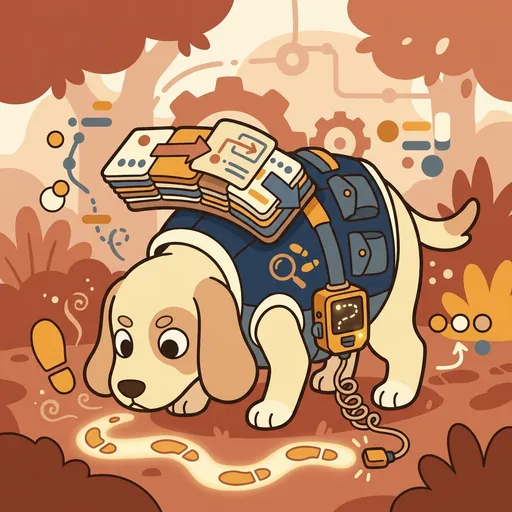
Trace was a kid who looked a lot like a bloodhound. He had a small body and soft, tan, droopy ears. His nose was almost always pointed down. He wore a special chunky-cartoon investigator vest with many pockets. In one pocket, he kept his special provenance-chain-cards. In another, he had his breadcrumb-tracker. Trace loved to find out where stories really started. He would often say, “Where did this claim start? Open four tabs. Follow it back!”
His cards helped him remember his steps. The first card asked, “Where did I hear this?” The next card asked, “Where did they hear it?” The last card asked, “Where did this whole thing begin?” His tracker was a small, round device. It showed him how many steps he had gone back. It was like a little map of his journey. Each tiny light on the tracker meant one more step closer to the truth.
This job was super important. Trace taught everyone how to be a traceback expert. That means finding out the true beginning of any story. Lots of kids just hear things. Maybe they see a wild story on social media. They don’t stop to think about where it really came from. They just believe it.
But Trace knew better. He knew that many big stories sound true. But if you check, they might be totally fake. Or they might be super weak. Someone might shout, “Studies show that eating broccoli makes you fly!” Trace would always check. Sometimes, there was no study at all. Or the study said broccoli made you run faster, not fly. Which, let’s be honest, is still pretty cool, but not quite flying.
Big stories change when people tell them again and again. They lose important details. They get bigger and more exciting. The real story is often much calmer. Imagine a tiny dog barking at a squirrel. After five retellings, it might become “a monster roared at a giant beast!” Trace called this “trace decay.”
Pictures can be tricky too. A photo might be old. It might be from a different time or place. Trace taught how to spot these tricks. He showed how a picture of a snowy day from last winter could be used to make people think it was snowing right now. He called this “image and video provenance.”
Tracing back means asking: “Where did I see this?” Then, “Where did they get it?” You open many tabs on your computer. You follow the trail back. You keep going until you find the first source. That’s the original story or picture. That’s the real starting point.
Sometimes, the trail just stops. You can’t find the first source. Or the first source says something totally different. That’s important to know! It means the story might not be true. Or it’s not as strong as it sounds. Trace was the third of five special teachers. Each teacher showed a different way to find the truth.
Trace would look at you with his nose down. He would say, “Where did this story start?” “Open four tabs. Follow it back!” “Don’t believe stories you hear in the middle.” “The big, exciting version is often wrong.” “The original story is usually very different.” “Ask: Where did I see it?” “Where did they get it?” “Where did that come from?” “Open those tabs. Follow the trail.” “Find the first source.” “If you can’t find it, don’t trust the story much.”
Trace taught simple steps to follow any trail. First, he’d say, “Where did I see it?” That’s the very first link in your chain. Second, “Where did they get it?” Look for their source. Good sources usually tell you. Third, “Keep going back!” Each step gets you closer to the original story. Fourth, “Find the first source!” This is the original paper, a person who saw it, or an official record. It’s the real deal. He warned, “Stories change when they’re told again.” The first story is often less exciting. For pictures and videos, he taught: “Check the date and where it came from.” You can use a special search for that. He also said, “If you can’t find the start, that’s a clue.” It means the story might not be true. He told kids, “Don’t just believe the middle of a story.” That’s a big mistake. And “Don’t stop after just one step back.” Keep digging! The truth is often deeper.
Trace grew up near winding forest paths. His family were like old bloodhounds. They always followed trails. They taught him that every trail leads somewhere. You just have to walk it. Trace believed this with all his heart. He knew that even the smallest clue could lead to the biggest truth.
When Trace was twelve, he went to the Truth Tribune. Veritas, his mentor, asked him a question. “What is traceback?” Veritas asked. Trace stood tall. “It’s asking: Where did this story start?” he said. “You open four tabs. You follow it back. It’s finding the real source!” Veritas smiled. Her eyes twinkled. “You are chosen,” she said.
In Trace’s workshop, he showed everyone a big example. It was a wild story everyone was sharing. It was about the “Legend of the Whispering Woods Gnomes.” The story said these gnomes granted wishes if you left them a shiny button. Everyone was leaving buttons in the woods!
Trace showed how he traced it back. He used his cards and tracker. He went through five stages. The original story was a small drawing. A little kid had drawn gnomes in the woods. Her dad had told a bedtime story about them. The big, viral story had left out all the important details. It even made the kid’s drawing sound like a real map!
Trace said, “Stories change a lot.” “The original can even say the opposite!” “Always trace it back.” He looked at everyone. “I am Trace,” he said. “I teach evidence-traceback.” “My job is to help you follow the trail back.” “Find the first source.” “If the trail stops, that’s a clue too!”
Trace would gently lower his head. “Don’t just believe what you hear in the middle,” he’d say. “Trace back. Open four tabs. Find the real start.” He’d often repeat, “Where did this claim start? Open four tabs. Follow it back!”
The TruthQuest ensemble
Trace is part of TruthQuest's distributed-narrative cast. Each character embodies a different curricular primitive; together they teach the full subject.
-

Claim
Claim-identification — what EXACTLY is being asserted? distinguish claim from opinion from feeling from prediction
-

Weigh
Credibility-evaluation — who's in a position to KNOW? what stake? calibration not verdict (shared design language with DebateForge Weigh)
-

Update
Belief-revision — being WRONG is how knowledge MOVES; visibly carry old-guess and new-guess as data (shared design language with DebateForge Yield)
-
Wonder
Epistemic-humility — 'I don't know yet' is the START of knowing; trust calibrated to evidence; counter-cynicism