Ribbet
the mental number line (farther along = more)
Press play to listen along. The line being read lights up as you go.
Show full transcript
Loading transcript…

Ribbet was a little green frog who lived by a row of lily pads. The pads sat in a line across the pond — pad one, then two, then three, all the way to the far, far pad. Ribbet loved to hop along them and say each number out loud.

"One!" Ribbet hopped to the first pad. "Two!" A hop farther. "Three!" Farther still. Each hop carried her a little more along the line. The bigger the number, the farther from home she landed — and the farther she looked back and grinned.
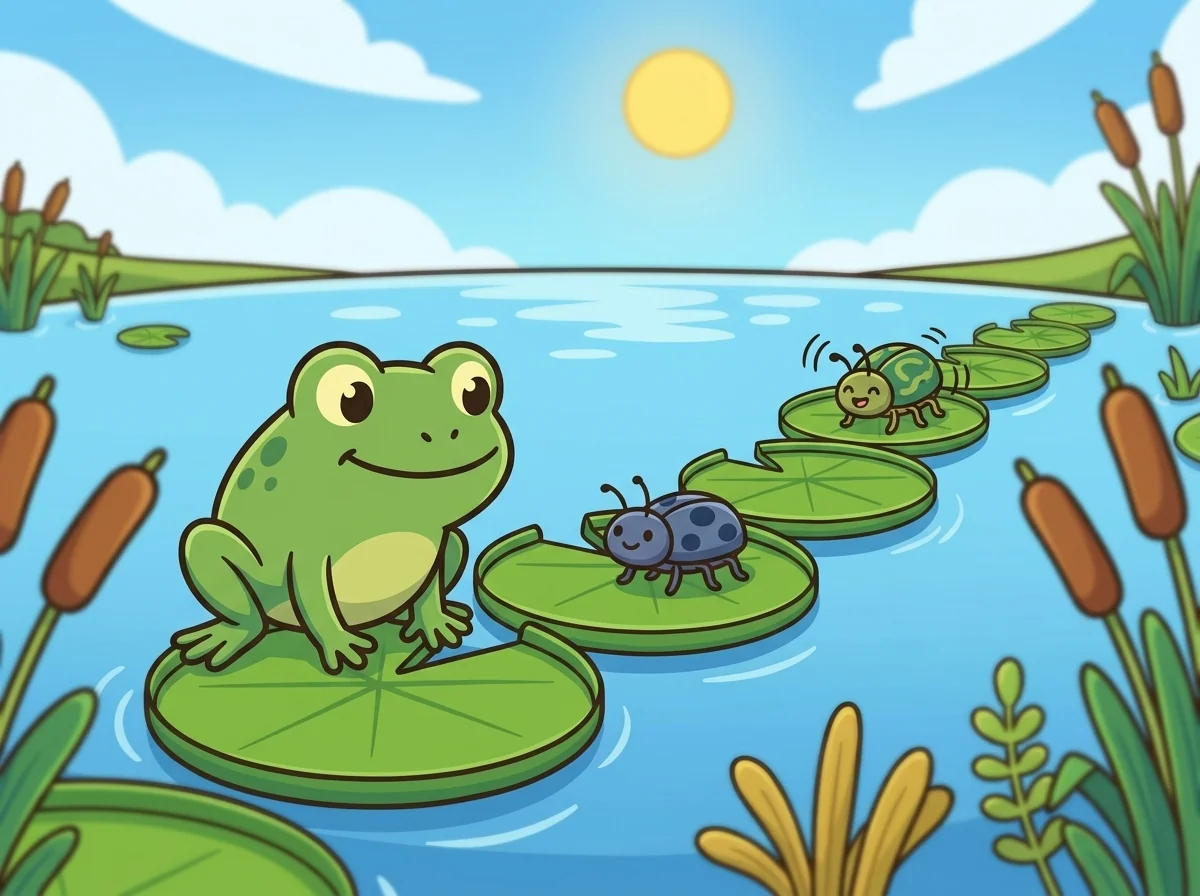
One day two beetles raced. One stopped on pad two. One stopped on pad five. "Who went farther?" they asked. Ribbet looked down the line. Pad five was way past pad two. "Five is farther," she said, "so five is more." The beetle on five did a happy wiggle.

Ribbet's favorite trick was one more. If she sat on pad four and hopped once, she landed on five — one step bigger. If she hopped again, six. Each single hop moved her one pad up the line, one number bigger. Farther along always meant more.

When the sun went down, Ribbet sat on the highest pad she'd reached all day and looked back at the long line of pads behind her. She had started at one and hopped so far. Her legs were tired and her heart was proud. Every hop had taken her one more, and one more, all the way to here.
"Look how far I went," she whispered to the pond. And the pond, full of quiet ripples, seemed to agree.
The TallyTots ensemble
Ribbet is part of TallyTots's distributed-narrative cast. Each character embodies a different curricular primitive; together they teach the full subject.
-

Dottie
Subitizing — a ladybug whose back-spots you know at a glance, without counting; instant recognition IS subitizing
-

Wriggle
The successor principle — a caterpillar who grows one segment when you add one and sheds one when you take one; ±1 IS the next/previous number
-

Clutch
Counting / cardinality — a hen who touches each egg once as she counts; the last number IS how many in all