Bones
BONES — chance is design craft, not betting. designed randomness has a job.
Loading audio…
Press play to listen along. The line being read lights up as you go.
Show full transcript
Loading transcript…
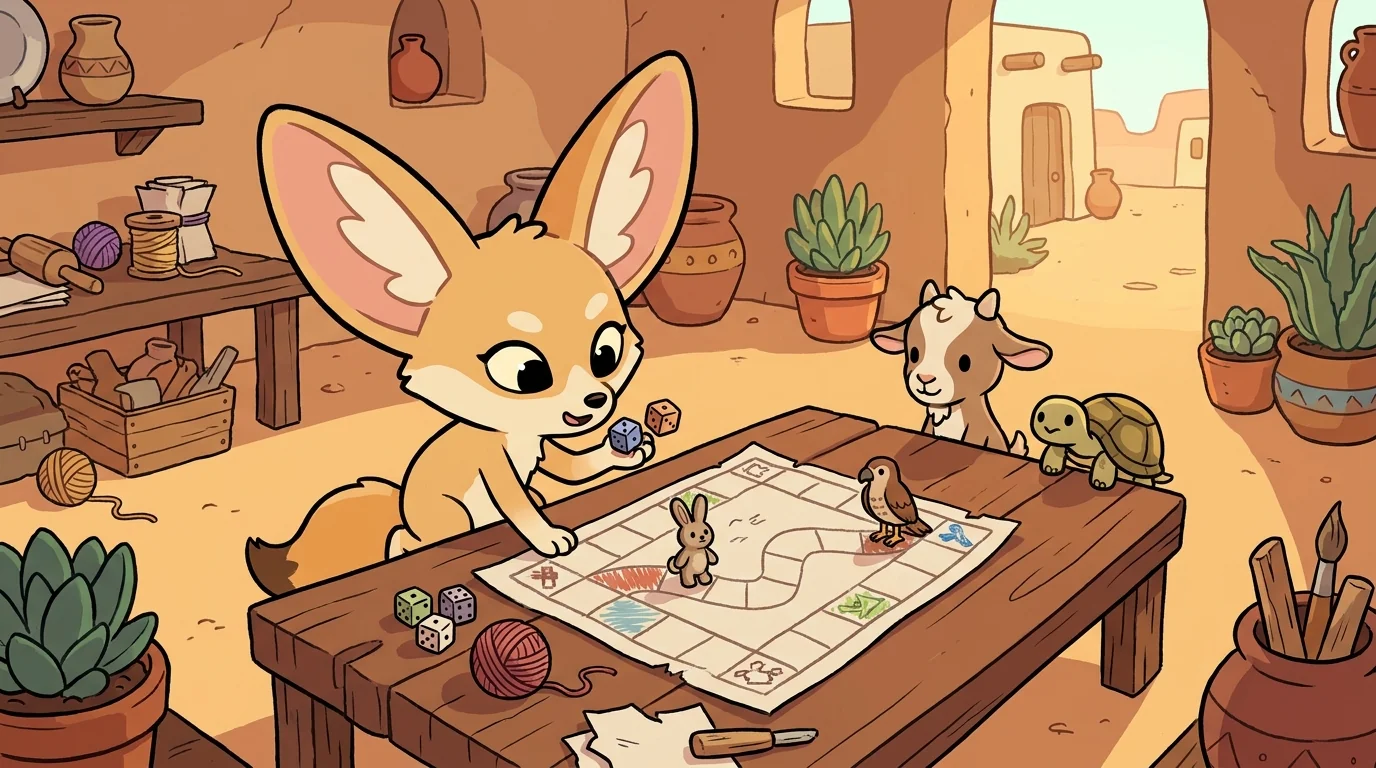
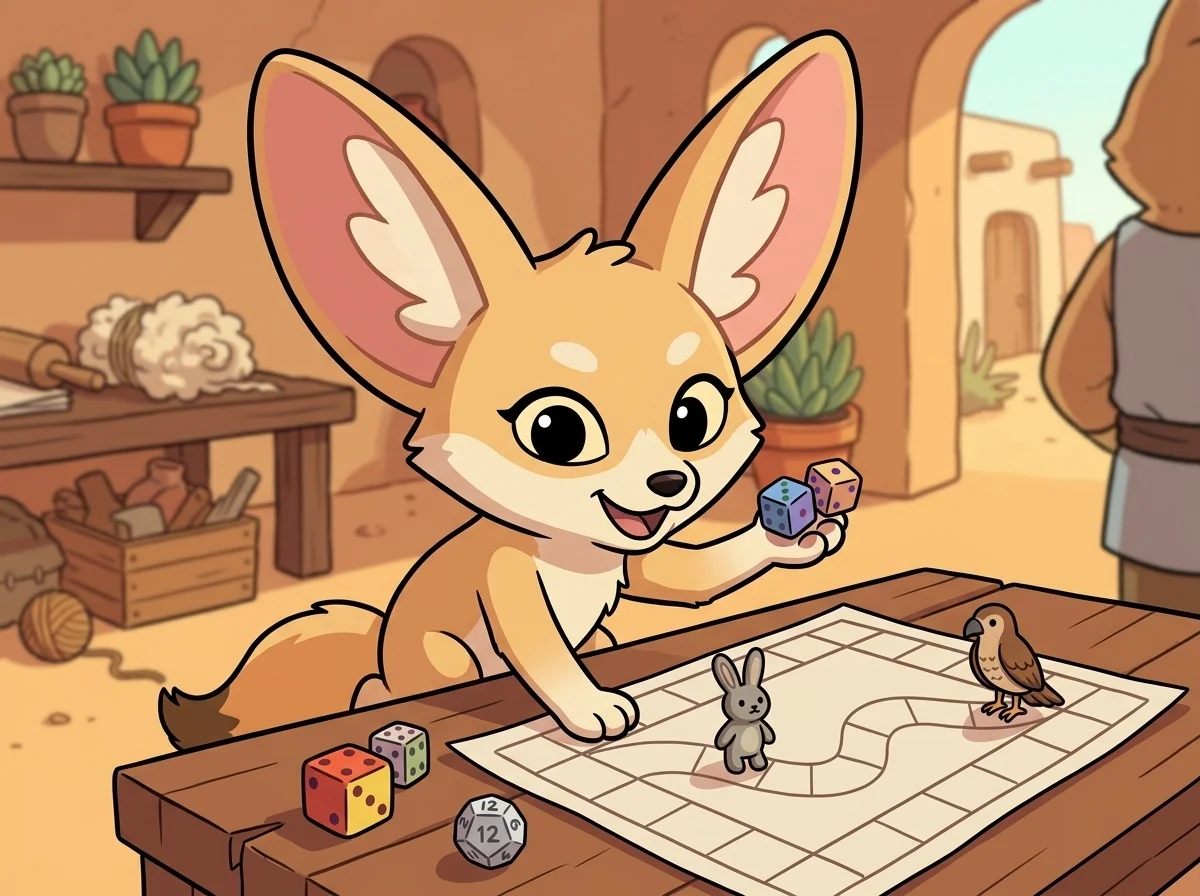
In the middle of the desert-village workshop, a small fennec fox named Bones knelt over a plain wooden table with three different dice in her paw, and she was making a game feel unfair on purpose.
She'd built a little chase across a paper board — a tiny felt rabbit running from a tiny felt hawk — and right now the rabbit always lost. "Too tidy," she muttered. Her big soft ears swiveled as she thought. She swapped the single die the hawk rolled for two smaller ones and rolled them a dozen times, watching where the numbers piled up. Sevens, mostly. A few twos. A rare, thrilling twelve.
A village kid leaned in over her shoulder. "You're just rolling dice over and over. That's not building anything."
"I'm building the feeling," Bones said, without looking up. "Watch what these two do." She handed him the pair. "Roll them twenty times and shout out the total each time."
He did. He noticed it himself around roll nine. "It keeps landing near the middle."
"Right. Two dice bunch toward the middle. So the hawk is usually pretty fast — but every so often it stumbles, and every so often it's terrifying." She nudged the felt rabbit forward one square. "Now the rabbit has a chance. Not a guarantee. A chance. That's the whole game — that lean-forward second where you don't know yet." She grinned, ears up. "The dice aren't deciding for us. They're doing a job."
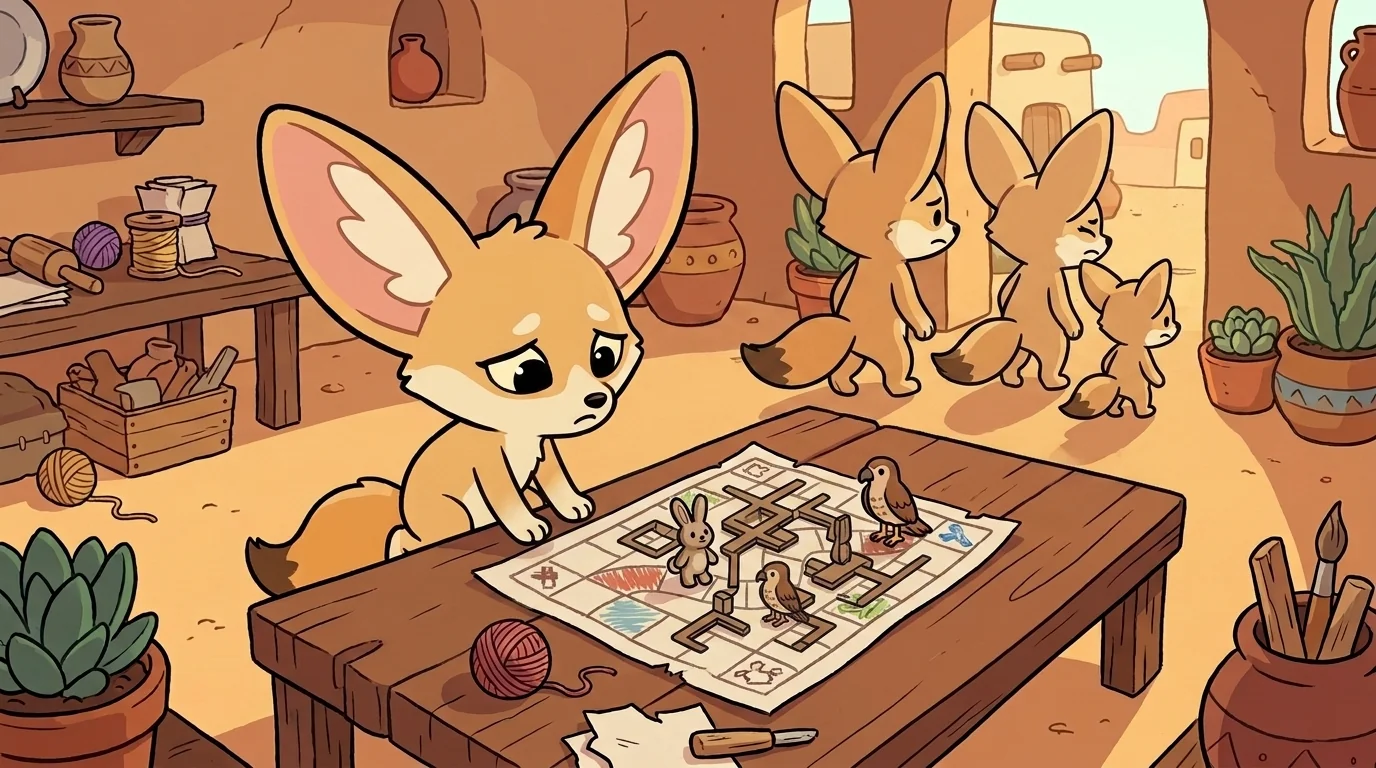
Bones had learned what that job was the hard way, back when she was small and thought fair meant the best player always wins.
Her family had made games for the village for generations, and the first game she ever built by herself was brutally fair — no dice at all, just clever moves. She was good at clever moves. She beat every kid in the village, over and over, until one afternoon her smallest cousin set down her pieces mid-game and said, quietly, "I already know I'm going to lose. So why play?" — and walked away.
Bones sat alone with her perfect, unbeatable game and felt something go tight and cold in her chest. She'd made a thing so tidy that only she enjoyed it. It wasn't a game anymore. It was a wall.
Her grandmother found her there. She didn't tell Bones she'd done something wrong. She just picked up a single worn die and set it in the middle of the board. "You built a game where the strong one always wins," she said. "So the small one stops trying. What if the small one could sometimes get lucky?"
"Then it wouldn't be fair," Bones said.
"It would be kinder fair," her grandmother said. "A little chance means the small one keeps hoping. Hope is what keeps someone at the table." She rolled the die. It came up high. "The dice don't win for you, little one. They give everyone a reason to lean forward. Learn what that reason is worth."
Bones didn't rebuild the game that day. But the cold, tight feeling melted into something she could think about. Chance wasn't cheating. Chance was an invitation.
She walked to TableForge at twelve, because a place that studied how to make games ought to understand the kind of fairness that leaves room for hope.
Blueprint, the old mentor who ran the workshops, met her at the gate. He didn't ask her to prove she was smart. He asked one question. "Isn't dice just gambling?"
Bones didn't answer with words. She set two little games on his desk. In the first, a coin decided everything in one flip — win or lose, nothing else. In the second, a handful of dice fed into a long chase where you rolled, and chose, and rolled again.
"This one," she said, tapping the coin game, "is just betting. You put in nothing, you do nothing, chance hands you a result. No craft." She slid the second game forward. "But here the dice give me tension — will I roll far enough? — and fairness, so the kid who's behind can still catch up, and surprise, so no two games feel the same. Same dice. Completely different job." She looked up at him. "One's a bet. One's a design."
Blueprint turned the two games over in his hands for a long moment. "You belong here," he said.
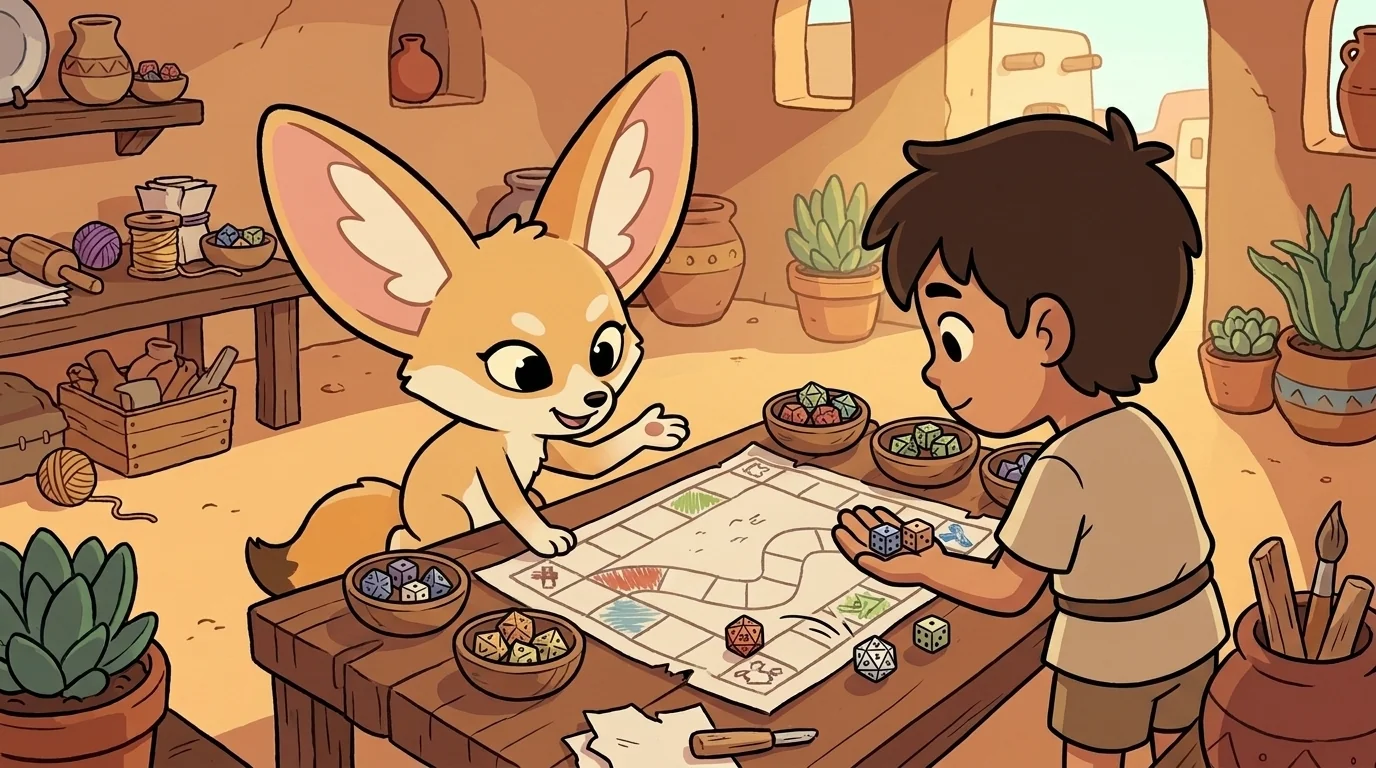
Bones's workshop was full of dice sorted into little bowls by what they were for.
A boy came in one afternoon, arms crossed, suspicious. "My mom says dice games are just luck," he said. "So why bother getting good at them?"
Bones knew that frown. It was the wall she'd once built, wearing a different face.
"Grab that pair," she said, pointing to a bowl. "Roll them and add. Do it ten times." He did, grumbling — then slowed down. "It's mostly landing around seven."
"So if you were designing a game and you needed usually-medium, sometimes-wild, which dice would you reach for?"
He blinked. "...Those. The pair."
"And if you needed anything-can-happen, big-swings?" She rolled a single twenty-sided die across the table, where it clattered up a two, then a nineteen. "That one. Flat. Every number just as likely. Huge highs, brutal lows." She set it down. "The gambler doesn't care which dice — they just want the thrill of the bet. But the designer picks the exact dice that do the exact job the game needs. That's a skill. You can get good at it."
The boy uncrossed his arms and picked up the pair, then the twenty, weighing them. "So the dice are like... tools."
"The dice are like tools," Bones agreed. "Betting money on a roll is one thing, and it lives in a whole different world with different rules. Choosing a roll's shape so a game feels alive — that's ours. Same little cubes. Not the same craft at all."
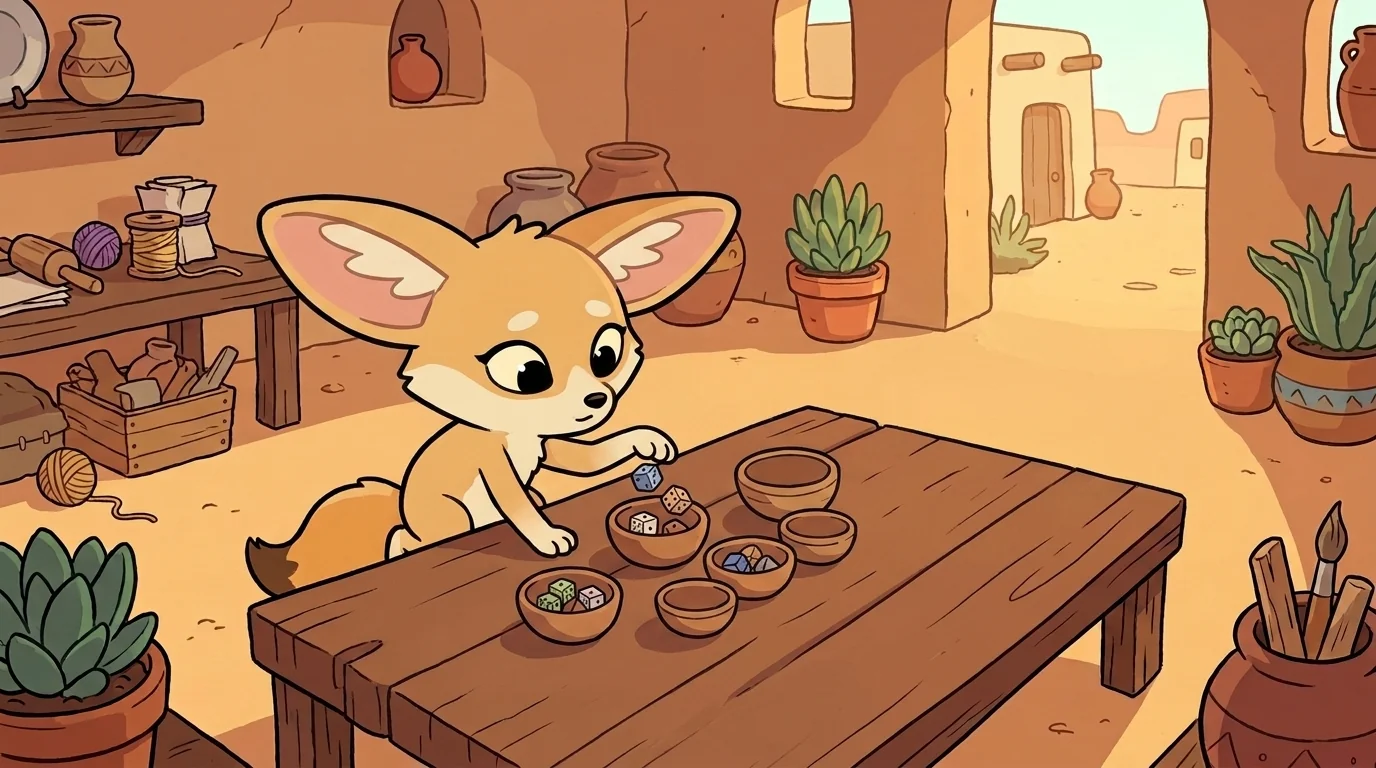
Later, when the workshop was empty, the boy came back with one more question, quieter now.
"When you roll," he said, "and you don't know yet what'll happen — how come that feels good? Shouldn't not-knowing feel bad?"
Bones thought about her cousin walking away from the wall she'd built. About the small die her grandmother set down like an open door.
"Because not-knowing is where the hope lives," she said. "When it all comes down to one roll, everybody at the table leans in at the same time, holding the same breath, and for one whole second anything is still possible — even for the kid who's losing. That lean-forward feeling isn't nerves going wrong. It's the game keeping everyone in it." She scooped the dice back into their bowls, ears soft. "That's all I really make. Not luck. Room to hope. The kind of fair where nobody puts their pieces down early and walks away."
The boy nodded slowly, and Bones watched the suspicious set of his shoulders come loose — the same way, years ago, the cold thing in her own chest had finally let go.
The TableForge ensemble
Bones is part of TableForge's distributed-narrative cast. Each character embodies a different curricular primitive; together they teach the full subject.
-

Hand
Cards + hidden information — what-you-HOLD is information; what-you-SHOW is a different question
-

Move
Turn-structure + action economy — every turn is a question and an answer; turn-as-question framing
-

Trial
Playtest + iteration — what-they-DID matters more than what-they-SAID; first-playtest-supposed-to-fail framing
-
Theme
Game-mechanic + theme integration — the-game-IS-its-mechanics; Habgood intrinsic-integration anchor; theme-MUST-do-work framing