Hand
HAND — what you HOLD is information; what you SHOW is a different question.
Loading audio…
Press play to listen along. The line being read lights up as you go.
Show full transcript
Loading transcript…
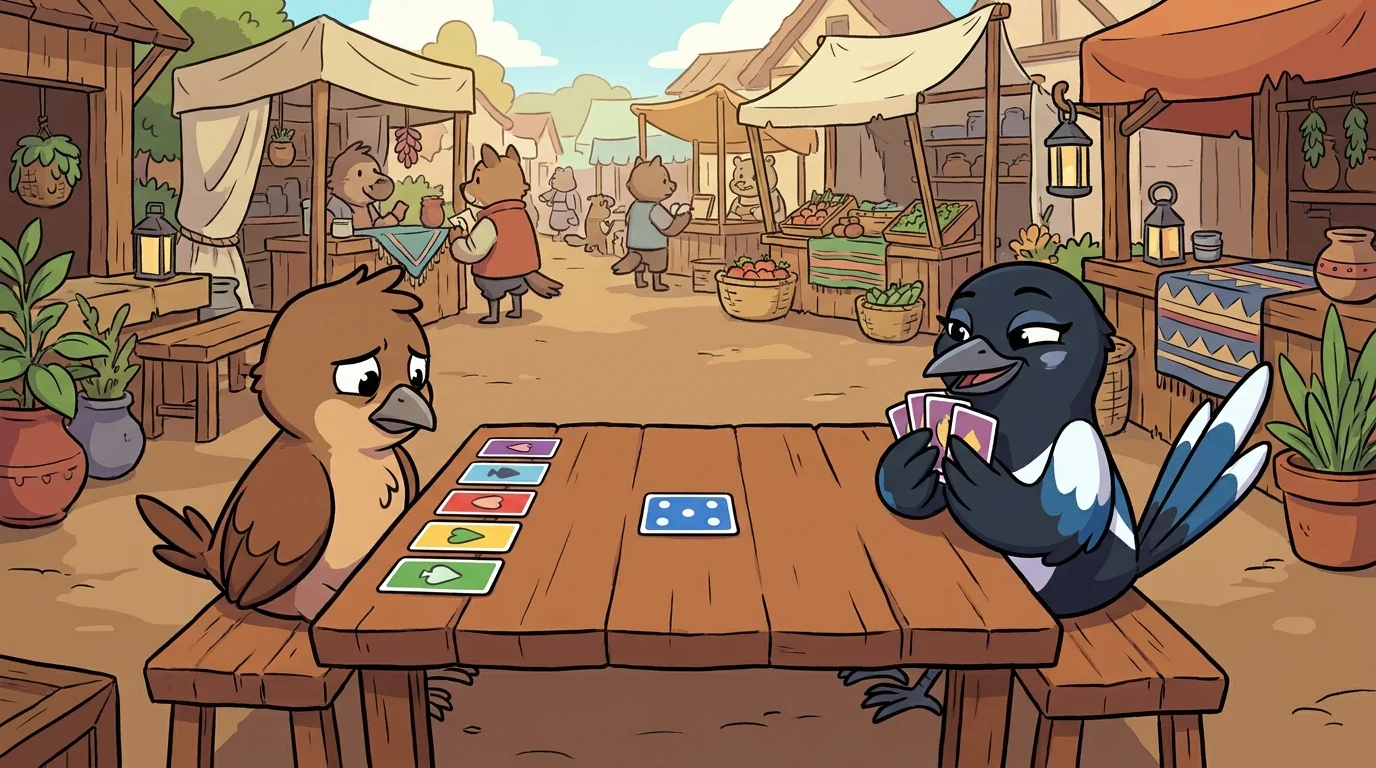
At a card table in the trade-stand village, a small magpie named Hand fanned three cards against her chest so that only she could see them, and grinned like she owned a secret the whole world wanted.
She did, sort of. Across from her, a younger bird had laid every one of his cards face-up on the table, all in a neat proud row, and was losing badly.
"You can see mine," he complained. "Why can't I see yours?"
"Because mine are still information," Hand said, "and yours turned into scenery the moment you put them down."
She played one card, face-up, into the middle. A blue seven. It landed with a small tap that felt bigger than it was.
"There," she said. "Now that one's yours too. Everybody knows it. It's public." She tilted her three-card fan, two cards left, hidden. "But these two? Still mine. Still questions. You have to guess what I'm holding — and while you're guessing, you're not paying attention to what you already told me by showing everything."
The younger bird stared at his tidy, useless row.
"The cards in your hand are worth the most while they're still hidden," Hand said, softer now. "Not because they're magic. Because nobody knows them yet. The second they hit the table they stop being a secret and start being a fact. Facts are fine. But a game with no secrets is just arithmetic."
She curled her wing back over her two cards, patient as a locked drawer.
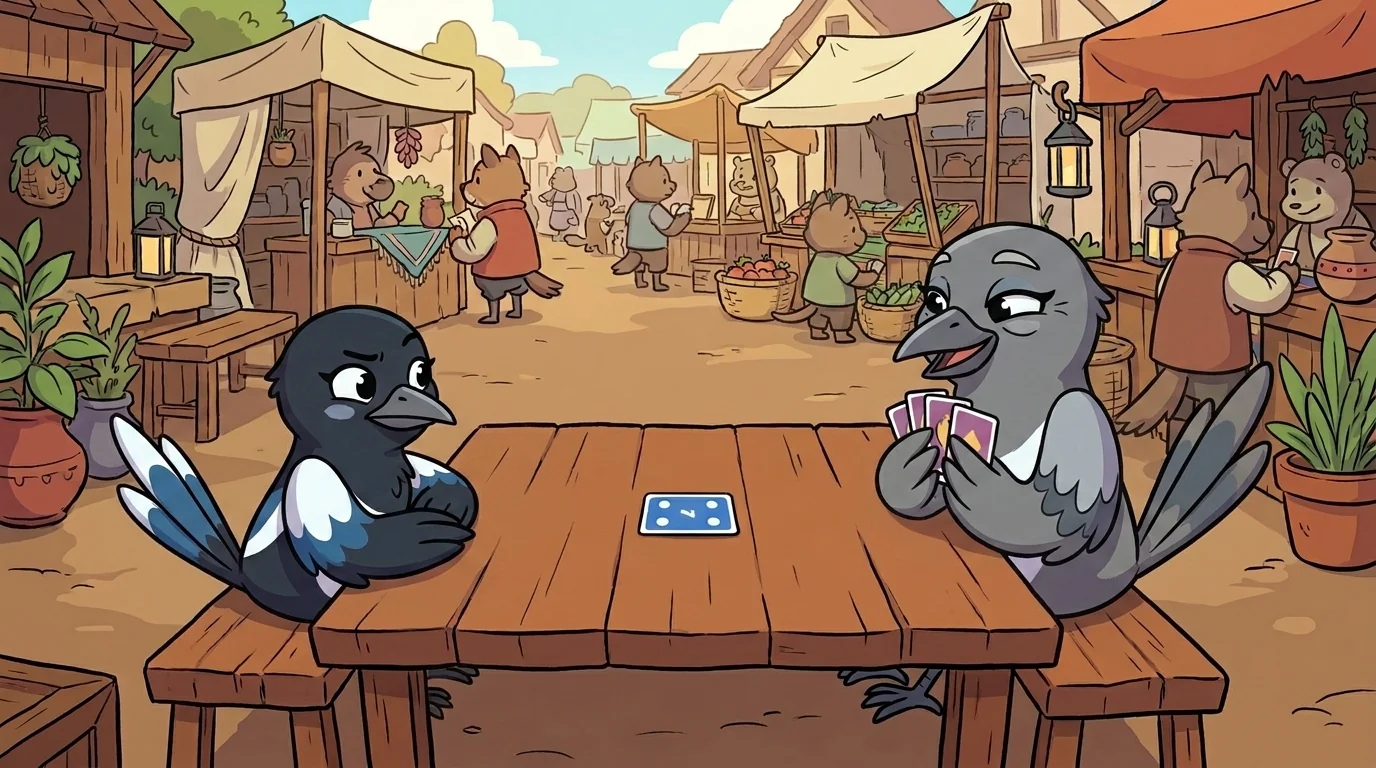
Hand had learned the worth of a held card the hard way, when she was small.
Her family had been card-traders for the village for generations, and the first time they let her sit in a real game she'd done exactly what the proud younger bird had done. She'd shown everything. She'd been so excited to prove she understood the cards that she waved them around, announced her plans, laid her strategy bare.
She lost every hand. Not because her cards were bad — because she'd given them away before she played them. Everyone at the table knew what she'd do next, so nobody could be surprised, and surprise, it turned out, was half the point.
She'd gone quiet and hot-cheeked, feeling like she'd failed at something she couldn't even name.
Her grandmother — an old magpie with clever eyes and a slow voice — had gathered up the cards and not scolded her. She'd only fanned five of them and held them close to her own chest.
"What do you feel," she asked, "not knowing what I'm holding?"
"...Itchy," Hand admitted. "Like I want to know."
"That itch is the game, little one. That's the whole engine of it." She turned one card face-up between them. "This one I've given you. It's true, it's real, you can plan around it. But these four —" she pressed them tighter — "these keep the table awake. What you hold is information. What you show is a different question entirely, and you get to choose when to answer it."
Hand didn't win the next hand either. But she stopped waving her cards around. The held, private, close-to-the-chest feeling had a name now: hers. And knowing it was hers to spend, and not to spill, made her sit up a little straighter.
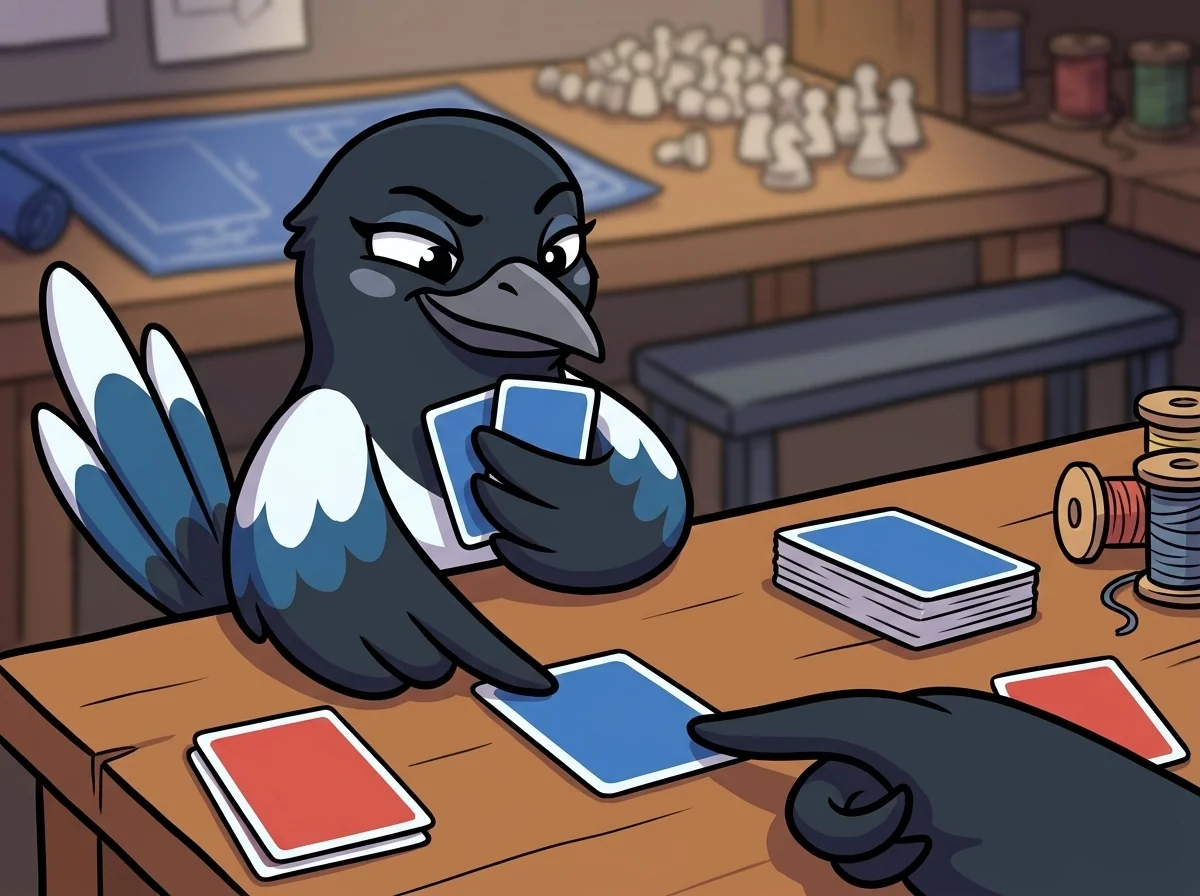
She walked to TableForge at twelve, because a place that studied how games are built ought to understand the ones you play with secrets in your wings.
Blueprint, the old mentor who ran the workshops, met her at the gate. He didn't ask her to prove she was cunning. He asked one question. "What makes a card game strategic?"
Hand didn't answer with words. She took four cards from his desk. One she laid face-up in front of him. One she slid into the discard pile, also face-up. One she tucked back into the deck, face-down, and gave the deck a shuffle so nobody could say where it went. The last she held against her chest, hidden.
"That one you can see," she said, pointing to the face-up card. "Public. That one's spent — everyone knows it's gone. That one's somewhere in the deck; we both share the not-knowing. And this last one —" she tapped her own chest — "only I know. Four cards, four different kinds of knowing. The game happens in the gaps between them."
Blueprint looked at the small map of secrets she'd made on his desk for a long moment. "You belong here," he said.
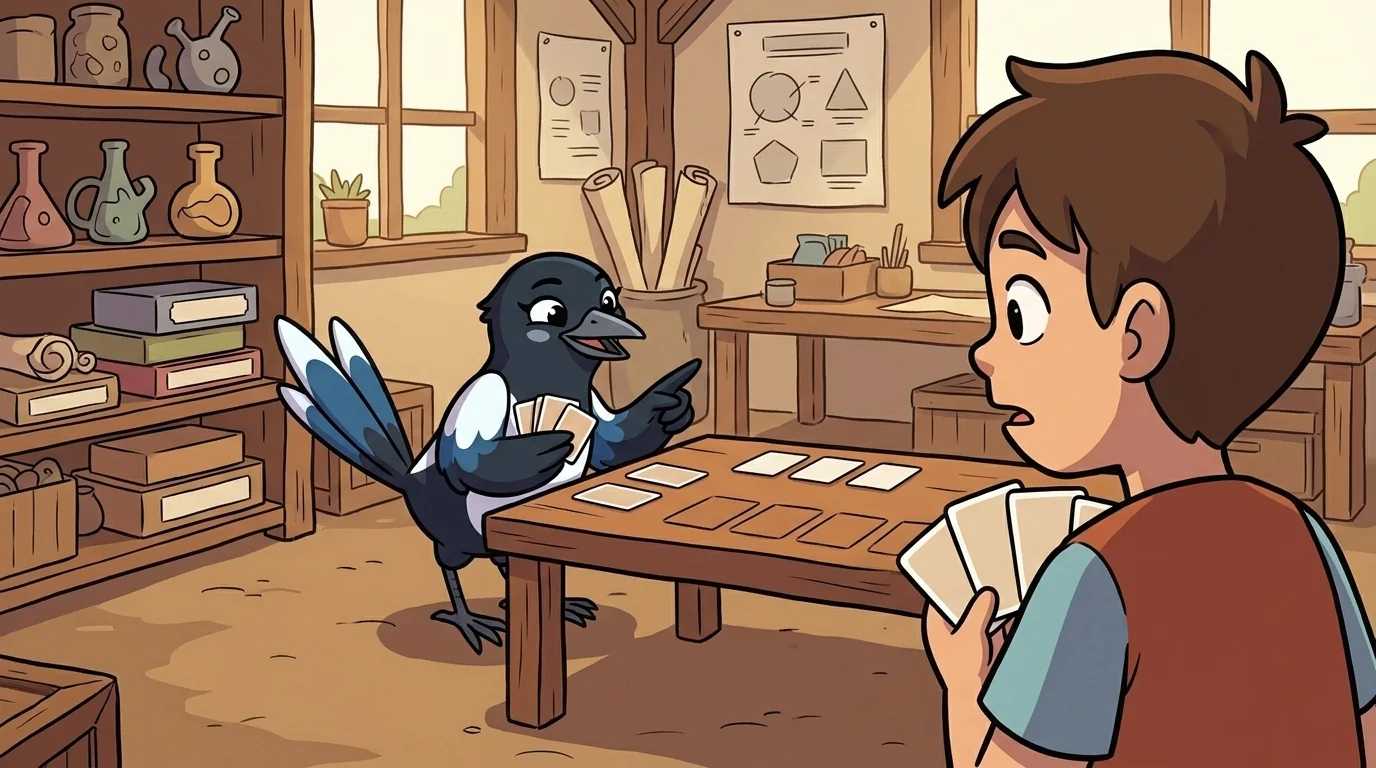
Hand's workshop was full of small experiments in who-knows-what.
A boy came in one afternoon, frowning at a card game he'd designed. "It's boring," he said, "and I can't work out why. Everybody plays with their cards face-up so it's fair."
Hand knew that flatness. A game with nothing hidden was a game already over.
"Play me a round," she said. He did — every card visible, every move obvious, both of them able to see exactly what was coming. It ended in about four dull moves.
"Now," Hand said, "hide your hand. Just hold your cards where I can't see them."
He did. And immediately his face changed — he had a choice now. He could bluff. He could hold back his best card and let her think he had nothing. He played a low card slowly, like it hurt, and Hand narrowed her eyes.
"See that?" she said. "You just told me a story with how you played, not with what you said. Maybe true, maybe a bluff. I have to read your move, not your mouth." She leaned in. "That's not lying, by the way. In a game, hiding and hinting are allowed — everybody at the table knows the rules let you. It's information-management. It's the craft. Nobody's being tricked; they signed up for the puzzle."
The boy played another card, watching her face this time instead of the table, and grinned when she couldn't tell if he was serious.
"Now it's a game," Hand said.
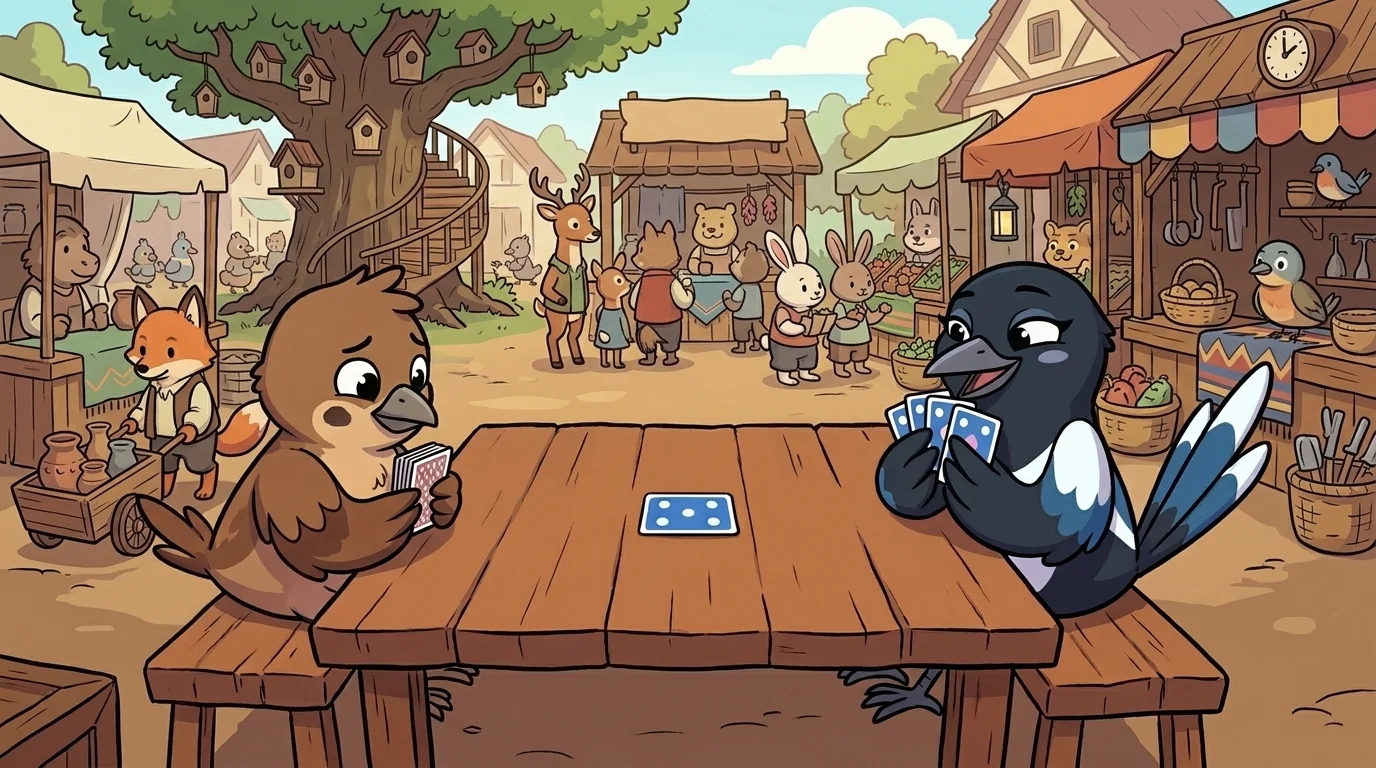
Later, when the workshop was empty, the boy came back holding his redesigned cards close to his chest, the way she held hers.
"When you don't know what someone's holding," he said, quieter, "how do you decide what to believe?"
Hand thought about the proud younger bird's useless row, and her grandmother's four hidden cards, and the itch that keeps a table awake.
"You watch what they do, not what they claim," she said. "Somebody can tell you they've got nothing while they play like a champion. Believe the playing. Words are cheap at a card table; moves cost something." She fanned her own cards and, for once, didn't hide them. "And the held feeling — that close, careful, only-I-know-this feeling — that's not being sneaky. That's just knowing something's yours to spend when the moment's right, and not one second before."
The boy nodded slowly, holding his little deck like it mattered now, because it did.
Hand didn't say the rest out loud, but she thought it, warm and sure: the best secrets aren't the ones you keep forever. They're the ones you're patient enough to spend well.
The TableForge ensemble
Hand is part of TableForge's distributed-narrative cast. Each character embodies a different curricular primitive; together they teach the full subject.
-
Bones
Dice + randomness + probability — chance is design craft, NOT betting; gambling-adjacency gate anchor
-

Move
Turn-structure + action economy — every turn is a question and an answer; turn-as-question framing
-
Trial
Playtest + iteration — what-they-DID matters more than what-they-SAID; first-playtest-supposed-to-fail framing
-
Theme
Game-mechanic + theme integration — the-game-IS-its-mechanics; Habgood intrinsic-integration anchor; theme-MUST-do-work framing