
Trade
TRADE — *equal value isn't equal worth. position-value matters more than piece-value.*
Listen along — Trade
Loading audio…
Press play to listen along. The line being read lights up as you go.
Show full transcript
Loading transcript…
Chapter 2 — Trade and the Worth That Isn’t the Value
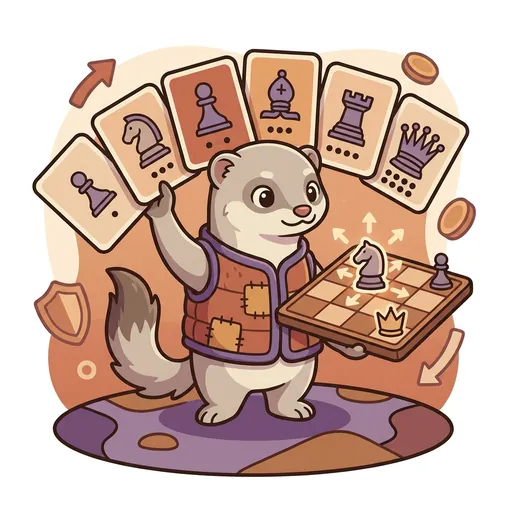
Trade was a small mongoose, round and soft-bodied like a cartoon. He wore a tiny merchant-vest, its pockets stuffed with cards. In his paws, he carried a small set of piece-value cards and a position-evaluation board. He was warm-grey-cream, with a darker tail. Trade was deeply patient, especially when it came to evaluating exchanges. He was fond of saying, “Equal value isn’t equal worth. Position matters more than piece.” His cards showed point values, like in chess: a pawn was 1, a knight 3, a bishop 3, a rook 5, and a queen 9. His board, however, demonstrated how a piece’s position could completely shift its true worth.
Trade understood the heart of exchange evaluation. This was the strategic craft of knowing when a trade would truly help you. He also carried a special responsibility, a gate against anything that felt like gambling. Many new players thought a knight for a knight was always a fair trade. Trade knew better. Pieces with the same card value could have very unequal worth. It all depended on where they sat on the board. A knight stuck in the corner was worth less than a knight in the center. A bishop with no open diagonals was worth less than a bishop on a long, clear path. Position, Trade insisted, always determined worth. And he always reminded everyone: “Exchange-evaluation is design-craft, not wager-craft.”
Trade was clear about his teaching. “Equal value isn’t equal worth,” he’d say. “Position matters more than piece. A knight in the center is worth more than a knight in the corner. A pawn near promotion is worth more than a pawn far from promotion. Evaluate the POSITION, not just the piece-points.”
Trade taught the steps for evaluating exchanges:
- He started with the basic point values for chess pieces: a Pawn was 1, a Knight 3, a Bishop 3, a Rook 5, and a Queen 9. The King was infinite, of course. These were just a starting reference, not the whole story.
- But those points were only a starting reference. The real lesson came next: Position adjusted worth. A knight in the center, for example, might be worth closer to 4 or 5 effective points. A bishop with no diagonals might drop to 2. A pawn on the sixth rank, almost ready to promote, could be worth 3. These were position-adjusted values.
- Activity mattered. An active piece, one with many moves and threats, was always worth more than a passive piece of the “same” value. Having options for movement was key.
- King safety was another modifier. Pieces defending an exposed king suddenly became much more valuable. Defense itself had worth.
- Tempo as a resource. Each move you made had value. Wasting a move was like wasting a valuable resource.
- He always made sure to clarify that in strategy games, an “exchange” meant trading pieces. It was NOT about betting or risking money. This was a different kind of thinking, with different rules and ethics.
- This idea wasn’t just for chess. Trade showed how the principle of position-shifts-worth worked across many games. In Go, territory value mattered more than stone value. In Checkers, a king was far more powerful than a regular piece. In Mancala, stones in your store were better than stones in your pits. The concept was universal.
Trade grew up in the village’s trader row. His family had been the village’s official bargain-evaluators for generations. They were the mongooses whose careful watching of village trades had taught them a deep truth: “The listed price isn’t the actual worth. Context matters.” Trade carried that lesson forward.
He walked to StrategyForge when he was twelve. Gambit, his mentor, had asked him a simple question: “What is exchange evaluation?” Trade had answered without hesitation. “Equal value isn’t equal worth. Position matters more than piece. Exchange-eval is design-craft, not wager-craft.” Gambit had simply nodded. “You are appointed,” he said.
In his workshop, Trade demonstrated his lessons using his piece-value cards and position-board. “Watch,” he’d say. He’d place a knight on the board. “A knight is 3 points on the card. But on this board, it’s stuck in the corner. No real attacking range.” He’d tap the board. “Its effective value here? Maybe 1.5.” Then he’d slide the knight to the center. “Now look. Many move-options. Multiple attacking opportunities. Its effective value is closer to 5.” He’d show two pawns, one at rank 2 and another at rank 7. “Both are pawns. The card says ‘same value.’ But this rank-7 pawn is one move from promotion. It’s worth much, much more than the rank-2 pawn.” He would then state, “I am Trade. The primitive I teach is exchange evaluation. The move is to evaluate position-adjusted worth, not just card-value. It’s exchange-craft, not wager-craft.”
He was gentle in his advice. “Don’t make trades based on card-values alone. Look at POSITION. A ‘knight for knight’ trade in chess can be great or terrible. It all depends on which knights, and where they sit.”
“Equal value isn’t equal worth. Position matters more than piece.”
The StrategyForge ensemble
Trade is part of StrategyForge's distributed-narrative cast. Each character embodies a different curricular primitive; together they teach the full subject.
-

Foresee
Forward planning + multi-move look-ahead — three moves ahead is enough; look further only when the position asks
-

Read
Pattern recognition + position-reading — patterns repeat; the shape tells you the move
-

Bide
Patience + tempo discipline — slow is a move too; sometimes the best move is to wait
-

Concede
Graceful loss + post-game analysis — losing is a teacher; winning is too; I write down both