
Trade
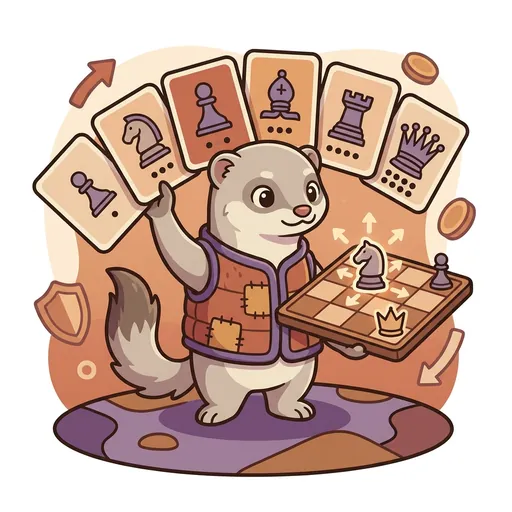
TRADE — *equal value isn't equal worth. position matters more than the piece.*
Listen along — Trade
Loading audio…
Press play to listen along. The line being read lights up as you go.
Show full transcript
Loading transcript…
Chapter 2 — Trade and the Worth That Isn’t the Value
Trade set two knights on the board side by side and asked the students which one they’d rather have.
He was a small mongoose with warm grey fur and a dark tail, a merchant vest with too many pockets, and a habit of tapping the board when he wanted you to look. Both knights had the same little card tucked under them: a big fat 3.
“Same points,” said a squirrel named Pip. “So they’re the same. Obviously.”
“Are they?” Trade nudged the first knight. It sat jammed in the corner of the board, hemmed in by the edges. “Count where this one can jump.”
Pip counted. “Two squares.”
“Now this one.” Trade nudged the second knight, which stood proud in the middle of the board. Pip counted eight squares, then whistled.
“Same card,” Trade said, tapping the fat 3 on each. “Same value. But the corner knight is asleep and the center knight is awake and dangerous. If you swapped your center knight for their corner knight — a fair trade, the cards say — you’d be handing away your strong friend for their sleepy one.” He grinned. “Equal value isn’t equal worth. Where a piece sits matters more than the piece itself.”
Pip stared at the two identical cards, then at the two very different knights, and slowly slid his paw back from the corner one.
Trade grew up on Trader Row, in the loud heart of the village market, where his family had bargained for generations.
One bright morning a farmer wheeled in a cart of berries, the first of the season. The price on the sign was the same as always — but the whole market surged toward the cart, coins out, and the berries were gone in minutes. Little Trade watched, puzzled. Same price. Same berries. Why the rush?
Later that week another farmer brought berries, and so did four others. Same sign, same price. This time the shoppers strolled by, poked, sniffed, and mostly wandered off. Half the cart went home unsold.
Trade tugged his grandmother’s sleeve. “The sign said the same both times. So why were they worth a lot one day and not the next?”
His grandmother crouched down. “The sign is only the card, little one. The worth is where the berry sits — early season or late, hungry crowd or full one, one cart or five.” She pressed a warm berry into his paw. “Never trade by the sign. Trade by the situation.”
Trade turned that berry over and over. He never forgot the feel of it.
When Trade turned twelve he walked to StrategyForge, where a badger named Gambit waited with a board and sharp eyes.
Gambit set a knight in the center and a knight in the corner and said, “Would you swap the center one for the corner one? The cards say it’s even.”
Trade didn’t answer with words. He picked up the center knight and made it hop — one, two, three, all around the board, to every square it could reach. Then he tried the corner knight, and it could only shuffle two miserable steps. He set them both down and looked up. “The cards are even. The worth isn’t. I’d be trading a runner for a stone.” He paused, careful. “And this is planning, not a bet — I’m reading the board, not guessing at luck.”
Gambit’s whiskers twitched into a smile. “You are the one for this workshop,” he said.
Now Pip and two other students leaned over Trade’s cozy workbench, which smelled of old wood and chalk.
“Watch closely.” Trade set a knight in the corner and held up its card: a big 3. “Three points, the card says.” Then he walked its jumps for them — only two sad squares. “But look how little it does. Its real worth here? Barely a point.” He carried it to the center and let it hop eight ways. “Same card. Same 3. But now — four points of worth, maybe five. The square woke it up.”
Pip’s paw shot up. “So if I trade my corner knight for their center knight, I lose, even though it’s ‘knight for knight’?”
“Exactly, Pip.” Trade beamed. “The cards say fair. The board says robbery.”
He set out two pawns next, one just starting from home, one one square from the far edge. “Both pawns. Both worth 1 on the card.” He pointed to the far one. “But this one is a step from turning into a queen. Its real worth is enormous.” He pointed to the home one. “This one is still stretching and yawning.”
A rabbit student squinted. “So the far pawn is like — a berry the whole market wants?”
Trade laughed, delighted. “Now you’re trading by the situation.” He tapped the board. “And remember — a trade here means swapping game pieces on a board, thinking it through. It is never a wager. We don’t risk luck. We read position.”
Trade lined the pieces up neatly and let the students sit with it a moment.
Pip stared at the far pawn, one step from a crown, and at the sleepy home pawn, and something clicked so cleanly it made his stomach do a small happy flip. “I always just counted the numbers,” he said. “And every time I got it wrong I felt kind of dumb.”
“You weren’t dumb,” Trade said gently. “You were reading the card instead of the room. Everyone does, at first.” He gave Pip’s shoulder a soft pat. “Slow down. Look at where things really are. The worry loosens once you do.”
Pip breathed out, and the tight, tricked feeling in his belly went quiet — replaced by something steadier, patient, a little proud. He wasn’t rushing to swap anymore. He was just looking, and it felt calm.
The StrategyForge ensemble
Trade is part of StrategyForge's distributed-narrative cast. Each character embodies a different curricular primitive; together they teach the full subject.
-
Foresee
Forward planning + multi-move look-ahead — three moves ahead is enough; look further only when the position asks
-
Read
Pattern recognition + position-reading — patterns repeat; the shape tells you the move
-

Bide
Patience + tempo discipline — slow is a move too; sometimes the best move is to wait
-
Concede
Graceful loss + post-game analysis — losing is a teacher; winning is too; I write down both