
Layer
LAYER — *the overtone fingerprint. why violin ≠ flute at same pitch.*
Listen along — Layer
Loading audio…
Press play to listen along. The line being read lights up as you go.
Show full transcript
Loading transcript…
Chapter 3 — Layer and the Overtones That Make Each Voice Itself
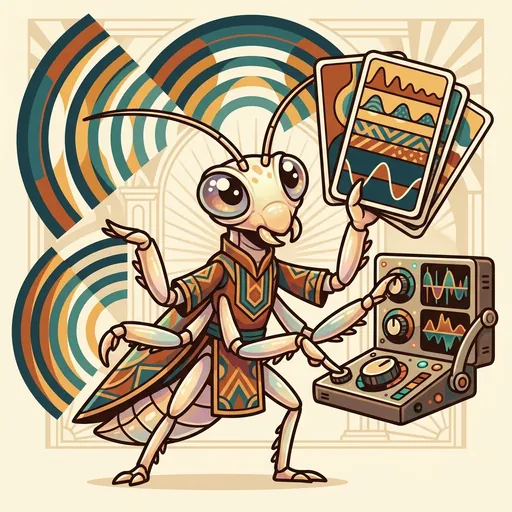
Layer, a curious mantis-shrimp of a tween, carefully arranged a series of glowing cards on a console. Her iridescent shell shimmered under the studio lights, shifting from soft cream to a faint rainbow as she moved. She wore a chunky-cartoon studio tunic, splattered with what looked like dried paint or maybe sound waves. Layer was small, but her multiple eyes, always scanning, took in everything around her. She was deeply attentive to the overtone fingerprints of sound.
“Alright, everyone,” Layer announced, her voice a soft hum. “Today, we’re diving into timbre.” She tapped a button on her timbre-tracker, a small device that looked like a kaleidoscope for sound. “It’s the sound-science craft of overtone-fingerprints.”
Maya, a human girl with bright red hair, leaned closer to the console. “Timbre? Is that like… what makes a sound loud or soft?”
Layer shook her head, her antennae twitching slightly. “Not exactly. Loudness is amplitude. Timbre is what makes a violin sound different from a flute, even when they play the exact same note.” She paused for effect, letting the idea settle. “It’s the overtone fingerprint. Why violin ≠ flute at same pitch.”
She gestured to a large screen above the console. “Watch this.” Layer pressed another button. A pure, clear tone filled the SoundSphere lab. A simple, smooth wave appeared on the screen, like a gentle hill. “That’s a basic sine wave,” she explained. “It’s almost a pure note. Think of it like a flute playing a single, soft note.”
Next, Layer selected a violin icon. The same note, an A440, played through the speakers. But this time, the sound was richer, fuller. The wave on the screen became more complex, jagged edges clinging to the smooth hill. Layer pointed to the new squiggles. “See these little wiggles? Those are the overtones.”
She picked up one of her overtone-cards. It showed a graph with several smaller peaks rising above a main one. “Overtones are like tiny extra notes,” she continued. “They’re multiples of the main note, the fundamental frequency. Every instrument adds them in different strengths.” Layer’s multi-perceiving eyes darted between the screen and the card, making sure everyone followed. “The violin has lots of rich, high overtones. That’s why it sounds so warm.”
Then she switched back to the flute. The sound became lighter again, and the wave on screen smoothed out, though not as perfectly as the pure sine wave. “The flute is closer to that pure fundamental,” Layer said. “Fewer strong overtones.”
“So, the overtones are what give each instrument its unique voice?” Alex, a boy with perpetually messy hair, finally chimed in.
“Exactly!” Layer beamed. “They’re the sound’s fingerprint. Each instrument, each voice, even each synthesizer, has its own unique combination of overtones.” She slid a few more overtone-cards across the console, each showing a different pattern. One was spiky and sharp, another rounded and wide. “Synthesizers are amazing because they let us manipulate these overtones. We can build entirely new sounds, just by changing the overtone recipe.”
She demonstrated, pulling up a synthesizer interface. With a few quick adjustments, the simple flute sound transformed into something metallic and otherworldly. The overtone display shifted wildly. “We’re just changing the fingerprint,” she said, her voice full of wonder. “Making a new sound persona.”
The students watched, mesmerized, as Layer continued to tweak the virtual instrument. The lab filled with strange, beautiful noises, each one a testament to the invisible forces of timbre. Layer’s passion for these hidden sound layers was clear in every precise movement, every focused glance. She knew that understanding these subtle differences was the key to unlocking a whole new universe of sound.
The SoundSphere ensemble
Layer is part of SoundSphere's distributed-narrative cast. Each character embodies a different curricular primitive; together they teach the full subject.
-

Wave
Frequency — the pitch axis; high-frequency sounds vibrate fast, low-frequency sounds vibrate slow
-

Bloom
Envelope — the attack / sustain / decay / release shape of a sound (how it begins, holds, and fades)
-

Ring
Space — reverb, echo, and room ambience (how the same sound feels different in a bathroom vs a stadium vs a forest)
-

Tune
Synthesis — how primitive sound-elements (frequencies + envelopes + layers + space) combine to build entirely new sounds