
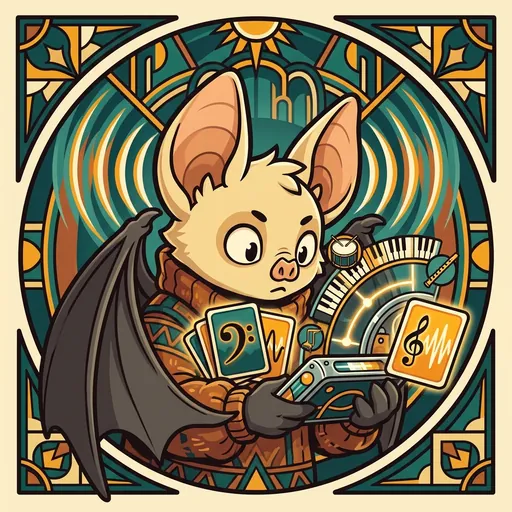
Wave
WAVE — frequency. high vibrates fast, low vibrates slow.
Listen along — Wave
Loading audio…
Press play to listen along. The line being read lights up as you go.
Show full transcript
Loading transcript…
Chapter 1 — Wave and the Speed of the Vibration
In the middle of the soundsphere studio, a small bat-tween named Wave hung upside down from a rafter with both ears wide open, tracking a sound nobody else could hear.
Her head tilted. One ear swiveled left, then the other swept right, and she went completely still — the way you go still when you’re trying not to lose the end of a thread. Somewhere across the room a thin, needling whine was climbing the air, and Wave was following it home.
“There you are,” she murmured. She dropped off the rafter, flared her charcoal wings, and glided in a slow curve straight toward a stack of dusty old speakers.
A kid named Pip looked up from a wobbly stool. “You’re just gliding at the speakers.”
“I’m following a wiggle,” Wave said. She landed lightly on top of the stack and pressed one ear flat against the cabinet. “A very fast one. Hear it?”
Pip’s teeth were already aching. “The mosquito noise? Yeah. It’s driving me nuts.”
“That’s the one.” Wave pulled a little clip-on tracker from her tunic pocket and held it toward the speaker. Numbers jumped on its screen and settled: 18,000. “Eighteen thousand wiggles every single second. That’s why it sits so high and sharp. Fast wiggle, high sound.” She flicked one wing toward the far wall, where a big old piano stood, and tapped its lowest key on the way past. Booooom — a rumble Pip felt in his chest more than heard. “Slow wiggle, low sound. Same idea, opposite end.”
She hung the tracker back on her tunic and grinned at Pip. “High vibrates fast. Low vibrates slow. That’s the whole trick, honestly. Everything else is just details.”
Wave hadn’t always liked being the one who heard everything.
When she was little, sounds arrived at her ears too loud and too many. A humming light. A ticking clock two rooms away. The high thin sing of a screen nobody else could hear. She’d sit at the family table with her wings pressed over her head and feel like something was wrong with her — like her ears were broken, letting in too much of the world.
Her uncle, an old bat with slow-swiveling ears, had sat down beside her one evening while she covered her head. He didn’t tell her to toughen up. He just said, quietly, “You’re hearing the fast ones, aren’t you. The ones the others miss.”
Wave had nodded from under her wings, miserable.
“I hear them too,” he said. “Always have. It’s not that your ears let in too much, little one. It’s that they’re tuned — tuned finer than most. That whine you hate? Nobody else even knows it’s there. You do.” He tapped one of her covered ears, gentle. “That’s not a thing that’s wrong with you. That’s a thing that’s sharp about you.”
Wave had lowered her wings a little. The humming light was still there, still too fast, still annoying. But underneath the annoyance, for the first time, there was something almost like pride. Her ears weren’t broken. They were listening harder than everyone else’s. That, somehow, she could carry.
She came to the soundsphere studio the year she turned twelve, because a place all about listening ought to have room for someone who couldn’t stop.
The studio’s old teacher met her at the door. He didn’t ask her to prove she was clever. He nodded at a wall of instruments and asked one thing: “What is pitch?”
Wave didn’t answer with words. She walked to the piano, pressed the very lowest key — booom — and let the rumble roll out. Then she reached to the very top and pressed the highest — ting! — sharp and bright. She held her tracker to each one so the numbers showed: 27 for the low, 4,000 for the high.
“Pitch is how fast it’s wiggling,” she said. “This low one is slow. This high one is fast. The keys in between are all the speeds in between.” She tilted her head, listening to the last of the ting fade. “That’s all pitch ever is. Speed you can hear.”
The old teacher looked at the two numbers a long moment. “You belong here,” he said.
Which was how Wave ended up on top of a speaker stack, watching Pip rub his aching teeth.
“It just makes my head buzz,” Pip said. “Everyone else acts like it’s not even happening.”
Wave hopped down beside him. “Because for them it isn’t happening. Their ears don’t catch the fast ones. Yours do.” She picked up a small tuning fork from the bench and tapped it against the table. A clear, round note rang out — nothing like the mosquito whine. She held the tracker to it: 440.
“That sounds nice,” Pip said, surprised.
“Four hundred and forty wiggles a second,” Wave said. “Slow enough to feel round and warm. Now the speaker —” she pointed the tracker back at the stack — “eighteen thousand. Forty times faster. That’s why one feels like honey and the other feels like a needle. Same kind of thing. Wildly different speed.”
Pip frowned, but he was listening past the whine now, trying to feel the speed of it instead of just hating it. “So it’s not that it’s louder. It’s that it’s faster.”
“There it is.” Wave beamed. “And here’s the part that matters.” She rested a wing on the warm cabinet. “That speaker shouldn’t be singing at eighteen thousand. Something inside it is worn. Nobody in this whole studio knew — except you. Your ears found a broken thing before it broke worse.” She tapped his shoulder with a wingtip. “The sound you can’t stand? Today it’s a warning. Your sharp ears just did a job nobody else could do.”
Pip stared at the speaker like he was seeing it for the first time. It still whined. But it wasn’t just an annoyance anymore. It was a message, and he was the only one who’d read it.
Later, when the studio had emptied out, Pip came back with a quieter question.
“When it’s buzzing like that,” he said, “and it hurts, and nobody else even notices — how do I know it’s a good thing and not just… me being too much?”
Wave was quiet for a second. She thought about the family table, and the wing over her head, and her uncle’s slow voice.
“You feel it,” she said. “That’s the honest answer. There’s this fast, prickly, I-caught-something feeling — like your ears grabbed the end of a thread before it slipped away. It’s uncomfortable, yeah. But underneath the uncomfortable, there’s something steady. Like you’re paying closer attention than the whole room, and the room needs you to.” She looked toward the window, ears still faintly swiveling. “High vibrates fast, low vibrates slow — and you hear the fast ones clearest of anyone here. That’s not too much. That’s tuned.”
Pip nodded slowly. The whine was still there behind them, needling and high. But it didn’t press on him the way it had when he walked in. His shoulders came down. His ears, for once, felt less like a problem and more like they were his — sharp, and steady, and quietly, warmly proud.
The SoundSphere ensemble
Wave is part of SoundSphere's distributed-narrative cast. Each character embodies a different curricular primitive; together they teach the full subject.
-

Bloom
Envelope — the attack / sustain / decay / release shape of a sound (how it begins, holds, and fades)
-

Layer
Timbre — the overtone fingerprint that makes a violin sound like a violin and a flute sound like a flute (even at the same pitch)
-

Ring
Space — reverb, echo, and room ambience (how the same sound feels different in a bathroom vs a stadium vs a forest)
-

Tune
Synthesis — how primitive sound-elements (frequencies + envelopes + layers + space) combine to build entirely new sounds