
Dora and Cassius
DIRECT PROOF vs PROOF BY CONTRADICTION — the two foundational proof strategies. Dora proves a claim forward (premise → valid steps → conclusion); Cassius proves it by assuming its negation and deriving an absurdity. Some claims yield to both; some (like "√2 is irrational") only surrender to the back door.
Press play to listen along. The line being read lights up as you go.
Show full transcript
Loading transcript…
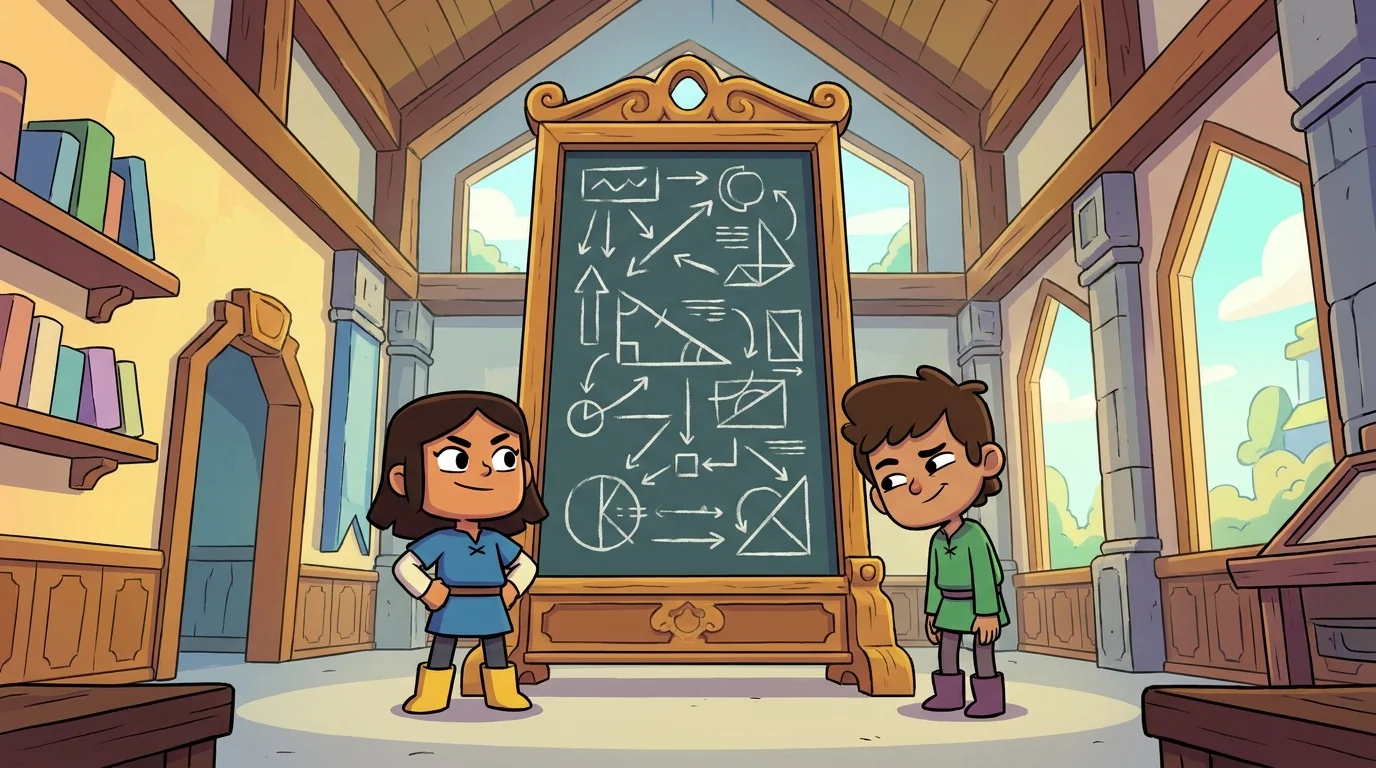
The proof-hall at Proofquest always smelled of dry slate, crushed chalk, and the sharp scent of lemon beeswax used to polish the oak benches. Today, the great central board held a single sentence written in high, elegant cursive.
The sum of two even numbers is always even.
It looked simple, almost friendly, but the apprentices knew better. Every claim on that board was a challenge waiting to be solved or shattered. Two apprentices stood before the slate, their shadows stretching long across the stone floor in the early morning light.
Dora stood exactly three feet from the center of the board. Her boots were aligned with the floorboards, her shoulders square, and her chin held high. She favored a *direct proof* because she liked a straight path. To Dora, a mathematical claim was a mountain you climbed from the front. You found the path, you took solid steps, and you arrived at the peak.
"You begin with what is true," she often said, adjusting her neat blue collar. "Then you walk forward until you reach the end. No tricks."
Cassius stood five feet to her left, leaning his shoulder against a cold stone pillar. He had his hands shoved deep into his pockets and his head tilted at a sharp angle. He looked at the board the way a locksmith looks at a rusted vault. Cassius preferred a *contradiction*. He did not like climbing mountains from the front. He preferred to find the loose stone at the back and pull until the whole structure came tumbling down.
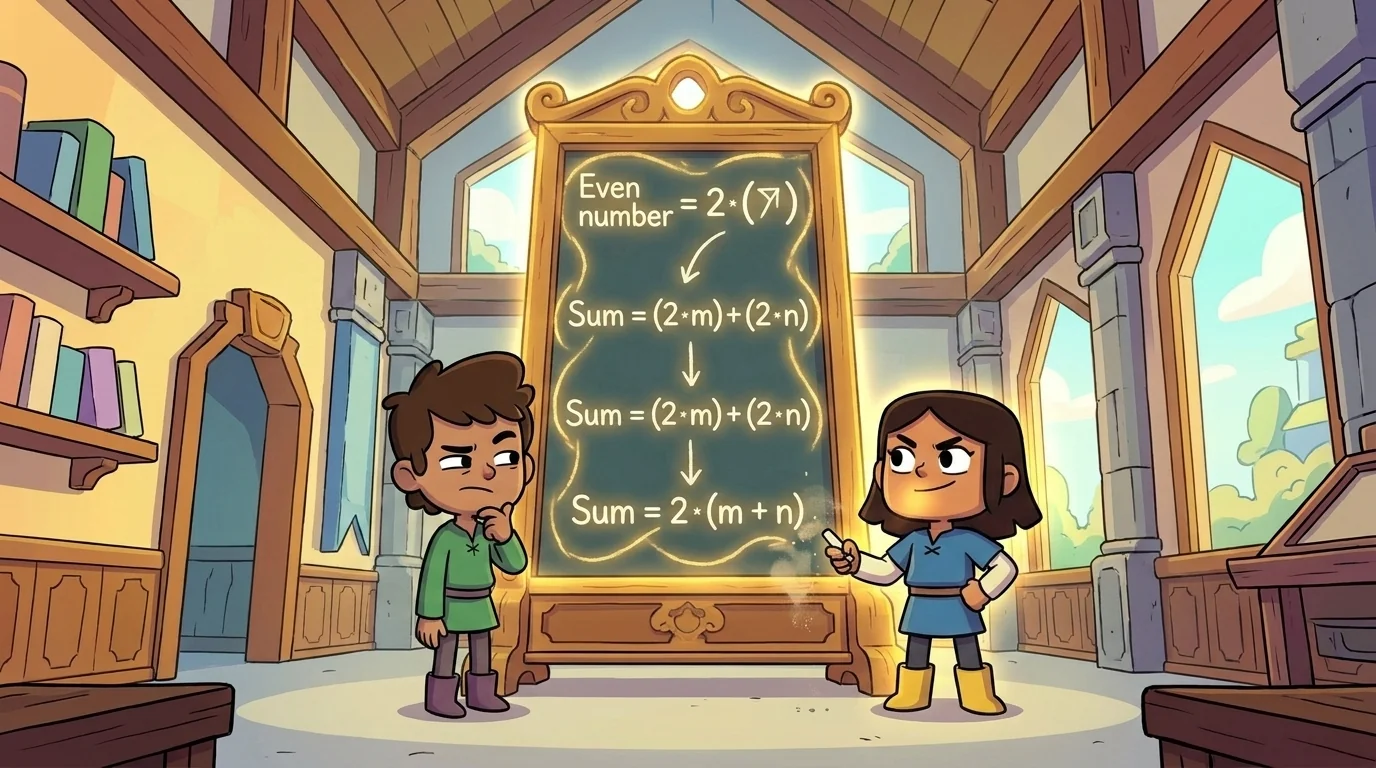
"I will go first," Dora announced, stepping up to the chalk rail because starting at the beginning was the only logical way to behave. She selected a fresh piece of white chalk, snapping it in half to get a sharp, clean edge.
"We start with two even numbers," she said, her voice echoing in the quiet hall. "An even number is always twice some other whole number, so we can write them down as variables."
She wrote on the board in clean, blocky letters, her hand steady as she worked:
Let the first number be represented by two m, and let the second number be two n.
"Here, m and n are just any integers," Dora explained, looking back at the gallery of younger students. "Now, we simply add them together to see what kind of sum we get."
She wrote the next line directly underneath the first, making sure the margins aligned perfectly. She wrote the expression, two m plus two n, on the dark slate:
2m + 2n
"Both terms share a common factor of two," she said, her chalk clicking rhythmically against the slate. "Because of this, we can factor that two out of the expression to simplify it."
She drew a neat set of parentheses around the remaining variables:
2(m + n)
She stepped back, brushing a speck of white dust from her sleeve as she spoke. "Since m and n are integers, their sum must also be an integer, which we can call k."
"So our final expression is two k," she said, tapping the board with her chalk for emphasis. "By definition, any number that is twice an integer must be an even number."
"We started with the facts, we took true steps, and we arrived at our destination."
The letters on the board began to glow with a soft, warm gold light. The magic of Proofquest recognized a completed truth, and the golden light spilled over the front benches.
"Front door," Dora said, placing her chalk back in the groove with a satisfied nod. "It is clean, honest, and completely finished without any unnecessary detours."
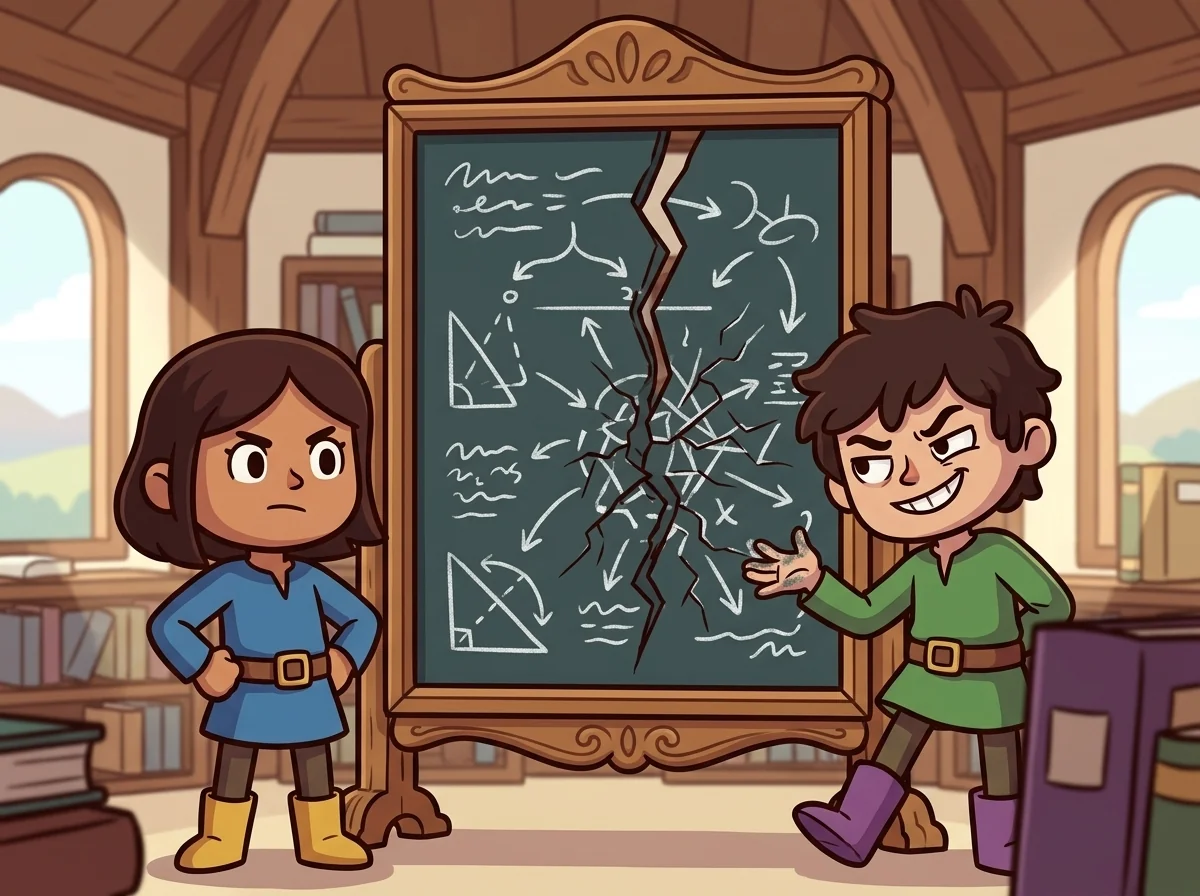
Cassius pushed himself off the stone pillar and picked up a piece of yellow chalk that had been worn down to a stub.
"Very pretty, Dora," he said, walking to the board with a slow, deliberate stride. "But now let's try my way, which will feel a bit like walking backward in the dark."
He did not look at her golden letters, drawing a thick yellow line right through the middle of the board instead. "We want to prove that the sum of two even numbers is always even," Cassius said, turning to the class. "So, let's start by assuming the exact opposite of what we want to prove."
A murmur ran through the benches as the younger students exchanged worried glances.
"Assume the opposite," Cassius continued, his eyes gleaming with the quiet mischief of a prankster. "Suppose we add two even numbers together, and the result is actually an odd number."
He wrote the wrong idea on the board in messy, slanted yellow script:
Assume 2m + 2n is odd.
"But that's not true!" squeaked Cricket, a first-year apprentice who sat in the front row clutching a brass ruler. "Even numbers never add up to an odd number."
"I know they don't," Cassius said, turning to her with a wide grin. "But we are going to pretend they do, following this lie down the hallway to see where it leads."
He turned back to the board and pointed to his yellow equation. "If the sum is odd, then we can write it as two k plus one, where k is some integer. That is simply the definition of an odd number."
"Now, let's use Dora's neat little trick," Cassius said, factoring out the two on the left side of the equation.
2(m + n) = 2k + 1
He tapped the yellow chalk against the board, leaving a small powdery smudge. "Look closely at the contradiction we have just created on the slate. The left side is two times an integer, which means it must be even. But the right side is clearly an odd number because of that extra one."
He stepped back, crossing his arms over his chest. "So we have an even number that is equal to an odd number, which is a total impossibility. A single number cannot be both even and odd at the exact same time."
The yellow letters on the board began to vibrate, and a low, uneasy hum filled the quiet room.
"That is impossible," Cricket whispered, her eyes wide as she stared at the shaking chalk.
"Exactly," Cassius said, his voice dropping to a low whisper that carried across the hall. "The universe cannot hold both facts at once, so the logic must break."
With a sharp, echoing crack, the yellow equation split down the middle and crumbled into dust. The yellow chalk dust drifted down to the floor like falling soot, leaving only Dora's golden proof glowing on the left.
"When the lie destroys itself," Cassius said, "the truth is the only thing left standing. The sum cannot be odd, which means it must be even by default."
Cricket stood up, her heavy wooden shoes clattering against the oak floor as she looked back and forth between them.
"But you got the exact same answer," Cricket said, her brow furrowing in deep confusion. "You both proved the exact same thing, so why do we need two different ways to get there? Isn't one of you just taking the long way around to reach the same spot?"
Dora and Cassius exchanged a look, and for once, there was no competitive spark between them.
"For this problem, yes," Dora admitted, leaning her elbows against the polished wooden railing. "My way is much faster because it is direct, clean, and does not require any imaginary explosions."
"And my way was definitely the scenic route," Cassius agreed, tossing his chalk stub in the air and catching it. "But some mathematical mountains do not have a front path that we can climb."
He walked back to the board and wiped a large section clean with a damp felt cloth. The wet slate dried quickly in the warm room, leaving a dark, empty space waiting for a new challenge.
He wrote a new claim on the board: The square root of two cannot be written as a neat fraction.
"This means that you cannot write the square root of two as a simple fraction made of whole numbers." He turned to Dora with a challenging smile, gesturing for her to take the chalk. "Go ahead, Dora," he said. "Walk up to this one from the front."
Dora stepped forward, her brow furrowing as she stared at the new words on the slate. She picked up her white chalk, but her hand hovered inches from the black surface without moving. She looked for a starting point, searching for a given value or a simple definition she could build upon.
There was nothing there to work with, only a smooth and featureless wall.
"I cannot do it," Dora said slowly, lowering her hand to her side in defeat. "There is no starting number to define, and I cannot write down a formula for something that does not exist."
"Exactly," Cassius said, taking the chalk from her hand with a gentle, knowing nod. "You cannot build a path out of nothing, but you can assume the path exists and watch it crumble. Watch. We assume the square root of two can be written as a fraction, a over b, in its simplest form."
He wrote the assumption on the board: Assume the square root of two equals a/b.
"If we square both sides, we get two equals a-squared over b-squared, which means two b-squared equals a-squared," Cassius explained. "This means a-squared must be even, which means a itself must also be even. Let's say a equals two k for some integer k."
He substituted this back into the equation, his chalk clicking rapidly against the slate as he worked. "Now we have two b-squared equals the quantity two k squared, which simplifies to four k-squared. Divide both sides by two, and we get b-squared equals two k-squared."
Cricket leaned forward, her knuckles turning white as she gripped the edge of her desk. "So b-squared is also an even number!" she gasped, her eyes wide.
"Yes!" Cassius said, pointing his chalk at her with a triumphant grin. "Which means b must be an even number as well. But remember what we assumed at the very beginning of this proof? We assumed the fraction a over b was already simplified to its lowest terms. If both a and b are even, they can both be divided by two, meaning our fraction was not simplified."
He tapped the board with a sharp flourish, leaving a final white dot. "Our assumption has eaten itself, and the entire logical structure has collapsed into nothing."
Dora watched the board as the white letters began to shimmer and fade, leaving only the quiet truth behind.
"Some truths only have a back door," Dora said softly, turning to look at Cassius. "You cannot prove they are true by building them step by step from the front. You can only prove them by showing that their opposite is a complete impossibility."
"Exactly," Cassius said, "and that is not a trick, but simply where the door happens to be."
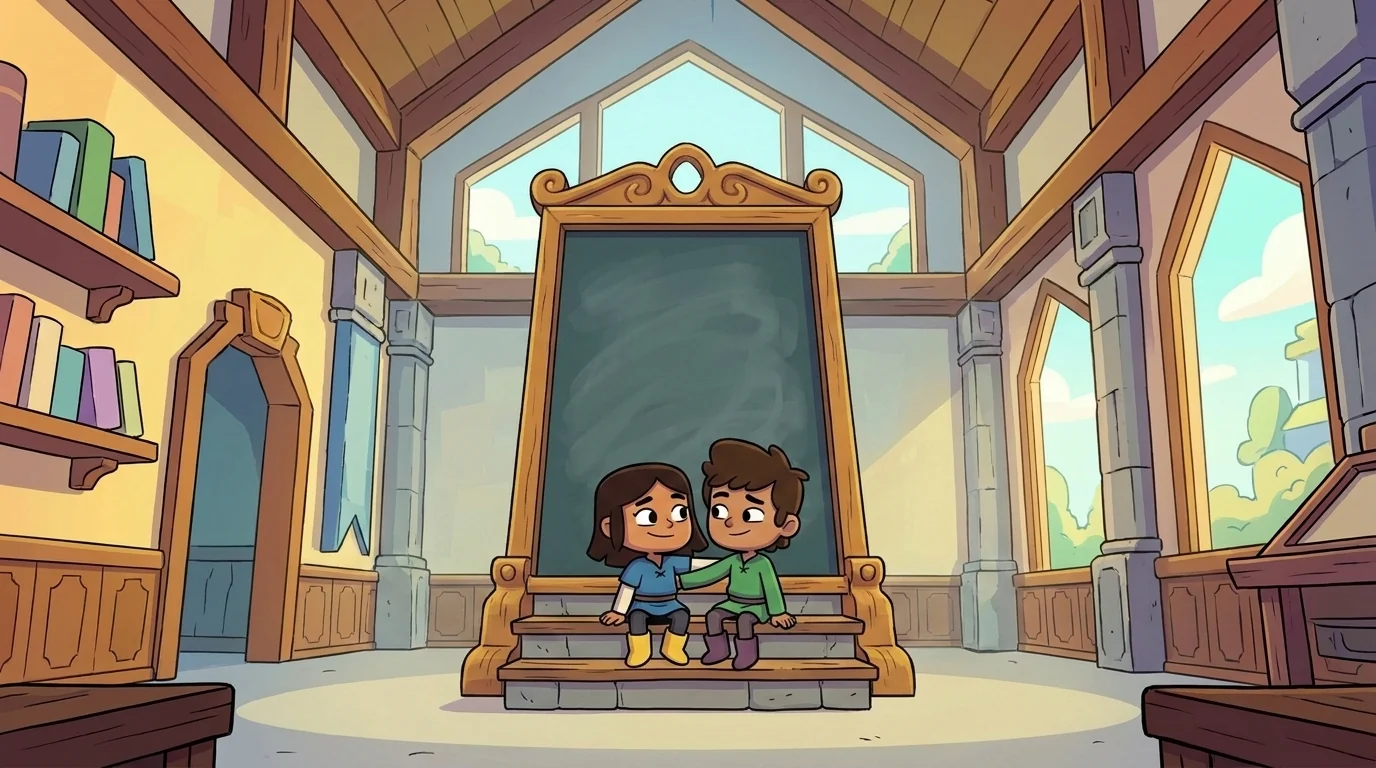
Later, when the hall had emptied and the shadows had grown long, the two proven claims glowed quietly on the board. One had been reached from the front, and the other had been found from the back. Dora and Cassius sat together on the stone steps outside the hall, watching the sun sink below the distant hills.
"I used to think you were just showing off," Dora said, resting her chin in her hands. "All that business of assuming the opposite felt like sneaking around in the dark of the night. I thought I was the only honest one because I walked straight through the front door."
She bumped his shoulder with her own, a small smile playing on her lips. "It really bugged me that your sneaky way was just as honest as mine."
"And I used to feel like the odd one out," Cassius said, staring down at his dusty boots. "I was the backwards apprentice, the one whose proofs made everyone frown until the very last line."
He was quiet for a moment, turning a piece of yellow chalk over and over in his palm. "It took me a long time to stop feeling strange and start feeling like a specialist. I am the one they call when the front door is locked tight and there is no key."
"Two doors," Dora said, "but we both find our way to the exact same truth."
"That is a good feeling, actually," Cassius said, surprised by his own words. "Knowing there is more than one honest way in makes the whole hall feel much bigger. It means that nobody has to get locked out in the cold."
They sat in the warm, settled quiet of two people who had spent a long time believing they were opposites. Now, they realized they were simply teammates who looked at the world from different angles. And that, more than any proof written on the slate inside, was the truest thing in the entire valley.
The ProofQuest ensemble
Dora and Cassius is part of ProofQuest's distributed-narrative cast. Each character embodies a different curricular primitive; together they teach the full subject.
-

Direct-Proof Dora
Direct proof: assume premises, derive conclusion by straightforward logical steps
-
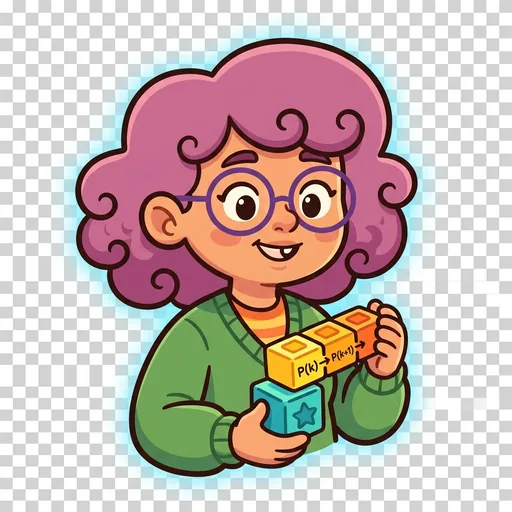
Induction Ida
Weak / standard mathematical induction: base case + inductive step
-

Strong-Induction Sten
Strong induction: base case + assume all prior cases hold
-

Contradiction Cassius
Proof by contradiction (reductio ad absurdum): assume the negation, derive a contradiction
-

Construction Cole
Proof by construction: prove existence by explicit construction of an example
-

Pigeonhole Perch
Pigeonhole principle: if n+1 items are placed in n bins, at least one bin contains 2+ items
-

Exhaustion Edda
Proof by exhaustion / cases: enumerate every case and verify each
-

Counterexample Cricket
Disproof by counterexample — one exception topples a universal claim
-

Biconditional Bex
Biconditional proof — proving 'if and only if' in both directions
-

Uniqueness Una
Proof of uniqueness — suppose two, show they must be the same one
-

QED
Closing-mark mentor — the ∎ at the end of every proof; the gentle voice that names completion + invites the next problem