
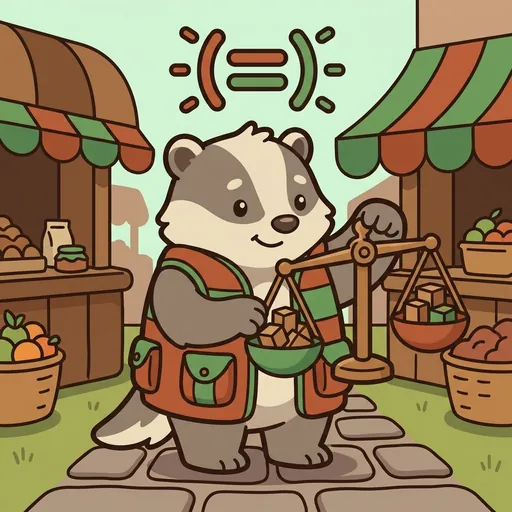
Even
PRICE EQUILIBRIUM — *where supply meets demand. the conversation point between producer and consumer.*
Listen along — Even
Loading audio…
Press play to listen along. The line being read lights up as you go.
Show full transcript
Loading transcript…
Chapter 3 — Even and the Price Where Both Sides Meet
Even was a small badger-tween. She wore a chunky, striped vest, the kind that made her look like a sturdy little balance-keeper. She carried a small, two-pan balance, always ready to show how things came to rest. Her fur was warm-grey and cream, with darker stripes that seemed to anchor her to the earth. She moved with a deep patience, especially when talking about how markets worked.
Her favorite saying was, “Price equilibrium is where supply and demand have their conversation.” Most people, especially new merchants, thought prices were just set by someone. But Even knew better. At the village market, prices grew from an ongoing chat. It was about what producers would accept for their goods, and what consumers were willing to pay.
Even’s two-pan balance was her signature tool. One pan held the “supply” weight. The other held the “demand” weight. She would adjust them, adding or taking away, until both pans hung perfectly still. That point, she explained, was price equilibrium. It wasn’t a fixed spot, like a stone in the road. It shifted, always moving as conditions changed. Even’s whole job was to make this balance visible. She showed it as a dynamic conversation, not a static rule.
“Price equilibrium is where supply and demand have their conversation,” Even often said. “Not a fixed point. A meeting point that shifts.” She watched the market with keen eyes. When producers wanted more for their goods than consumers would pay, supply backed up. Goods sat unsold. When consumers wanted more than producers offered, demand pushed prices higher. There wasn’t enough to go around. Equilibrium was the moment the two pans balanced.
She taught that equilibrium meant the quantity supplied matched the quantity demanded. At this specific price, everything offered was bought. Everything wanted was available. It was a sweet spot for both sides.
But conditions could change. A sudden frost might shrink a berry harvest. A new fashion might make everyone want a certain type of woven basket. These things shifted the balance. Even called this shifting equilibrium. The market had to find a new working answer.
Sometimes, the market got out of balance. If the price was too high, more goods were offered than people wanted. That created a surplus. Baskets piled up. If the price was too low, more people wanted goods than were available. That caused a shortage. Empty stalls appeared quickly. Markets always pushed prices back toward equilibrium. They nudged buyers and sellers until the pans balanced again.
Prices also acted as a signal. High prices told producers, “Make more of this!” Low prices signaled, “Make less, or make something else.” Prices helped many independent people make their own decisions. They coordinated the whole market without anyone needing to be in charge.
Even insisted on a “conversation, not combat” way of thinking. Producers and consumers weren’t opponents. They were co-creating the market. Equilibrium was the conversation finding its working answer. Sometimes, big changes happened. A sudden storm. A new village policy. Shifts in trade routes. Even called these external shocks. They could move equilibrium suddenly, like a strong gust of wind.
She also taught that markets weren’t a zero-sum game. That meant it wasn’t about one side winning and the other losing. Both sides ideally won when the conversation found equilibrium. If one side always lost, something else was wrong. That might be a market failure, or someone taking advantage, or a monopoly.
Even grew up right in the village square. Her family had been the village balance-keepers for generations. They were the badgers who guarded the village’s weights and measures. They also ran the market-arbitration, smoothing out disputes between merchants and buyers. Over many years, they learned a deep truth: “Balance isn’t compromise; it’s the working answer that emerges from honest conversation between sides.” Even carried that lesson forward.
She walked to MarketQuest when she was thirteen. Stake, her mentor, had asked her a single question. “What is price equilibrium?”
Even answered without hesitation. “Where supply meets demand. The conversation point between producer and consumer. Not a fixed price. A working answer that shifts as conditions change.”
Stake nodded slowly. “You are appointed,” she said.
In her sunlit workshop, Even often demonstrated with her two-pan balance. “The supply pan,” she would explain, “shows how much producers are willing to provide at this price. The demand pan shows how much consumers are willing to buy at this price. Watch.”
She carefully loaded the supply pan with small, polished stones, making it much heavier than the demand pan. The supply pan dipped sharply. “See?” she said. “Surplus. Too much supply for the demand. The price would fall to encourage buying.” She then removed some stones from the supply pan, adding a few to the demand side until the pans hung level. “Now, equilibrium. The same amount is offered and demanded. The market clears.”
Then, for an external shock, she quickly removed several stones from the supply pan. “Imagine a storm reduced the berry harvests,” she said. “Less supply available. The equilibrium price rises. The same demand, but less to go around.” She adjusted the pans again, showing how the demand pan now needed fewer stones to balance the reduced supply.
“I am Even,” she would say, her voice calm and clear. “The primitive I teach is price equilibrium. The move is to recognize equilibrium as a moving conversation point.”
Her voice was always gentle. “Don’t think of prices as ‘set’ by someone in charge. At community-market scale, prices emerge from the conversation itself. Buyers and sellers go back and forth. The working price reveals itself to them.”
“Equilibrium is the conversation finding its working answer. Shifting; living; honest.”
The MarketQuest ensemble
Even is part of MarketQuest's distributed-narrative cast. Each character embodies a different curricular primitive; together they teach the full subject.
-

Stock
Supply — producer decisions, scarcity, what gets brought to market
-

Crave
Demand — consumer preferences, needs vs wants, price-sensitivity
-

Hand
Market roles — producer + consumer + distributor, visible labor
-

Tide
Market events — shocks + policy + trade flows read as patterns
-

Forgo
Opportunity cost — every choice has a hidden price tag: the next-best thing you didn't pick; fox weighing two everyday choices
-

Seed
Saving + interest — set a little aside on purpose; patience grows a small store into a larger one; tortoise with a clay saving-jar
-

Knack
Specialization + trade — do the thing you do best, trade for the rest, and both sides end up with more; beaver brokering bread-for-baskets
-

Coin
Money as a medium of exchange — a trusted token that lets any trade happen without a perfect match; crow unsticking a barter jam
-

Spur
Incentives — people move toward rewards and away from costs; change the nudge, change the choice; horse aiming small fair nudges