
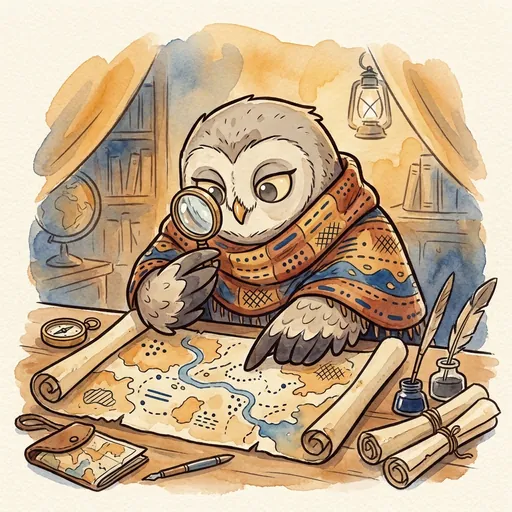
Key
LEGEND LITERACY — the legend is the mapmaker's confession. what's NOT on the map is also a map.
Listen along — Key
Loading audio…
Press play to listen along. The line being read lights up as you go.
Show full transcript
Loading transcript…
Chapter 3 — Key and the Confession in the Corner
In the corner of every map in MapForge, there is a little box full of tiny pictures, and a small grey owl named Key was the only one who read it first.
She sat on a stool in the map-hall, an old map unrolled across the table, and she did not look at the mountains or the rivers or the winding roads. She looked at the box in the corner — dots, lines, a splash of blue, a patch of hatching — and tapped each one with her feathered finger. “Dots are cities,” she murmured. “Lines are roads. Blue is water. Hatching is forest.” Only then did her eyes lift to the map itself, and now every symbol on it had a name.
A boy leaned over her shoulder. “You read the little box before the actual map? The map’s right there.”
“The box tells the truth about the map,” Key said. “If you skip it, you’re just guessing what the pictures mean.” She wore a soft shawl printed with the same marks — dots, lines, blue, hatching — so that anywhere she went, the meaning of a map traveled with her, wrapped round her shoulders. She smoothed it. “And there’s a second thing.” She ran her finger down the little box, then stopped at the empty space below the last symbol. “It also tells you what the mapmaker decided not to draw. See here? Roads, yes. But no footpaths. No place where the old orchard used to be.” She tilted her head. “The empty part of the box is talking, too. You just have to be quiet enough to hear it.”
Key learned to hear the quiet when she was small.
Her family were the legend-keepers of a watch-tower village, owls who copied maps by lamplight and had night-sharp eyes that caught what daytime readers rushed past. One evening her grandmother spread out two maps of the very same valley and asked her which was true.
Key studied them. They looked almost identical — same hills, same stream. But one showed a scattering of little houses along the north ridge, and the other showed the ridge blank, as if nobody lived there at all.
“They can’t both be right,” Key said. “Somebody’s houses are missing.”
“Nobody’s houses are missing, little one. The houses are still there.” Her grandmother tapped the blank ridge with one claw. “This mapmaker just decided they didn’t matter enough to draw. That’s not a mistake. That’s a choice.” She let the word sit. “A map isn’t the world. It’s what one person chose to keep and what they chose to leave out. When you learn to see the leaving-out, you’re not reading the map anymore. You’re reading the mapmaker.”
Key stared at the blank ridge for a long time. It stopped feeling empty. It started feeling like a held breath — a silence that meant something. She never looked at a corner-box the same way again.
She walked to MapForge at twelve, because a place that studied maps ought to care about the corner nobody reads.
Atlas, the mentor who ran the map-hall, met her at the door. He didn’t ask her to draw a coastline or plot a course. He asked one thing. “What is legend literacy?”
Key didn’t recite. She reached past him to a map pinned by the entrance, put her finger on the little box in the corner, and read it aloud — dots, lines, colors — then slid her finger to the blank space beneath. “And this,” she said. “No footbridges. No seasonal camps. The box tells you what the symbols mean. The empty part tells you what the mapmaker left off — and that’s a map too.”
Atlas looked at the blank corner she was pointing at, then at the small owl pointing at it. Most people, he knew, never looked at that box at all.
“You belong here,” he said.
Key’s workshop smelled of old paper. One afternoon a girl brought her a beautiful old map of a faraway region — crisp lines, gold lettering, proud and official.
“Read the corner first,” Key said.
The girl found the little box. “Capital cities. Roads. Railways. Mines. Borders.” She grinned. “It’s got everything.”
“Does it?” Key set a second map beside it — plainer, hand-drawn, of the exact same land. “Read this one’s corner.”
The girl read. Then she went quiet. “This one has… language regions. Community forests. Old ceremony grounds. Walking routes for the dry season.” She looked between the two. “The first map didn’t have any of those.”
“Same rivers. Same mountains. Same ground,” Key said gently. “Two different corners. The first mapmaker thought cities and mines were the whole story. The second knew the land was full of people already living on it.” She tapped the proud old map’s tidy little box. “This corner isn’t lying about what it shows. But look at everything it’s silent about. Whose home just vanished, so the map could look simple?”
The girl traced the blank spaces where villages should have been. “So the empty part…”
“Is a confession,” Key said. “The corner of a map is the most honest part of it. It admits what mattered to the person who drew it — and, if you’re listening, what they were happy to forget.”
That evening the girl came back with one more question, quieter now.
“When something’s just… not there,” she said. “How do you even know to look for it? An empty space is empty. How do you notice nothing?”
Key thought about the blank ridge, and the two houses that weren’t missing at all, and her grandmother’s lamplit hands.
“You feel it before you can say it,” she said. “There’s this little tilt in your chest — a wait, where is it? — the same feeling as walking into a room and knowing before you count that a chair is gone. That feeling isn’t nothing. It’s you noticing a silence.” She pulled her shawl a little closer, all its dots and lines and blue. “The whole world is full of maps that are quiet about somebody. Once you can feel the quiet, you can never unfeel it — and that’s not a heavy thing to carry. That’s just being awake.”
The girl nodded slowly, and Key watched her look at the corner of the map one more time, softly, the way you’d look at someone who’d been trying to tell you something all along.
The MapForge ensemble
Key is part of MapForge's distributed-narrative cast. Each character embodies a different curricular primitive; together they teach the full subject.
-
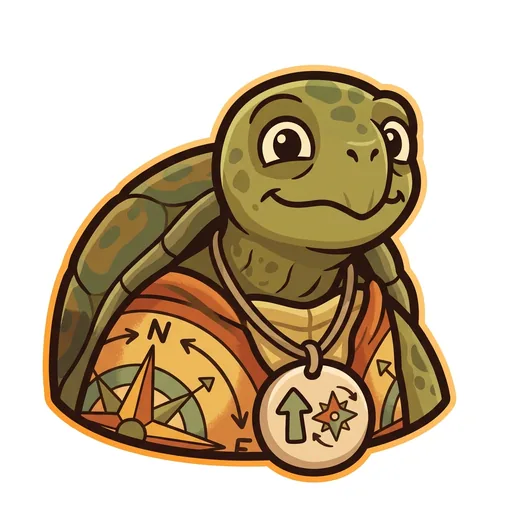
Bearing
Orientation — the tortoise-elder who treats north-up as a convention, not a truth ('north is one direction, not the direction'); teaches that orientation is a choice mapmakers make
-
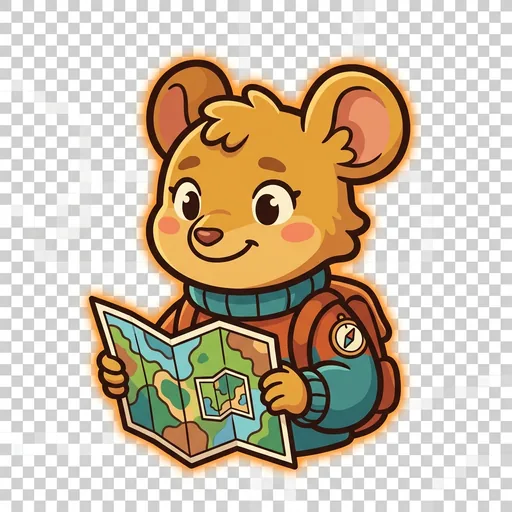
Inset
Scale — the field-mouse-tween with a folded map-within-a-map who teaches scale-choice as a political act ('bigger map, less detail; smaller map, more story — pick on purpose')
-
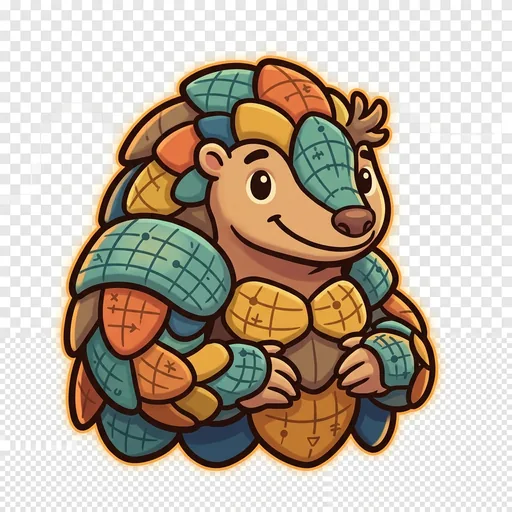
Plot
Coordinates — the pangolin-tween with graticule-scale armor who teaches that coordinate systems are human inventions, plural across cultures ('every place has many addresses; many cultures have many ways of saying here')
-
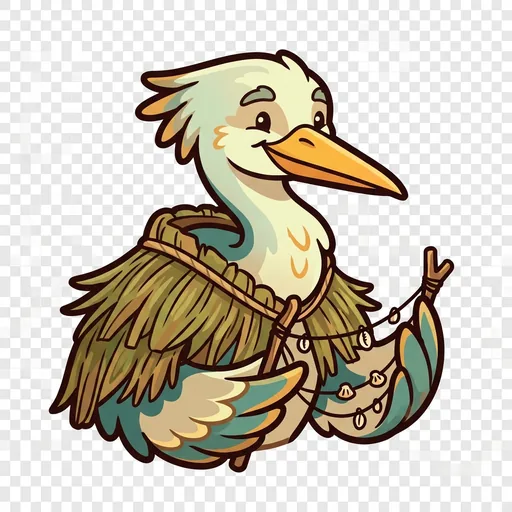
Wayfind
Non-Western mapping traditions — the heron-elder in a woven-grass cloak with stick-chart props who structurally elevates Polynesian wayfinding, Aboriginal songlines, and Indigenous TEK as peer cartographies ('some maps you sing, some you walk, some you only learn from elders')